The modern artificial intelligence landscape is defined by an arms race of scale. As frontier large language models (LLMs) balloon into architectures comprising hundreds of billions—and in some cases, trillions—of parameters, deploying them into production has become an economically and computationally prohibitive endeavor. Models like the newly released Kimi-K3 demand staggering infrastructure footprints, requiring roughly three terabytes of VRAM merely to load into memory. To bridge the chasm between raw capability and operational feasibility, the machine learning community has increasingly turned to knowledge distillation: the process of training a lean, efficient "student" model to replicate the sophisticated behavior of an unwieldy "teacher" network.
Yet, a profound bottleneck has long plagued this pipeline. While distillation holds the promise of compressing massive capabilities into nimble, accessible footprints, the actual mechanics of performing the distillation process have traditionally been remarkably expensive. Standard "online" distillation requires keeping both the giant teacher model and the developing student model resident in memory simultaneously. At every single training step, the teacher must execute a full forward pass to generate a complete probability distribution across its entire vocabulary—a vocabulary often exceeding 200,000 tokens. When combined with long sequence lengths stretching into tens of thousands of tokens, the resulting activation matrices generate memory spikes that easily dwarf the capacities of even the most advanced enterprise GPUs, such as the NVIDIA H200 or B200. Consequently, cutting-edge distillation has historically remained the exclusive domain of deep-pocketed tech giants commanding clusters of hundreds of coordinated accelerators.
This paradigm is poised for a dramatic shift. A groundbreaking new research paper titled “Efficient Knowledge Distillation for LLMs: Offline Top-K Logits and a Fused Chunked KL Loss” introduces a radical architectural overhaul to the distillation pipeline. By decoupling the teacher from the active training loop through cached top-$K$ logits and engineering a memory-efficient, fused chunked Kullback-Leibler (KL) divergence loss, the researchers have fundamentally re-architected how gradients and probability distributions are computed.
Together, these two systemic innovations eliminate the crushing VRAM spikes that previously bottlenecked model compression. Distillation tasks that once demanded vast arrays of networked server nodes can now be executed seamlessly on a single GPU. Furthermore, long-context healing—previously an insurmountable engineering hurdle due to memory scaling constraints—is now democratized, opening the floodgates for widespread, cost-effective experimentation across academia, startups, and enterprise engineering teams alike.
Detailed Chronology and Technical Evolution
To understand the magnitude of this breakthrough, one must trace the historical evolution of knowledge distillation within machine learning. Originally conceptualized as a technique for transferring knowledge from an ensemble of classifiers or a single large network to a smaller network, traditional distillation relied on minimizing the Kullback-Leibler divergence between the softened output probabilities of the teacher and the student. For years, this technique found widespread utility in computer vision and smaller-scale natural language processing tasks.
However, the advent of the Transformer architecture and the subsequent explosion of foundational Large Language Models transformed knowledge distillation from a clever optimization trick into an existential industrial necessity. With open-source and open-weight models proliferating rapidly—exemplified by families such as gpt-oss, Qwen, GLM, and Kimi—organizations rushed to adapt these architectures to domain-specific or edge-computing environments. Industry leaders quickly recognized that deploying a multi-billion-parameter behemoth for routine inference was commercially unsustainable. Major players stepped in to fill the void: NVIDIA released compressed iterations like the Nemotron 3 Puzzle 75B, while firms like Multiverse Computing introduced high-performance compact architectures such as the Hypernova 60B.
Despite these commercial releases, the underlying methodology for producing them remained stubbornly resource-intensive. The traditional training paradigm relied exclusively on online distillation. In this setup, the teacher model actively participates in every training iteration. At step $N$, input tokens are fed into the teacher, which performs a high-precision forward pass across its massive parameter space. It outputs a probability distribution over its entire vocabulary—for instance, 201,088 tokens in the case of gpt-oss-120b.
When evaluated at a sequence length of 32,000 tokens using a standard batch size of 4, the sheer dimensions of the tensor become staggering. The teacher-probability tensor alone takes the shape of $4 times 201,088 times 32,768$. Encoded in standard bfloat16 precision, this single tensor consumes approximately 50 gigabytes of VRAM. When factoring in the model weights of both the teacher and the student, optimizer states, activation gradients, and auxiliary overhead, peak memory utilization during a single training iteration routinely crosses 250 gigabytes. This figure obliterates the memory ceiling of a single NVIDIA H200 (which caps out at 141 GB of HBM3e) or even the anticipated limits of newer architectures, forcing engineers to adopt complex tensor-parallelism and multi-node sharding strategies simply to initialize a training run.
Recognizing these compounding inefficiencies, researchers set out to dismantle the two primary culprits of memory inflation: the perpetual co-existence of the teacher and student in memory, and the dense, vocabulary-wide matrix materialization required by standard KL-divergence loss functions. The resulting paper introduces a two-pronged solution that fundamentally alters the economics of model compression.
The first pillar of this innovation is offline distillation via cached top-$K$ logits. Rather than forcing the teacher to execute redundant forward passes at every single training epoch—a wasteful practice given that the teacher’s behavior remains static relative to the evolving student—the pipeline executes the teacher once. The system extracts and caches only the top-100 most probable tokens for every position in the sequence, discarding the long tail of low-probability vocabulary items that contribute negligibly to the gradient signal. Once this cache is generated, the teacher is completely excised from memory. The student model trains exclusively against the cached logits, freeing up massive swathes of VRAM and allowing the exact same cache to be repeatedly utilized across countless hyperparameter sweeps and architectural ablations.
The second pillar tackles the mathematical formulation of the loss function itself. Standard KL divergence implementations construct a massive grid mapping every single token position in the sequence against every single word in the vocabulary. For vocabularies exceeding 100,000 entries and context lengths stretching across tens of thousands of tokens, this matrix is gargantuan. Default libraries in frameworks like PyTorch and NVIDIA’s Megatron-Bridge construct this entire grid simultaneously before computing a single scalar loss value.
The researchers formulated a fused, chunked KL loss that processes data incrementally. Instead of materializing the entire vocabulary-by-sequence matrix, the algorithm computes and discards the loss slice by slice. Memory usage is thus decoupled from vocabulary size and sequence length, remaining strictly bounded within the footprint of a single processing chunk.
Supporting Context and Metrics: A Head-to-Head Benchmark
To rigorously validate the efficacy of these architectural changes, the research team conducted exhaustive benchmarking comparing traditional online distillation against three distinct offline loss configurations: a dense offline baseline, a forward-chunked KL loss, and the fully fused chunked KL loss.
Tests were conducted on a single high-performance NVIDIA H200 GPU utilizing Llama 3.1 8B Instruct as the teacher model and a compact 3.2-billion-parameter Llama variant as the student. The context length was fixed at 8,000 tokens. Across all four methodologies, the resulting training loss curves converged almost identically. This empirically confirmed that shifting to offline training utilizing cached top-100 logits incurs zero degradation in model recovery quality—it is effectively a lossless compression technique.
Method (8K Context, Single H200)
Peak Memory
Iteration Time
Throughput
Online Distillation
102.8 GB
25.9 s
237 TFLOP/s
Offline, Dense KL
78.3 GB
18.5 s
331 TFLOP/s
Offline, Forward-Chunked KL
61.8 GB
18.4 s
335 TFLOP/s
Offline, Fused Chunked KL
58.3 GB
20.2 s
304 TFLOP/s
While the throughput metrics at an 8K context demonstrate competitive performance across all variants, the true transformative power of the fused chunked architecture emerges when scaling to extreme context lengths.
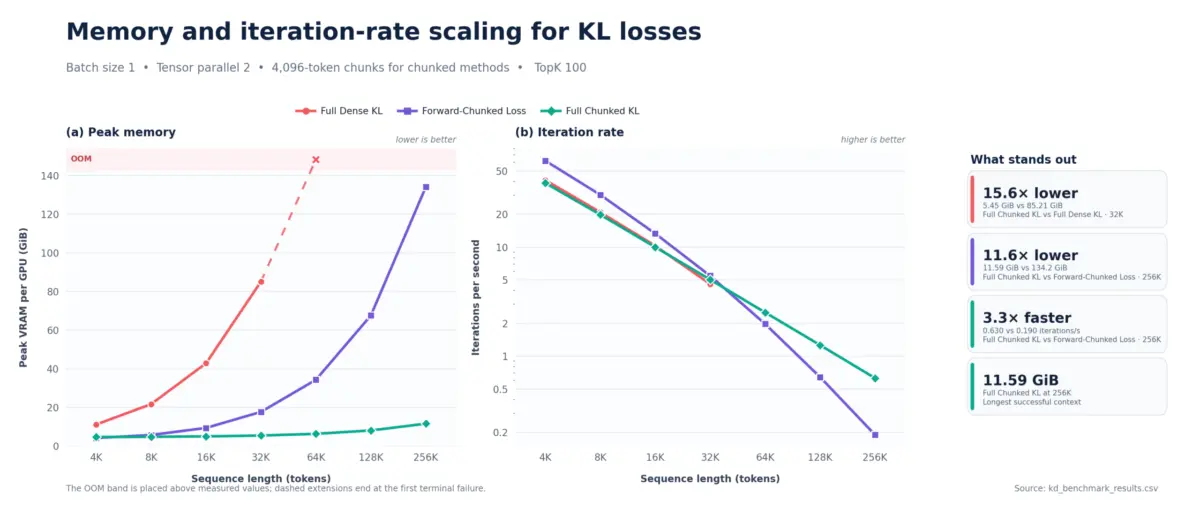
In isolated benchmarks evaluating a toy output-projection network at a 32K token context, peak memory consumption plummeted from 85.2 GiB using the traditional dense loss down to a mere 5.45 GiB with the fully chunked variant—representing an astonishing 15.6× reduction in VRAM. As sequence lengths were pushed further, the limitations of legacy architectures became starkly apparent: the dense loss implementation failed entirely from 64K tokens onward due to out-of-memory (OOM) errors. By contrast, at a massive 256K token context, the fully chunked loss utilized just 11.6 GiB of memory (compared to 134.2 GiB for alternative chunked approximations) while operating approximately 3.3× faster per iteration.
When applied to a real-world enterprise workload—distilling a GPT-OSS 20B model at a 32,768-token context—the memory savings translated directly into radical infrastructure downsizing. The required compute footprint shrank from an unwieldy four-node GPU cluster down to a single standalone server node. Step times dropped from 57.0 seconds down to 12.23 seconds (a nearly 5× speedup), and per-GPU throughput surged from 74.2 TFLOP/s to 345.7 TFLOP/s.
[Traditional Dense KL Loss] ---> Spikes to ~250 GB VRAM at 32K Context (Fails on H200)
[Fused Chunked KL Loss]   ---> Peaks at ~128 GB VRAM at 32K Context (Runs smoothly on single H200)
Official Statements and Industry Implications
The implications of this research extend far beyond academic optimization, striking directly at the economic realities of commercial AI development. Industry analysts have long noted that the cost of model fine-tuning and compression serves as a primary gatekeeper keeping advanced AI development concentrated within a handful of hyper-scaler organizations.
Representatives from Multiverse Computing, the firm driving much of this open-source research initiative under their CompactifAI research banner, emphasize that democratization of the distillation pipeline is paramount for sustainable industry growth.
"Our objective has never been merely to shave off marginal percentages of compute efficiency, but to fundamentally alter what engineering teams can achieve on accessible hardware," notes lead research documentation from the project. "When long-context healing and knowledge distillation transition from a multi-node, cluster-level engineering ordeal into a workflow that can be executed rapidly on a single workstation GPU, the entire velocity of innovation changes. Teams can iterate on custom architectures, domain-specific alignments, and long-context adaptations in hours rather than weeks."
The resulting student models produced by this optimized pipeline further validate the approach. Distilling the Llama 3.1 8B Instruct teacher down to a nimble 3.2-billion-parameter student yielded an architecture that retained the vast majority of its parent’s downstream accuracy. On standard benchmarks assessing reasoning and comprehension—such as BoolQ and HellaSwag—the compact student matched teacher performance closely, while maintaining competitive scores on complex academic evaluations like MMLU (staying within a tight nine-point margin despite operating at less than half the parameter count).
By open-sourcing the complete implementation of the chunked-loss mechanism via their public GitHub repository (github.com/CompactifAI/Full-Chunked-KL-Loss), the research collective has provided the global developer community with an immediate, drop-in mechanism to upgrade existing machine learning pipelines.
Future Outlook: The Road Ahead for Model Compression
As the artificial intelligence industry matures, the brute-force scaling of foundational models is increasingly meeting economic and physical boundaries. Power grid constraints, silicon manufacturing limits, and the sheer cost of datacenter operations mean that future gains must come from algorithmic brilliance rather than simply throwing more compute at the problem.
The breakthroughs detailed in Efficient Knowledge Distillation for LLMs point toward a future where model compression is continuous, automated, and deeply integrated into standard CI/CD pipelines for machine learning. With the memory barriers of online distillation and dense matrix materialization systematically dismantled, several emerging trajectories come into focus:
Edge and On-Device Personalization: With distillation reduced to single-GPU feasibility, smaller enterprises and consumer hardware developers can routinely distill frontier capabilities into ultra-compact models tailored for local, privacy-preserving execution on smartphones, laptops, and IoT devices.
Infinite-Context Distillation: As commercial models increasingly adopt context windows stretching past one million tokens, the memory scaling advantages of fused chunked loss functions will become mandatory. Techniques that scale linearly rather than quadratically with sequence length will form the bedrock of next-generation ultra-long-context architectures.
Hyper-Iterative Architecture Search: Because cached top-$K$ logits eliminate the need to repeatedly execute multi-billion-parameter teacher models during training, researchers can perform rapid, low-cost ablations across thousands of student architectural variations in the time it previously took to complete a single training run.
Ultimately, this research marks a turning point in how the AI community manages its infrastructure footprint. By transforming knowledge distillation from an elite, resource-starved bottleneck into an agile, single-device operation, the path is cleared for a more sustainable, decentralized, and innovative era of artificial intelligence development.