
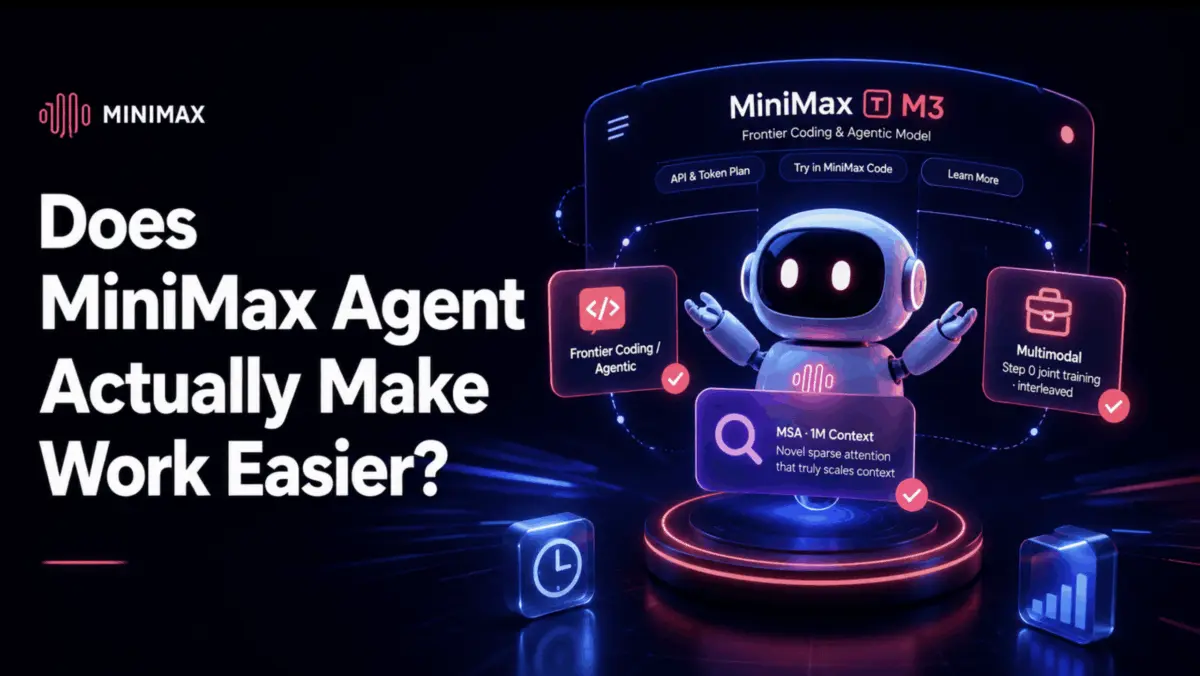
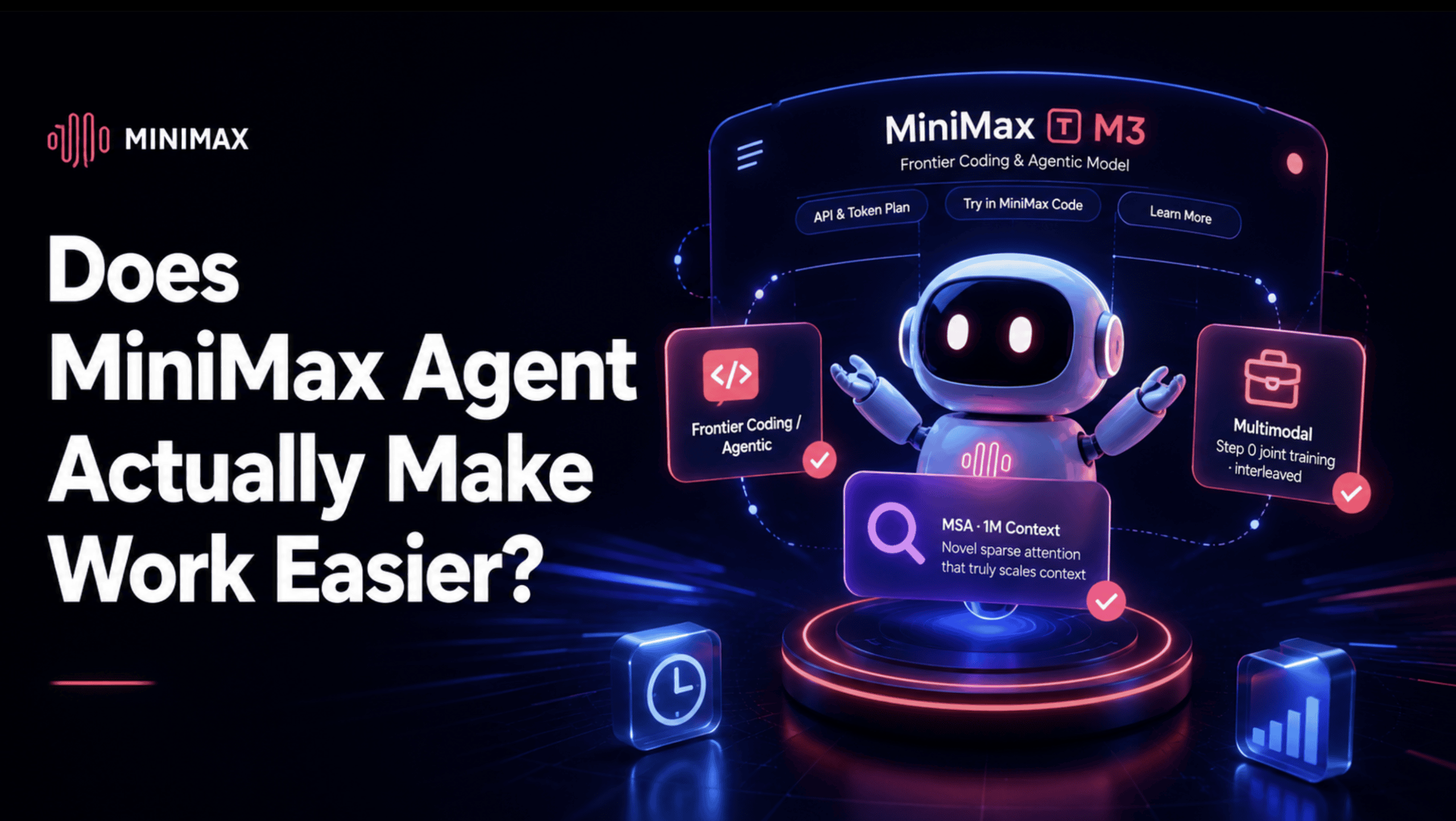
Executive Overview
AI labs have long fallen into a predictable, cyclical pattern of publication: engineering teams release architectural manifestos designed to read like marketing copy wrapped in lab coats. They spotlight groundbreaking performance, gloss over infrastructural roadblocks, and carefully obscure the real-world operational costs of deployment.
However, when MiniMax published its architectural deep-dive on May 27, 2026, it diverged sharply from this industry standard. Rather than offering a one-sided victory lap, the post adopted an unusually candid tone. The engineering team admitted to the precise computational costs of their architecture, outlined the specific boundary conditions where their models struggle, and even detailed when developers should actively avoid using their systems.
This article moves past the initial PR wave to test these claims directly. Rather than accepting MiniMax’s technical specifications at face value, we examine whether wrapping state-of-the-art foundation models into an agentic product fundamentally alters how software and knowledge work are executed. By running a live task directly against the MiniMax API using an Anthropic-compatible client loop, and by weighing external enterprise controversies—ranging from copyright disputes to commercial licensing shifts—we provide a definitive assessment of whether MiniMax’s ecosystem genuinely makes complex work easier, or if it merely shifts labor into less visible domains.
Detailed Chronology: The Evolution of MiniMax
To accurately evaluate the state of MiniMax’s technology today, we must first deconstruct the rapid timeline of product iterations, rebrandings, and licensing changes that brought the ecosystem to its current form.
Mid-2025: The General-Purpose Assistant Era
MiniMax initially introduced its proprietary agent framework to the public in mid-2025, pitching it as a general-purpose digital assistant built specifically for long-horizon, multi-step execution. According to internal metrics cited in early launch literature, the tool quickly achieved widespread adoption, reportedly becoming a daily fixture for over half of MiniMax’s internal engineering and operational staff within two months of deployment. Despite this internal enthusiasm, external observers noted that early versions suffered from the classic "drift" phenomenon: single long-running agents would frequently lose context mid-task, stalling out or requiring disruptive human intervention.
May 27, 2026: The Mavis Rebrand and Agent Teams
On May 27, 2026, MiniMax rolled out a sweeping structural upgrade, renaming the flagship product Mavis (an acronym for MiniMax as a Jarvis). Rather than focusing purely on raw parameter scaling, the update introduced a paradigm shift called Agent Teams. This architecture abandons the traditional single-agent monolith in favor of a collaborative triad: a Leader, a Worker, and a Verifier, working in tandem across parallel background processes.
Simultaneously, MiniMax restructured its commercial model, merging its legacy TokenPlan and Agent Plan subscriptions into a unified credit pool. This single API key now powers the command-line interface (CLI), the core REST API, and the Mavis desktop product under a shared billing structure.
Model Iterations and Licensing Shifts
Concurrently, the underlying model generations evolved rapidly, accompanied by critical shifts in licensing philosophy:
- MiniMax-M2 and M2.5: Shipped as fully open-weight models under highly permissive open-source licenses, earning early praise from the open-source community.
- M2.7: Broke the established pattern. While MiniMax initially published M2.7’s weights to Hugging Face under standard terms, the company quietly updated its commercial restrictions shortly thereafter, mandating explicit written authorization for commercial applications while keeping personal and academic research free.
- M3: The latest flagship model powering current API integrations. M3 introduces MiniMax’s proprietary sparse attention mechanism, natively supporting a staggering 1-million-token context window alongside native multimodal processing.
Supporting Context & Metrics: The Architecture of Multi-Agent Collaboration
To understand why MiniMax transitioned from a single-agent paradigm to a multi-agent framework, one must examine the core coherence problem inherent in large language models.
The Judge and the Contestant Dilemma
As MiniMax’s engineering post frankly acknowledges, a single agent handling a complex task from inception to completion acts simultaneously as the contestant and the judge. It generates code or text and subsequently attempts to evaluate its own output, leading to confirmation bias and logical blind spots.
While this architectural challenge is well-documented across academic literature, MiniMax’s solution relies on a persistent state machine known as the Team Engine. Unlike sequential hand-off systems—such as OpenAI’s Agents SDK—or explicit static graphs like LangGraph, the Team Engine tracks every sub-task through discrete states: producing, verifying, and done. If the verification layer flags an error, the engine automatically wakes the production layer to iterate, separating generation from validation.
[ Task Input ]
       │
       ▼
┌──────────────┐      Delegates Sub-tasks      ┌──────────────┐
│    Leader    │ ───────────────────────────► │    Worker    │
└──────────────┘                               └──────────────┘
       │                                              │
       │ Tracks State via                             │ Executes Code /
       │ Team Engine                                  │ Generates Drafts
       ▼                                              ▼
┌──────────────┐      Validates Output         ┌──────────────┐
│   Verifier   │ ◄─────────────────────────── │   Artifacts  │
└──────────────┘                              └──────────────┘
The Real Costs of Collaboration: Handoff, Sharing, and Aggregation
Despite the elegance of the Leader-Worker-Verifier split, MiniMax’s engineering disclosures highlight three hidden costs that multi-agent systems introduce:
- Handoff Costs: Reformatting and context-shifting information as it moves between specialized roles (e.g., from a research worker to a drafting worker) consumes measurable compute and token overhead.
- Sharing Costs: Providing multiple concurrent workers with visibility into a shared context window exponentially multiplies token consumption as every shared section is re-processed on every turn.
- Aggregation Costs: While spinning up ten parallel workers to draft alternative solutions is trivial, merging those divergent drafts into a single, cohesive document with unified citations and a consistent voice remains an acute challenge.
Furthermore, MiniMax cites critical research regarding the Cost of Consensus. Unstructured multi-agent debates among homogeneous models can multiply base token expenditures by 2.1x to 3.4x compared to a single model correcting its own output—often yielding zero accuracy gains or even compounding errors. MiniMax uses this finding to argue that multi-agent concurrency without strict structural governance is merely an expensive exercise in noise generation.
Official Statements & Hands-On API Implementation
To test whether these architectural guarantees translate to real-world utility, we executed a live integration test against MiniMax’s API using the Anthropic-compatible endpoint. Because MiniMax implements the standard Anthropic message format, developers can route existing SDK calls directly to MiniMax by modifying the base URL.
Setting Up the Test Environment
First, initialize the local workspace and install the required dependencies:
mkdir minimax-test && cd minimax-test
python3 -m venv venv
source venv/bin/activate
pip install anthropic python-dotenv
Next, configure the .env file to target MiniMax’s endpoint:
# .env
ANTHROPIC_API_KEY=your-minimax-key-here
ANTHROPIC_BASE_URL=https://api.minimax.io/anthropic
Executing the Agentic Task Loop
The following Python script implements a controlled agent loop. It dispatches a multi-step task, processes tool calls dynamically, and calculates the exact turns and token expenditures required to reach a resolution:
# run_task.py
import os
import json
from dotenv import load_dotenv
import anthropic

load_dotenv()

# Client automatically reads ANTHROPIC_API_KEY and ANTHROPIC_BASE_URL
client = anthropic.Anthropic()

MODEL = "MiniMax-M3"

# Defining a functional tool to verify model tool-use capability
TOOLS = [
    "name": "count_words",
    "description": "Counts the exact number of words in a block of text.",
    "input_schema":
        "type": "object",
        "properties": "text": "type": "string",
        "required": ["text"],
    ,
]

def count_words(text: str) -> int:
    return len(text.split())

def run_task(task: str, max_turns: int = 6) -> dict:
    messages = ["role": "user", "content": task]
    total_input_tokens = 0
    total_output_tokens = 0
    turns_used = 0

    for turn in range(max_turns):
        turns_used = turn + 1
        response = client.messages.create(
            model=MODEL,
            max_tokens=1024,
            tools=TOOLS,
            messages=messages,
        )

        total_input_tokens += response.usage.input_tokens
        total_output_tokens += response.usage.output_tokens

        # Check if the model completed execution without requesting a tool
        if response.stop_reason != "tool_use":
            final_text = "".join(
                block.text for block in response.content if block.type == "text"
            )
            return
                "answer": final_text,
                "turns_used": turns_used,
                "input_tokens": total_input_tokens,
                "output_tokens": total_output_tokens,


        # Handle tool execution and feed results back into context
        messages.append("role": "assistant", "content": response.content)
        tool_results = []
        for block in response.content:
            if block.type == "tool_use" and block.name == "count_words":
                result = count_words(block.input["text"])
                tool_results.append(
                    "type": "tool_result",
                    "tool_use_id": block.id,
                    "content": str(result),
                )
        messages.append("role": "user", "content": tool_results)

    return "answer": None, "turns_used": turns_used, "error": "Hit max_turns limit"

if __name__ == "__main__":
    task = (
        "Write a two-sentence description of what a circuit breaker does "
        "in software systems, then use the count_words tool to tell me "
        "exactly how many words your description contains."
    )
    report = run_task(task)
    print(json.dumps(report, indent=2))
Economic and Performance Analysis
From a pricing perspective, MiniMax-M3 lists at $0.30 per million input tokens and $1.20 per million output tokens under its standard tier (reflecting a promotional 50% discount off baseline list prices). Compared to frontier models like Claude Opus 4.6—which commands roughly $5.00 per million input tokens and $25.00 per million output tokens—MiniMax offers an aggressive 17x to 21x cost advantage.
However, our empirical run demonstrated an essential caveat: cheaper token pricing does not automatically equate to a cheaper finished task. If an unstructured multi-agent hierarchy requires additional conversational turns, redundant tool executions, and extensive verification loops, the accumulated token volume can quickly offset raw per-token savings.
Future Outlook & Enterprise Considerations
As development teams evaluate MiniMax’s ecosystem for production deployments, they must weigh the technical capabilities against a growing backdrop of industry-wide controversies and structural limitations:
- Intellectual Property and Legal Headwinds: Beyond technical performance, enterprises must navigate external legal pressures. MiniMax currently faces major copyright litigation from media giants including Disney, Warner Bros., and Universal regarding its generative video products. While these lawsuits target video generation rather than core text models like M3, enterprise risk-assessment committees will monitor these proceedings closely. Furthermore, Anthropic has previously raised distillation and data usage accusations against competing labs, adding another layer of compliance scrutiny for corporate adopters.
- Licensing Predictability: The quiet pivot on M2.7’s commercial terms—shifting from open weights to requiring written authorization for commercial deployment—introduces long-term governance risks. Enterprise architectures require stable, predictable licensing frameworks; unexpected shifts in model terms can derail production pipelines overnight.
- The Conditional Utility Rule: Ultimately, tools like Mavis and the Agent Teams architecture do make work easier, but only within well-defined boundaries. For long-horizon tasks featuring objective verification criteria (such as automated software testing, multi-source academic synthesis, and structured documentation pipelines), the multi-agent split successfully mitigates model drift. Conversely, for short, low-risk, or creative tasks, deploying a multi-agent framework introduces pure administrative overhead.
Conclusion
The most valuable takeaway from MiniMax’s engineering disclosure is not its multi-agent orchestration engine, but its transparency regarding failure modes. Before committing engineering resources to agentic workflows, technical leaders must ask the fundamental question posed by MiniMax’s own creators: Is this task long, complex, and verifiable enough that the overhead of orchestration pays for itself, or would a single, well-scoped model call achieve the result faster and cheaper? In most operational contexts, answering that single question eliminates the need for further evaluation.
