
Executive Overview
The paradigm of artificial intelligence has shifted fundamentally over the past three years. Traditional definitions of machine learning—focused on structured data classification, regression, and classical statistical inference—have been overshadowed by the explosive rise of Large Language Models (LLMs), Generative AI, Retrieval-Augmented Generation (RAG), and autonomous AI agents.
For professionals, engineers, and curious beginners alike, navigating this new frontier presents a daunting challenge. The online education market is saturated with courses whose titles have been superficially updated from "Machine Learning" to "AI" while the underlying syllabi remain frozen in the past. Today’s workforce demands a different set of competencies: prompt engineering, Transformer architecture comprehension, model fine-tuning, vector database integration, and practical software deployment.
Crucially, acquiring these skills no longer requires a prohibitive financial investment. World-class educational pathways, open-source roadmaps, and hands-on toolkits are now available entirely free of charge. This investigative report breaks down five of the absolute best free educational resources currently available to help you master modern AI and LLMs, tailored for everyone from absolute novices to production-ready software engineers.
Detailed Chronology: The Evolution of Modern AI Education
To understand why these five specific courses represent the gold standard of contemporary AI learning, it is helpful to examine how the educational landscape has transformed alongside the technology itself:
- Pre-2022 (The Classical ML Era): Online learning was dominated by foundational mathematics, linear regression, decision trees, and basic neural networks. Courses took months to complete and focused heavily on academic theory rather than practical application.
- Late 2022 (The Generative AI Explosion): The public release of foundational generative models upended traditional software development. Developers and non-technical professionals alike scrambled for guidance on prompting, leading to a proliferation of low-quality, superficial tutorials.
- 2023–2024 (The Infrastructure & RAG Boom): As hallucinations and static knowledge bases proved problematic for enterprise adoption, the industry pivoted toward RAG systems, vector embeddings, and parameter-efficient fine-tuning (PEFT). Educational content had to evolve from simple API wrappers to complex system architecture.
- 2025 and Beyond (The Autonomous & Agentic Era): The current landscape emphasizes "vibe coding," agentic workflows, autonomous execution tools (such as Claude Code), and efficient local model deployment. The five courses evaluated in this report reflect this state-of-the-art reality, offering targeted learning tracks for distinct professional personas.
Supporting Context & Metrics: Breaking Down the Learning Pathways
Choosing the right course depends entirely on your current technical baseline and professional objectives. The modern AI ecosystem demands specialization across four distinct tiers: workplace productivity, application prototyping, technical system engineering, and open-source core development.
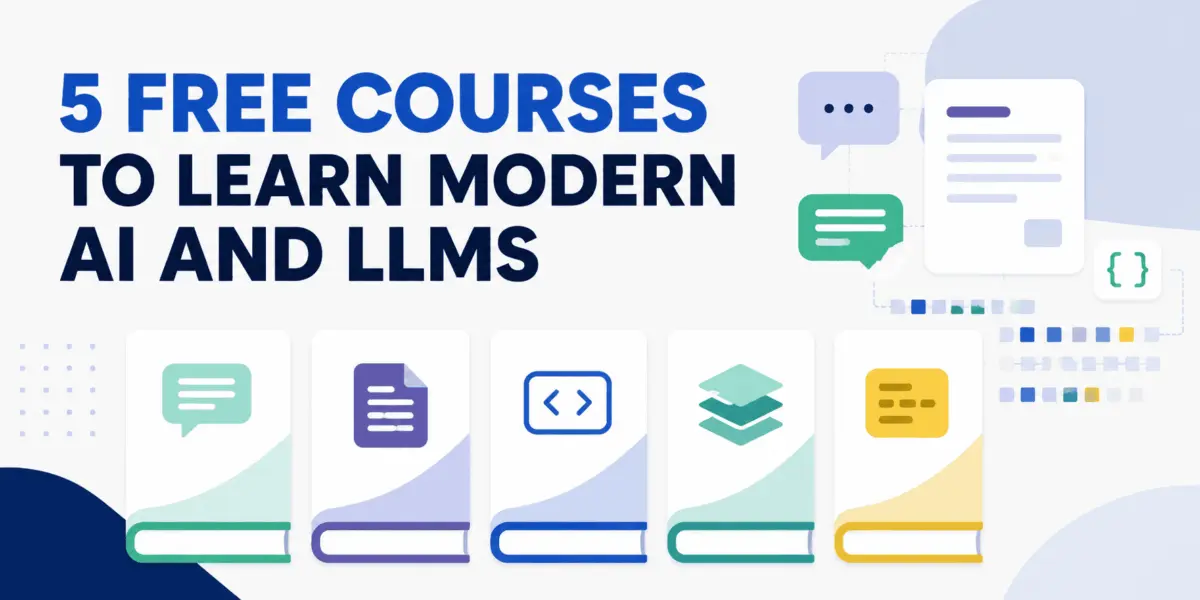
The following breakdown details the five premier free programs designed to address these distinct niches.
1. Introduction to AI for Work (DataCamp)
- Target Audience: Absolute beginners, business analysts, project managers, marketers, and non-technical professionals.
- Time Commitment: 2–3 hours.
- Core Curriculum: Fundamentals of artificial intelligence, generative AI capabilities, productivity enhancement, content creation workflows, and ethical AI utilization.
For professionals who feel left behind by the AI wave, diving straight into PyTorch code or Transformer mathematics is a recipe for burnout. DataCamp’s Introduction to AI for Work circumvents this by focusing strictly on practical workplace integration.
The curriculum assumes zero prior technical knowledge. It meticulously demystifies the distinction between traditional programming and machine learning, highlighting how generative tools can automate repetitive tasks, draft communications, and assist in data analysis. Crucially, the course dedicates significant module time to responsible AI usage—teaching learners how to recognize algorithmic hallucinations, protect sensitive company data, and critically evaluate machine-generated outputs. It is an ideal first stepping stone for anyone looking to boost daily productivity without writing a single line of code.
2. Easy-Vibe AI Coding Guide from Scratch
- Target Audience: Product managers, startup founders, digital creators, and beginner developers.
- Core Curriculum: Vibe coding, product ideation, frontend/backend integration, database setup, deployment, AI knowledge bases, and advanced workflows utilizing cutting-edge tools like Claude Code.
The traditional software development lifecycle has been radically compressed. You no longer need a four-year computer science degree to manifest a software product from an idea. The Easy-Vibe AI Coding Guide from Scratch embraces this paradigm shift, offering a project-first methodology.
Rather than bogging learners down in hardcore syntax theory from day one, this guide teaches students how to leverage modern AI coding assistants to spin up functional prototypes. It bridges the gap between conceptual product thinking and technical execution, walking users through database integration, frontend rendering, backend routing, and deployment. For founders and product builders looking to validate concepts rapidly using modern generative workflows, this resource provides an unmatched, pragmatic roadmap.
3. LLM Course by Maxime Labonne
- Target Audience: Software developers, machine learning enthusiasts, and aspiring AI engineers seeking a deep technical foundation.
- Core Curriculum: Divided into three progressive tiers—LLM Fundamentals, LLM Scientist, and LLM Engineer—covering neural networks, quantization, fine-tuning, evaluation, and system deployment.
For learners ready to move past high-level overviews and enter the engine room of artificial intelligence, Maxime Labonne’s LLM Course is widely regarded as one of the definitive open-source roadmaps available.
Structured logically into three distinct phases, the course begins with the mathematical and computational prerequisites necessary for understanding deep learning. It then splits into a dual-pathway approach: the Scientist track, which explores how to train and refine models, and the Engineer track, which focuses on building robust applications around those models. Topics such as model quantization (running large models on consumer hardware), dataset curation, and rigorous evaluation metrics are covered with exceptional depth. It is a rigorous, self-paced masterclass for technical practitioners.
4. LLM Zoomcamp (DataTalks.Club)
- Target Audience: Software engineers, data engineers, and backend developers wanting to build production-grade applications.
- Core Curriculum: Retrieval-Augmented Generation (RAG), vector databases, embeddings, hybrid search, reranking, AI agents, function calling, UI/API integration, and system monitoring.
Knowing how an LLM works mathematically is vastly different from engineering a resilient, production-ready application that utilizes one. DataTalks.Club’s LLM Zoomcamp addresses this exact engineering gap through an intensive, hands-on 10-week curriculum.
Students are guided step-by-step through the process of constructing an enterprise-grade AI assistant from scratch. The syllabus moves far beyond basic API calls, diving deep into vector search optimization, complex RAG pipelines, hybrid search algorithms, and the integration of autonomous agents capable of function calling. Furthermore, the course emphasizes operational excellence, teaching developers how to implement monitoring loops, user feedback mechanisms, and performance evaluations. If your goal is to ship real-world software products powered by LLMs, this program is indispensable.
5. Hugging Face LLM Course
- Target Audience: Developers with solid Python proficiency looking to master the open-source AI ecosystem.
- Core Curriculum: Transformers, Tokenizers, Datasets, Accelerate, Hugging Face Hub, model fine-tuning, dataset curation, and advanced reasoning architectures.
The open-source AI community is anchored largely by the ecosystem surrounding Hugging Face. Their dedicated LLM Course offers an exhaustive, authoritative exploration of how modern natural language processing models operate under the hood.
Prerequisites include a strong command of Python and a basic familiarity with deep learning concepts. Once inside, learners are immersed in the core tools used daily by professional AI researchers and engineers: the Transformers library, tokenization pipelines, dataset management utilities, and multi-GPU training accelerators via Hugging Face Accelerate. The curriculum walks users through downloading pre-trained weights from the Hub, fine-tuning them on custom domain-specific datasets, and deploying them for public consumption. It is the definitive bridge between academic theory and open-source engineering mastery.
Official Statements & Industry Insights
As the demand for specialized artificial intelligence talent reaches unprecedented heights, leading figures in the tech and education sectors have increasingly emphasized accessibility and practical capability over traditional credentialism.
Industry analysts point out that the barrier to entry for AI engineering has plummeted, while the demand for applied problem-solvers has skyrocketed.
"You no longer need millions of dollars in compute or a specialized doctoral degree to make a meaningful impact in artificial intelligence," notes an industry researcher focusing on open-source ecosystems. "The democratization of open-source weights, free GPU environments like Google Colab and Kaggle, and comprehensive community-driven roadmaps mean that anyone with internet access, curiosity, and discipline can build state-of-the-art systems."
Furthermore, engineering leaders emphasize that theoretical knowledge alone is obsolete in a market moving at breakneck speed.
"The professionals who succeed in the era of LLMs are not necessarily those who can memorize neural network architectures," states a senior machine learning architect. "They are the builders who understand how to orchestrate RAG pipelines, fine-tune models efficiently, and solve real-world operational bottlenecks using open-source toolkits."
Future Outlook: Navigating Your AI Journey
The trajectory of artificial intelligence over the coming decade points toward deeper integration, heightened automation, and increasingly accessible developer ecosystems. As models become more efficient, reasoning capabilities improve, and local inference on consumer hardware becomes ubiquitous, the skills acquired through these free courses will transition from specialized competitive advantages to baseline professional literacy.
To maximize your success in mastering modern AI, keep the following strategic principles in mind:
- Embrace Practical Execution: Watching video tutorials or reading documentation is insufficient. True comprehension occurs when you open a notebook, encounter a shape mismatch error, debug a vector database query, or successfully fine-tune your first model. Build projects continuously.
- Leverage Zero-Cost Infrastructure: Do not let the fear of expensive hardware stop you. Utilize free-tier resources on Google Colab, Kaggle notebooks, and free API credits provided by model providers to experiment without financial risk.
- Choose Your Niche Wisely: Assess your career objectives honestly. If you are an executive or business analyst, focus on productivity and workplace integration (DataCamp). If you are a founder or creator, prioritize rapid prototyping and vibe coding (Easy-Vibe). If you are an engineer, dive straight into rigorous technical roadmaps (Maxime Labonne, LLM Zoomcamp, or Hugging Face).
The tools are available, the knowledge is free, and the future is being written in real-time. Stop waiting for the "perfect" moment or the ideal paid bootcamp. Pick a pathway, open your code editor, and begin building today.
About the Author
Abid Ali Awan is a certified data scientist professional and technical content creator specializing in machine learning, generative AI, and data science methodologies. Holding a Master’s degree in technology management and a Bachelor’s in telecommunication engineering, Abid is deeply committed to democratizing AI education and developing innovative technological solutions for complex human challenges. You can connect with him via his professional portfolio at abid.work or follow his ongoing technical commentary on LinkedIn @1abidaliawan.
