

Executive Overview
The field of robot learning stands at an intriguing crossroads. Over the past several years, the AI and robotics communities have witnessed explosive leaps in policy architectures. Modern systems boast unprecedented capability, driven by advanced transformer-based Vision-Language-Action (VLA) models, sophisticated diffusion and flow-matching policies, and increasingly accurate world models. Furthermore, the necessary compute—GPUs capable of training these sprawling neural networks—is more accessible than ever before.
Yet, despite this technological maturity, a profound chasm remains between what modern algorithms can do and what physical robots can actually achieve in the real world. The bottleneck is no longer the model. It is the data.

Training a robot to perform everyday manipulation tasks—such as folding laundry, organizing a workspace, or preparing food—requires vast, highly diverse real-world datasets. Traditionally, collecting this data has relied on teleoperation: operators manually driving a robotic arm to execute demonstrations. While effective in tightly controlled laboratory environments, teleoperation is notoriously expensive, logistically demanding, and inherently difficult to scale. Most fundamentally, it presents an insurmountable barrier to entry for many researchers and developers: it requires an actual robot.
Enter Grabette, a radical open-source hardware and software system designed to bypass the traditional robot requirement entirely. Developed by Pollen Robotics, Grabette allows humans to record complex manipulation tasks in minutes using a lightweight, handheld gripper. It automatically transforms these human demonstrations into robot-ready datasets, offering a frictionless pipeline for robot learning. By eliminating the need for expensive labs, complex teleoperation rigs, or physical robots during the data collection phase, Grabette aims to seed a massive, open-source, collaborative manipulation dataset that no single research institution could ever build in isolation.

Detailed Chronology and Technological Genesis
The Precursor: Standing on the Shoulders of UMI
The philosophical and architectural foundation of Grabette did not emerge in a vacuum. It is directly inspired by the pioneering Universal Manipulation Interface (UMI) developed at Stanford University. UMI introduced the robotics community to a powerful paradigm: a handheld gripper equipped with a fisheye camera that records demonstrations "in the wild." By leveraging Simultaneous Localization and Mapping (SLAM) algorithms, the system recovers precise camera trajectories from human movements, enabling researchers to train robust visuomotor policies directly from handheld data.
While UMI proved that the recipe worked, early implementations often remained complex, and several commercial iterations quickly emerged as closed-source, proprietary hardware ecosystems (such as Agibot’s MEgo gripper, Genrobot’s DAS gripper, and Sunday Robotics’ skill capture glove).

Pollen Robotics identified a critical need in the ecosystem: the barrier from "I have a task I want a robot to learn" to "I have a trained model executing that task" needed to be lowered drastically. The result of months of iterative engineering is Grabette—a system engineered to integrate natively with modern, open-source robotics infrastructure, including the LeRobot dataset format, the Hugging Face Hub for seamless sharing, and a zero-install processing pipeline operated entirely from a web browser.
Anatomy of the System: Grabette and Gripette
Grabette is a handheld, instrumented gripper packed with the precise sensor suite required to reconstruct a 6-Degree-of-Freedom (6-DoF) manipulation demonstration.

A central design choice in Grabette’s hardware architecture is the integration of two distinct cameras, each fulfilling a specialized role:
- The Wide Fisheye Camera: This low-cost sensor provides the policy with the context-rich, wrist-camera-style perspective it needs to understand the surrounding environment and the object-hand interaction.
- The RGB-D Camera: This sensor performs the heavy computational lifting, enabling robust 6-DoF tracking of the device through space.
Crucially, while Grabette records human demonstrations, physical execution requires a robotic counterpart. Pollen Robotics therefore designed Gripette—the robotic arm end-effector twin of Grabette. Sharing the exact same hardware DNA, Grabette handles the data capture phase in human hands, while Gripette mounts to a robotic arm to execute the learned behaviors post-training.

The Two-Step Workflow: From Hand to Dataset
The development team prioritized user experience, stripping away the friction typically associated with robotic data pipelines. The workflow is distilled into two intuitive steps:
Step 1: Record
The user presses a physical button on the Grabette device. Data streams simultaneously from the observation camera, the tracking camera (capturing color, depth, and inertial measurement unit—IMU—data), and the gripper’s magnetic encoder joint values. A single shared hardware clock ensures perfect synchronization across all data streams. Pressing the button a second time halts the episode, saving the clean demonstration locally onto an onboard Raspberry Pi.

Step 2: Process Directly in Your Browser
Traditionally, processing raw SLAM data and converting it into machine learning-ready formats required complex Python scripts, specialized local environments, and substantial computational overhead. Grabette bypasses this entirely.
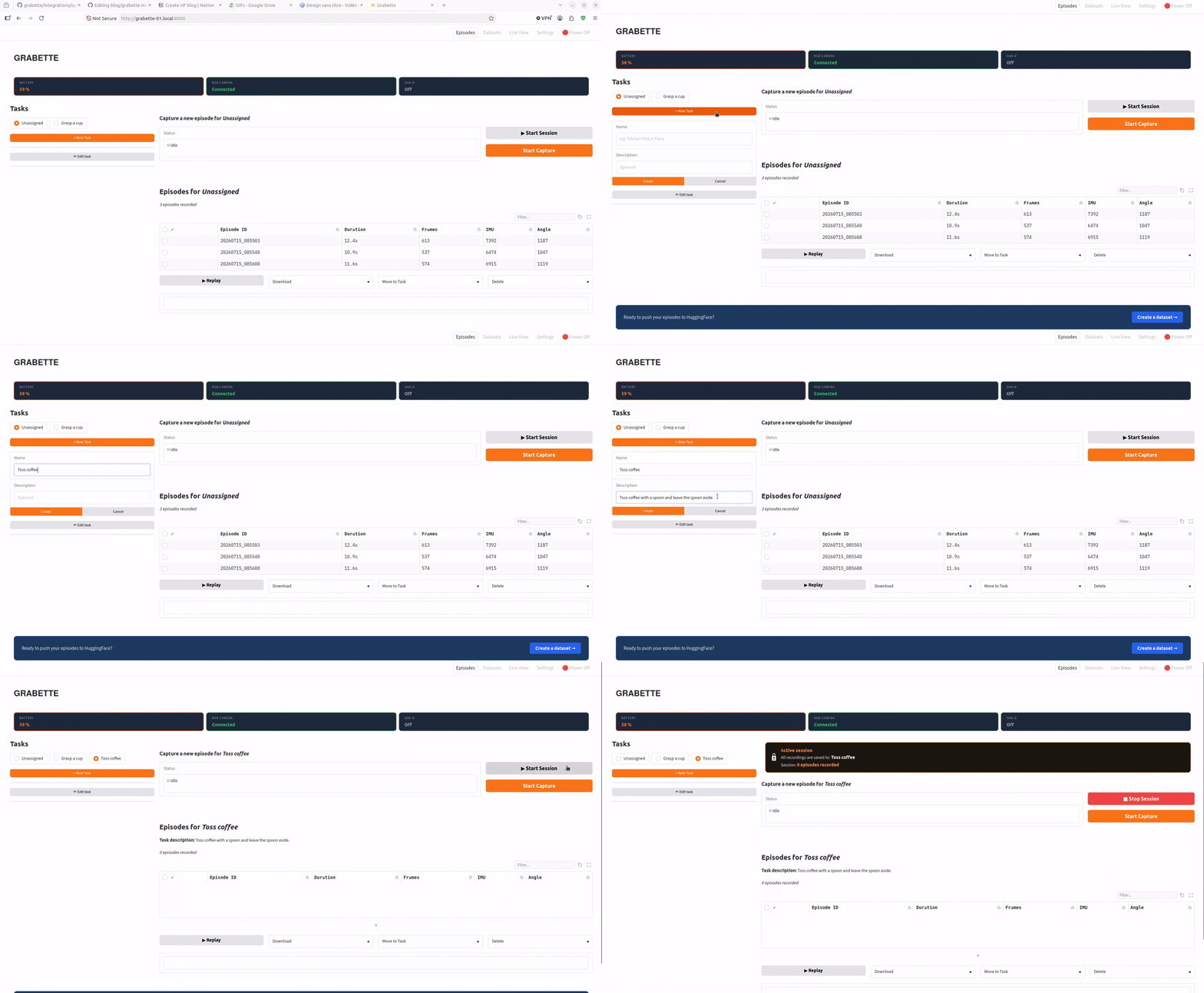
Users simply open the Grabette dashboard directly within a web browser. By selecting the recorded episodes and clicking a single button, automated post-processing kicks off. The browser interface coordinates trajectory recovery, cleans the data, and formats it natively for machine learning consumption.

Supporting Context, Metrics, and Ecosystem Integration
Built for Everyone: Open Source from the Ground Up
In an industry increasingly dominated by proprietary walled gardens, Pollen Robotics has committed to radical openness. The entire Grabette ecosystem—including hardware schematics, firmware, and software—is fully open-source and hosted on public repositories.
- Standard, Off-the-Shelf Components: Grabette avoids proprietary lock-in by relying on accessible, commercial-off-the-shelf (COTS) hardware. The system integrates a Raspberry Pi, standard Raspberry Pi cameras, an off-the-shelf OAK-D depth camera, and magnetic encoders. Developers can assemble a Grabette unit entirely from components ordered online.
- Robot-Agnostic Design: The data capture architecture and output data formats make zero assumptions about the morphology of a specific robotic arm. Demonstrations are recorded and stored as camera-local 6-DoF Cartesian poses paired with gripper states. The resulting output is a standard LeRobot dataset hosted on the Hugging Face Hub, meaning identical data can theoretically drive diverse robotic platforms and learning algorithms (though physical execution still requires the matching Gripette end-effector).
Proving the Loop: End-to-End Demonstration
To validate the system, Pollen Robotics released a complete, end-to-end example demonstrating how raw Grabette data transitions into a functional robot policy. Using a baseline of roughly 200 recorded demonstrations—spanning delicate manipulation tasks such as handling sugar packets, manipulating spoons, scrubbing with sponges, and driving screws with a screwdriver—the team trained functional visuomotor policies.

Because Grabette outputs standard LeRobot-compatible datasets, researchers are not locked into a single training paradigm; any learning framework capable of consuming LeRobot datasets can immediately ingest Grabette recordings.
Official Statements and Industry Philosophy
The philosophy underpinning Grabette addresses a fundamental structural flaw in contemporary AI research. While massive text and image models benefited from the unfathomable scale of the internet, physical AI has historically starved due to the physical friction of data collection.

"The data bottleneck doesn’t get solved by one lab, but by a community recording demonstrations everywhere," notes the development team at Pollen Robotics.
By removing the primary financial and logistical hurdles of data collection—eliminating the need for expensive robotic hardware arms, complex calibration procedures, and dedicated laboratory spaces—Grabette democratizes the creation of robotics data.

Furthermore, the initiative shifts the culture of robotics development from competitive data hoarding toward collaborative abundance. When recording a complex manipulation demonstration becomes as frictionless as shooting a short video on a smartphone, everyday users, hobbyists, students, and researchers alike can contribute to a shared global repository. This decentralized crowdsourcing model mirrors the open-source software movements that revolutionized computing decades prior.
Future Outlook: Beyond Grabette
While the current release of Grabette represents a major milestone for open-source robotics, Pollen Robotics views it merely as the opening salvo in a broader campaign to solve physical AI’s data crisis.

What Lies Ahead
The roadmap for the ecosystem includes active development on complementary hardware devices designed to capture multimodal perspectives. Among these is Casquette, an experimental head-mounted point-of-view (POV) recording device currently in progress. Casquette is designed to complement Grabette by capturing egocentric human demonstrations, adding rich first-person visual perspectives to the dataset pipeline.
However, the architects of Grabette emphasize that the most critical phase of the project’s future belongs not to the engineers in the lab, but to the broader community. As developers worldwide begin building their own Grabette units, recording domain-specific tasks, and uploading standardized datasets to the Hugging Face Hub, the barrier separating human intention from robotic capability will steadily erode.

By turning human hands into the primary data collection tool for artificial intelligence, Grabette and the growing community surrounding it are laying the groundwork for a future where physical robots can learn any task, anywhere, simply by watching us do it first.
