

Executive Overview
The landscape of surgical robotics is undergoing a profound paradigm shift. For decades, the field has transitioned steadily from manual teleoperation—where surgeons control mechanical instruments from a console—toward advanced vision-language-action (VLA) policies capable of executing complex, automated routines. However, the advancement of these intelligent systems has long been bottlenecked by a fundamental paradox: evaluating and training machine learning policies for surgery requires physical hardware that is extraordinarily expensive to operate, notoriously slow to reproduce, and fraught with catastrophic risks. A single algorithmic failure in a physical setup can destroy delicate instruments or compromise biological material.
While conventional physics-based simulators have historically offered a safer alternative, they fall woefully short when applied to the messy, dynamic reality of the operating room. Surgical scenes are exceptionally difficult to model mathematically. They feature deformable tissues, intricate instrument-tissue interactions, highly specular (reflective) surfaces, unpredictable sutures, bouncing needles, surgical smoke, and sudden occlusions. Manually authoring these variables for every possible scenario is an insurmountable engineering challenge.
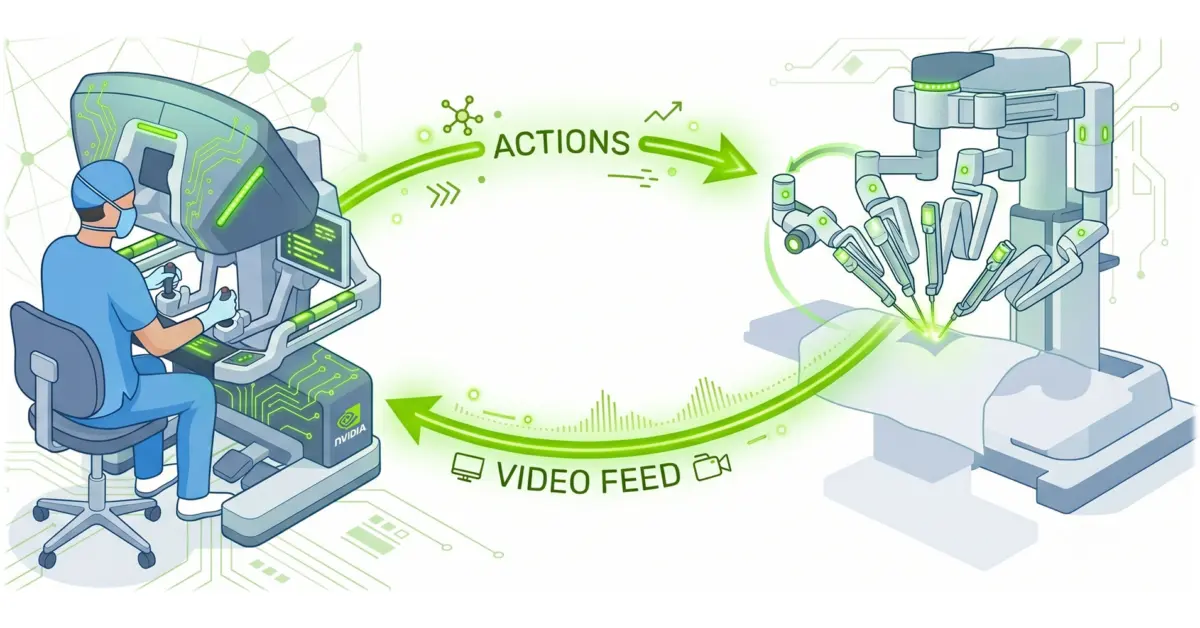
Enter world foundation models—a revolutionary path that sidesteps manual modeling by learning visual dynamics directly from synchronized video and robot kinematics. Building upon its earlier breakthroughs, NVIDIA has introduced Cosmos-H-Dreams, a real-time, action-conditioned generative simulator purpose-built for surgical robotics. By distilling heavy foundation models into causal, few-step student networks and pairing them with accelerated streaming inference engines, Cosmos-H-Dreams achieves what was once thought impossible: an interactive, closed-loop surgical environment that can be controlled in real time by either a human operator or an autonomous policy, running entirely on a single graphics workstation.
Detailed Chronology: From Static World Models to Interactive Streaming
To understand the magnitude of the Cosmos-H-Dreams breakthrough, it is essential to trace the rapid evolution of NVIDIA’s surgical AI roadmap over the past few years, moving from offline prediction to real-time interaction.
The Foundation: Cosmos-H-Surgical-Simulator
The journey began with the release of the Cosmos-H-Surgical-Simulator, an action-conditioned world foundation model constructed on top of the NVIDIA Cosmos-Predict2.5-2B architecture and post-trained extensively on the Open-H-Embodiment dataset.
Given an initial surgical context frame and a planned future robot trajectory, this model could synthesize video depicting the visual consequences of those actions. While powerful, its utility was strictly offline. Researchers could feed a recorded or policy-generated trajectory into the model, wait for the rollout to render, and score the results. It served as a brilliant tool for synthetic data generation and offline policy evaluation, but it lacked the interactive responsiveness required for closed-loop control or real-time human-in-the-loop experimentation.
The Real-Time Leap: Cosmos-H-Dreams
Recognizing the limitations of offline rendering, NVIDIA set out to transform its multi-embodiment surgical priors into a real-time streaming system. Cosmos-H-Dreams specializes the underlying intelligence for specific hardware setups—most notably the da Vinci Research Kit (dVRK) tabletop suturing environment—and distills the architecture into a causal student model that generates scenes autoregressively.
Furthermore, NVIDIA demonstrated the platform’s cross-platform versatility through strategic industry collaborations. By partnering with medical device innovators CMR Surgical and Cambridge Consultants, the engineering teams successfully integrated Cosmos-H-Dreams with the Versius surgeon controller, proving that the generative simulator could interface with commercial surgical platforms for real-time operation.
The Technical Engine: Distillation and Self-Forcing
The primary technical hurdle in creating a real-time surgical simulator is reducing computational latency while preserving complex surgical dynamics. Cosmos-H-Dreams accomplishes this via a rigorous three-step training pipeline:
- The Surgical Teacher: Starting from the bidirectional Cosmos-H-Surgical-Simulator Open-H checkpoint, the model utilizes a unified 44-dimensional action representation. For the dVRK model, dual-arm translation, rotation, and gripper states are mapped into this space. Crucially, the teacher was fine-tuned not just on ideal demonstrations, but on a diverse mixture of failures and out-of-distribution episodes—including dropped needles, missed throws, and failed knot ties. Reproducing failures is vital for any simulator meant to rigorously evaluate policy robustness. This teacher was stabilized by progressively scaling its temporal horizon from 12 frames up to 72 frames.
- Causal Warmup: Because standard diffusion models often rely on bidirectional attention (looking both backward and forward in time), they cannot stream data causally. Cosmos-H-Dreams precomputes and caches the teacher’s denoising trajectories, using them to train a causal student model equipped with a streaming key/value cache.
- Self-Forcing Distillation: Autoregressive models notoriously suffer from "exposure bias," where small generation errors compound over time during deployment. Cosmos-H-Dreams combats this using self-forcing distillation. The student model rolls forward using its own generated context, guided by distribution-matching supervision from the frozen teacher. This ensures the model learns to correct its own errors on the fly, paving the way for ultra-fast, few-step diffusion (as few as two denoising steps per latent frame).
Supporting Context & Metrics: Powering FlashDreams and Hardware Efficiency
Model distillation alone, however, is not enough to achieve interactive frame rates. NVIDIA solved the inference bottleneck by coupling Cosmos-H-Dreams with FlashDreams, an accelerated inference library explicitly designed for autoregressive world and video models.
Engineering Optimizations in FlashDreams
FlashDreams transforms the distilled student network into a high-throughput, low-latency streaming pipeline through a suite of advanced optimizations:
- Streaming KV Cache: Minimizes redundant memory allocation during long autoregressive generations.
- CUDA Graph Capturing: Reduces CPU overhead by pre-capturing execution graphs on the GPU.
- Model Compilation: Optimizes tensor kernels for maximum hardware utilization.
Performance Metrics
While standard foundational video generation models crawl at roughly 10 frames per second—rendering interactive loops impossible—FlashDreams elevates the Cosmos-H-Dreams pipeline to an astonishing ~160 frames per second.
This performance is achieved not on an inaccessible supercomputer, but on a single NVIDIA RTX PRO 6000 GPU. This hardware footprint democratizes advanced surgical simulation, bringing high-fidelity generative AI directly into standard research laboratories and clinical engineering departments.
Human-Machine Interfaces
Beyond raw rendering speed, Cosmos-H-Dreams bridges the gap between digital generation and physical interaction through multiple client integrations:
- Browser Clients: Transmit standard keyboard commands and receive synthesized video streams seamlessly over WebRTC.
- Spatial Computing (Meta Quest): Maps tracked physical controller motions directly into robot kinematics, rendering the resulting surgical scene in real time via WebXR.
- Closed-Loop Policy Integration: Allows autonomous reinforcement learning or imitation learning policies to ingest synthesized visual observations and output predicted actions in an unbroken loop.
Official Statements and Industry Perspectives
The introduction of Cosmos-H-Dreams has sent ripples through the medical robotics community, highlighting a shared vision among technology leaders and clinical engineers regarding the future of AI-driven healthcare.
Industry analysts note that the ability to simulate rare surgical complications—such as sudden tissue tears, excessive bleeding visualization, or dropped instruments—on demand solves one of the most stubborn data scarcity problems in medical AI training. By capturing the messy, unpredictable nature of real tissue interaction within a generative latent space, developers can stress-test robotic autonomy algorithms against edge cases that might occur only once in a thousand hours of physical clinical practice.
Furthermore, collaborations with established medical robotics developers like CMR Surgical underscore the industry’s readiness to adopt generative simulation tools. By proving compatibility with commercial systems like the Versius platform, NVIDIA has signaled that Cosmos-H-Dreams is not merely an academic exercise, but a scalable framework designed to accelerate the development cycle of next-generation surgical assistants.
Future Outlook: Toward Closed-Loop Surgical Physical AI
The arrival of Cosmos-H-Dreams opens an unprecedented frontier for surgical simulation, shifting the paradigm from rigid, hand-coded physics engines toward responsive environments learned directly from real-world data.
Defining New Benchmarks
As the research community adopts these tools, the evaluation criteria for surgical simulators must evolve. Future benchmarks will move far beyond simple visual fidelity to rigorously measure:
- Tool-tip reach and pose accuracy under deformation.
- Gripper-cycle fidelity and grip stability.
- Long-horizon temporal drift and counterfactual action diversity.
- Transfer learning agreement—proving that policies trained or evaluated inside the generative simulator achieve identical success rates when deployed on physical robotic hardware.
Downstream Applications
Looking further ahead, real-time generative world models promise to unlock transformative applications across healthcare and robotics:
- Latency-Aware Telesurgery: Utilizing world models to locally predict and smooth visual feeds, mitigating the disruptive impact of network latency during remote robotic procedures.
- Interactive Surgical Rehearsal & Planning: Empowering surgical teams to rehearse complex, patient-specific procedures against generative models before ever stepping into an operating room.
- Intraoperative Decision Support: Providing real-time predictive overlays that anticipate tissue behavior under manipulation.
It is vital to emphasize that Cosmos-H-Dreams is currently structured as an advanced research and development platform—it is not a diagnostic system, a replacement for intraoperative imaging, or a direct controller for physical patient-side surgical robots. Rather, it serves as the foundational stepping stone toward safe, scalable, and highly capable surgical Physical AI.
By collapsing the barriers between data generation, policy training, and rigorous evaluation into a single, unified environment, NVIDIA’s Cosmos-H-Dreams has established the blueprint for the future of intelligent surgery. Researchers and engineers can access the complete open-source code, model weights, and training pipelines via GitHub and Hugging Face, inviting the global medical technology community to build the next generation of life-saving robotic systems.
