

Executive Overview
India’s digital retail landscape is undergoing a structural paradigm shift. For years, the country’s tech consumers grew accustomed to the convenience of having groceries, fresh produce, and everyday household essentials delivered to their doorsteps within minutes. Pioneered by agile domestic startups during the pandemic, this ultra-fast delivery model—colloquially known as "quick commerce"—has quickly evolved from a niche urban convenience into the defining battleground for the future of Indian retail.
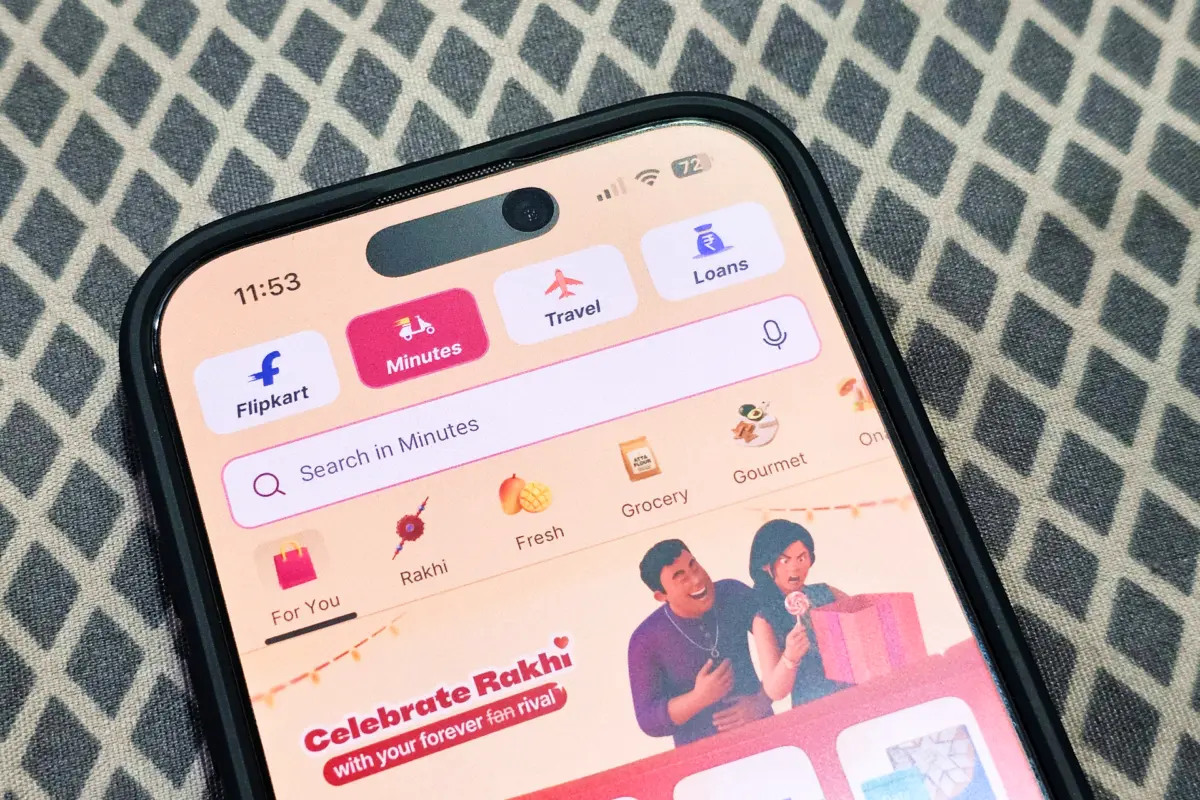
At the center of this transformation is Flipkart Minutes. Launched in August 2024 as the heavyweight e-commerce giant’s decisive foray into instant delivery, the Walmart-backed service has rapidly accelerated its operational footprint. Behind a relentless expansion of micro-fulfillment centers and a strategic mobilization of its massive, pre-existing e-commerce user base, Flipkart Minutes is closing in on established market leaders.
Data from industry insiders reveals that Flipkart Minutes is currently processing between 1.1 million and 1.2 million orders daily. This represents a staggering trajectory from November, when order volumes hovered around 390,000 to 400,000 per day. This meteoric rise places the two-year-old platform within striking distance of Swiggy’s Instamart—long considered one of the holy trinity of Indian quick commerce alongside Blinkit and Zepto—which presently handles approximately 1.4 million daily orders.
As traditional e-commerce giants like Flipkart and its global rival, Amazon, pivot aggressively toward instant delivery, the stakes could not be higher. Quick commerce is no longer merely an offensive growth strategy; it is a defensive imperative. With urban consumers fundamentally altering their shopping habits and refusing to return to traditional, scheduled grocery deliveries, the race for instant-delivery dominance has become a high-stakes war for the soul of Indian consumption.
Detailed Chronology: From Pandemic Novelty to Mainstream Dominance
To understand the magnitude of Flipkart’s current ascent, one must examine the origins of India’s quick-commerce ecosystem. The foundation was laid during a time of global crisis, when pandemic-induced lockdowns forced consumers indoors and accelerated reliance on digital delivery infrastructure.
- 2013: The roots of the movement trace back to the founding of Grofers, an online grocery platform that would later pivot to define the modern instant-delivery playbook.
- 2020: Food-delivery giant Swiggy officially launched Instamart in Gurugram, initially promising grocery deliveries within 45 minutes before compressing that window into minutes. This marked the birth of institutionalized quick commerce in India.
- 2021: Zepto burst onto the scene, capturing the imagination of venture capitalists and consumers alike with its hyper-focused 10-minute grocery delivery model. Concurrently, Grofers rebranded entirely to Blinkit, signaling a definitive all-in bet on hyper-local, ultra-fast logistics.
- 2021–2023: Blinkit, Zepto, and Swiggy Instamart consolidated their authority, establishing an entrenched triopoly that dominated India’s top-tier cities and rewrote consumer expectations for delivery timelines. Traditional e-commerce players watched from the sidelines, largely relying on multi-day scheduled deliveries for household goods.
- August 2024: Recognizing that the shift in consumer behavior was permanent rather than cyclical, Flipkart officially entered the fray by launching Flipkart Minutes. As a relative latecomer, the company faced an uphill battle against deeply entrenched incumbents who enjoyed years of first-mover advantage.
- Mid-2025 to Present: Flipkart Minutes embarked on a hyper-aggressive infrastructure expansion campaign. By systematically deploying micro-fulfillment centers at a rate of roughly 100 new units per month, Flipkart transformed from a late-stage challenger into a formidable tier-one contender, putting pressure on Instamart and challenging the market share of pioneers like Zepto and Blinkit.
Supporting Context & Metrics: Inside the Numbers
While Blinkit continues to command the top spot in the Indian quick-commerce hierarchy with an estimated 3.4 million to 3.6 million daily orders, followed by Zepto at 2.4 million to 2.6 million daily transactions (according to recent estimates from market research firm Datum Intelligence), the rapid ascent of Flipkart Minutes has compressed the competitive runway.
Infrastructure Expansion at Breakneck Speed
Flipkart’s growth is anchored in a massive capital commitment to its physical infrastructure. According to sources familiar with the matter, Flipkart Minutes now operates between 1,020 and 1,050 micro-fulfillment centers—commonly known as "dark stores." This is a dramatic escalation from the roughly 600 facilities the company operated in January and a mere 340 units recorded a year prior. With a stated corporate goal of reaching 1,500 dark stores by the end of 2026, Flipkart is adding roughly 100 fulfillment nodes every month.
To put this physical footprint into perspective, established market leader Swiggy Instamart operates over 1,200 dark stores across more than 130 cities, boasting a monthly active user base exceeding 14 million. Yet, Flipkart’s rapid deployment allows it to punch well above its weight class.
The Power of an Existing Ecosystem
According to Satish Meena, an adviser at Datum Intelligence, Flipkart’s most significant competitive advantage lies beyond its real estate investments. Unlike pure-play startups that had to burn billions of dollars exclusively to acquire customer eyeballs, Flipkart is able to tap into an enormous, pre-qualified pool of e-commerce consumers cultivated over nearly two decades of operations.
"Flipkart is already a serious player," Meena noted. "Once you open 1,000 dark stores and [are] doing a million orders per day, it’s serious enough."
Consumer Behavior and Unit Economics
The operational metrics driving Flipkart Minutes reveal robust customer retention and growing basket sizes:
- High Retention: Approximately 65% to 70% of monthly active purchasers on Flipkart Minutes are repeat buyers, underscoring strong stickiness and habitual usage.
- Increased Engagement: Transactions per customer have surged by 50% to 60% compared to figures from the previous year.
- Basket Economics: Consumers are spending an average of ₹400 to ₹500 (roughly $4.20 to $5.20) per order.
- Product Diversification: While foundational categories—such as fresh fruits and vegetables, daily staples, dairy, and meat—remain the primary volume drivers, Flipkart is aggressively expanding its margins by stocking higher-end gourmet selections, organic goods, and artisanal products.
- Uncompromising Speed: Despite scaling its order volume exponentially, Flipkart has successfully compressed its average delivery time down to roughly 11 minutes, improving upon the 13-minute average recorded a year ago.
Concurrently, established players are demonstrating improved unit economics. Swiggy recently reported that more than 45% of Instamart’s dark-store network has achieved contribution-margin positivity, signaling that the quick-commerce model is maturing past the era of unbridled, cash-burning expansion into sustainable unit profitability.
Official Statements and Industry Perspectives
The structural evolution of Indian retail has not escaped the attention of multinational tech giants. Amazon, the Seattle-based e-commerce behemoth, is actively scaling Amazon Now, its proprietary quick-commerce service designed to bring instant delivery to its massive Indian customer base.
During a high-profile visit to India, Amazon CEO Andy Jassy highlighted that Amazon Now has emerged as the company’s fastest-growing business line in the country, with order volumes doubling every single quarter since inception. Amazon has subsequently laid out ambitious blueprints to expand Amazon Now to over 300 cities, supported by a dedicated network of more than 1,000 micro-fulfillment centers alongside larger regional hubs designed to widen the breadth of rapid-delivery inventory.
Despite repeated inquiries, spokespersons for Flipkart, Amazon, Swiggy, Zepto, and Blinkit parent company Eternal declined to provide formal comments for this report. However, industry analysts emphasize that the dual push by Flipkart and Amazon is driven by existential necessity rather than mere corporate expansion.
Satish Meena frames the dual-front offensive and defensive strategy succinctly:
"Can you go back to scheduled delivery now in grocery? No. You will not go back."
As urban consumers normalize instant gratification for routine household purchases, any legacy e-commerce platform failing to match 10-to-15-minute fulfillment windows faces the imminent threat of losing those high-frequency transactions entirely to specialized quick-commerce applications.
Future Outlook: The Next Frontier of Digital Retail in India
As the quick-commerce landscape enters its next phase of maturation, several key trends will dictate market leadership over the coming years:
- Consolidation and Capital Efficiency: While market share battles will remain fierce, investors and corporate boards are increasingly prioritizing path-to-profitability metrics over pure GMV (Gross Merchandise Value) expansion. The ability to turn dark stores contribution-positive—as Swiggy Instamart has demonstrated across nearly half its network—will separate sustainable market leaders from cash-strapped also-rans.
- Inventory Sophistication: The quick-commerce catalog is rapidly expanding beyond basic grocery and impulse-buy convenience items. Platforms are increasingly experimenting with instant delivery for electronics, cosmetics, apparel, and over-the-counter pharmaceuticals, steadily encroaching upon traditional e-commerce territory.
- The Duopoly Threat to Startups: The entry and rapid scaling of heavily capitalized giants like Walmart-backed Flipkart and global titan Amazon fundamentally alters the competitive equilibrium. Armed with deep balance sheets, vast logistics expertise, and pre-existing customer bases, these traditional e-commerce titans possess the staying power to endure prolonged pricing wars against venture-backed pure-plays.
- Supply Chain and Dark Store Optimization: Winning the next phase of quick commerce will rely heavily on predictive analytics, artificial intelligence-driven demand forecasting, and hyper-local inventory management. Minimizing stockouts in high-density urban micro-fulfillment centers while managing spoilage on perishables will be the ultimate technical differentiator.
Ultimately, quick commerce in India has officially graduated from a pandemic-era experiment into the foundational infrastructure of modern consumer retail. For Flipkart Minutes, the journey from latecomer to serious market contender proves that execution speed, backed by unmatched capital and infrastructure commitment, can rapidly close industry gaps. As Amazon ramps up its own nationwide network, the Indian consumer stands as the ultimate beneficiary of a hyper-competitive delivery war that continues to redefine the boundaries of speed, convenience, and retail technology.
