

By: Senior Healthcare Correspondent
Published: July 2026
Executive Overview
The fundamental ideological fault line defining modern American healthcare was laid bare in Denver, Colorado, under the oppressive heat of a 97-degree summer afternoon. Inside the Colorado Convention Center, Kaiser Permanente Chief Executive Officer Greg Adams took the grand stage at the American Hospital Association’s (AHA) Leadership Summit to project an image of operational mastery. He pitched his massive organization as a pioneer that had successfully cracked the code on value-based care, driven by strategic expansion and the forward-looking integration of artificial intelligence (AI).
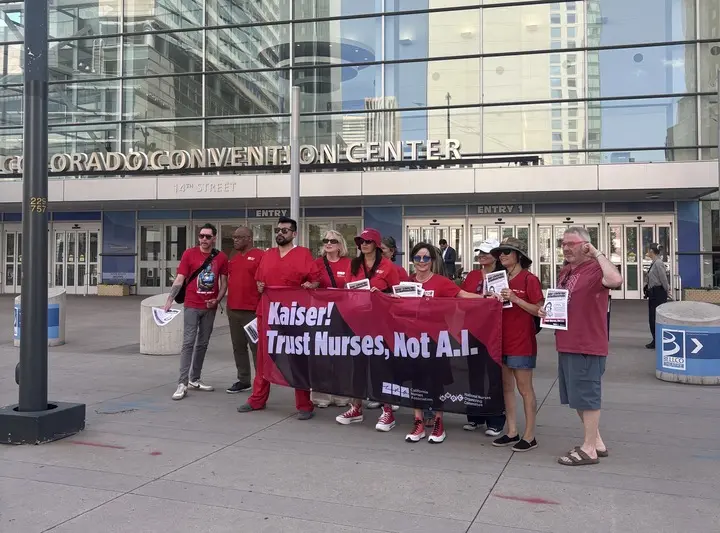
Just feet away, directly outside the convention center doors, a starkly different reality played out. A contingent of frontline healthcare workers—nurses represented by the California Nurses Association (CNA)—braved the punishing heat to stage a fiery demonstration. Their target was not merely Adams’ presence at the high-profile summit, but the overarching technological trajectory of the healthcare giant they serve.
According to these bedside nurses, Kaiser Permanente is aggressively deploying artificial intelligence and automated systems to handle critical operational and clinical judgment calls—including day-to-day staffing allocations and patient symptom assessments—entirely without the input of the medical professionals who actually deliver care.
This dramatic confrontation encapsulates a deepening industry-wide crisis: As healthcare conglomerates race to adopt algorithmic tools to cut costs, optimize efficiencies, and navigate tightening margins, a profound battle of control has erupted. It is no longer just a question of whether artificial intelligence has a place in medicine, but who dictates the terms of its integration. With multibillion-dollar profit margins, ongoing contract negotiations, and parallel whistle-blower litigation rocking premier institutions like the Mayo Clinic, the collision between executive-suite transformation and frontline labor underscores a pivotal, volatile juncture in the evolution of American patient care.
Detailed Chronology: A Tale of Two Realities in Denver
Inside the Hall: Greg Adams’ Vision for Value-Based Scaling
Inside the air-conditioned auditorium of the AHA Leadership Summit, Greg Adams delivered a keynote address aimed at positioning Kaiser Permanente at the bleeding edge of healthcare innovation. Addressing hospital executives and industry leaders, Adams wasted little time addressing the demonstrations unfolding outside, acknowledging the ongoing friction before pivoting swiftly to his core thesis: the imperative of systemic evolution through the Risant Health experiment.
Launched by Kaiser in 2023, Risant Health was engineered as a nonprofit vehicle designed to acquire, integrate, and operate community-based health systems under Kaiser’s proven value-based care frameworks. With the successful acquisitions of Geisinger and Cone Health in 2024, Adams reported that the Risant strategy is already delivering extraordinary, measurable returns.
For instance, Adams highlighted that more than 70% of physicians within the Geisinger system have formally adopted Kaiser’s value-based guidelines for primary care. This operational shift, according to Adams, has unlocked hundreds of additional specialty care appointments, slashed Geisinger’s average patient length of stay by nearly 15% (adjusted for case mix), and cut emergency department boarding rates in half.
Central to these operational gains is what Adams termed "intelligent triage"—an algorithmic approach designed to divert patients who would otherwise flood emergency departments toward more appropriate channels, such as urgent care, primary care, or virtual medical visits. Rather than eating into clinical revenue, Adams asserted, these lower inpatient utilization rates have successfully freed up institutional capacity to care for a broader population of patients.
Tying these operational metrics to a broader philosophical challenge, Adams implored industry leaders to abandon incrementalism. "We don’t always get to choose the moment we lead," Adams told the rapt audience, pointing to mounting cost pressures across the U.S. healthcare ecosystem as undeniable proof that the traditional boundaries separating daily hospital operations from long-term digital transformation must be permanently dissolved.
Outside the Center: The Frontline Perspective
While Adams championed efficiency and technological acceleration inside the convention center, the scene outside painted a picture of deep-seated apprehension and mistrust. Gathering in the blistering 97-degree heat, roughly a dozen nurses affiliated with the California Nurses Association hoisted placards and raised their voices to challenge the narrative being spun within the summit walls.
For these clinicians, the rapid, top-down implementation of artificial intelligence is not a benign administrative upgrade, but a direct threat to labor standards, clinical autonomy, and patient safety.
"Kaiser is one of the biggest and most influential health care systems in the country," said Natalie Rommel, a registered nurse at Kaiser’s hospital in Roseville, California. "That’s the reason our CEO is speaking at this conference, and it’s the reason why we have to demand better from them as the nurses at the bedside in Kaiser facilities."
The protesters argued that Kaiser’s heavy financial investments in algorithmic systems are designed explicitly to diminish the human element of nursing, making clinical staff increasingly replaceable. Terah Deason, a nurse practicing at Kaiser’s Santa Rosa facility and a vital member of the Northern California bargaining team currently locked in contract negotiations, elaborated on these fears.
"Kaiser is making billions and billions of dollars in profit, and they are investing a lot of that money into AI," Deason remarked during an interview. "The issue with that is that they’re using AI to determine all kinds of things that nurses would normally determine, such as how many nurses we need in a day on the floor. They’re using AI to assess how patients are actually feeling and what kind of treatment they’re going to get."
Deason warned that automating these foundational nursing duties lays the groundwork for a systematic labor suppression strategy. By positioning algorithms as capable substitutes for human clinical judgment, the health system risks reducing skilled nurses to disposable line items on a corporate balance sheet.
Crucially, Deason clarified that the union’s position is not reflexively Luddite or entirely anti-technology. "We do recognize that [AI] does have its uses," Deason noted. "There are times when it can be very useful in helping us, but we should be the one to determine how it’s used, and we should be the one to determine when it’s appropriate."
Supporting Context & Metrics: The Mechanics of Modern Transformation
To fully understand the friction between Kaiser’s leadership and its labor force, one must examine the broader economic and technological landscape framing the healthcare sector in 2026.
The Financial Footprint of Kaiser Permanente
Kaiser Permanente remains an indomitable economic titan within American healthcare. Reports from early 2026 indicate that the health system pulled in a staggering $9.3 billion in net income during the previous fiscal year. While these robust financial figures underscore the efficacy of its integrated care delivery and insurance model, they also place a massive target on the organization’s back.
Critics, consumer advocacy groups, and labor unions frequently point to these multi-billion-dollar surpluses to argue that Kaiser has strayed from its historical charitable mission, prioritizing top-line growth, reserve accumulation, and aggressive technological capitalization over equitable staffing ratios and wage parity.
Risant Health and the Export of Value-Based Care
The creation and rapid expansion of Risant Health represent a paradigm shift in how large health systems scale. For decades, the dominant model of hospital growth involved chaotic, fee-for-service acquisitions that often left acquired community hospitals struggling to adapt to corporate mandates.
Risant’s integration of Geisinger and Cone Health flips this script by imposing Kaiser’s rigorous, preventive, value-based architecture onto newly acquired regional networks. The metrics cited by Adams in Denver—a 15% reduction in length of stay and a 50% drop in emergency department boarding—are compelling talking points for hospital executives drowning in rising labor costs and post-pandemic operating deficits.
However, these metrics also signal an aggressive shift toward streamlined, mathematically optimized patient flow. When efficiency becomes the primary metric of success, the margin for human error—and the time required for holistic, empathetic nursing care—inevitably shrinks, fueling frontline anxieties.
The Automation of the Bedside
The specific technologies drawing the ire of Kaiser nurses involve predictive analytics and machine learning models applied to workforce management and patient acuity scoring. Traditionally, staffing matrices—determining how many registered nurses are required on a given hospital floor during a specific shift—are calculated using a complex blend of state-mandated ratios, historical patient volumes, and the seasoned, real-time clinical judgment of charge nurses and nurse managers.
By introducing automated staffing algorithms, health systems attempt to dynamically forecast labor needs based on real-time data inputs. While proponents argue this eliminates human bias and optimizes labor expenditures, critics counter that algorithms lack the contextual nuance required to evaluate true patient acuity. A patient may look stable on a screen while requiring intense emotional and physical intervention that only a bedside nurse can accurately gauge. When AI begins to automate these assessments, the boundary between administrative optimization and compromised patient care blurs dangerously.
Official Statements and Institutional Responses
Both sides of the Denver standoff quickly moved to formalize their positions through official channels as the public relations battle unfolded.
Greg Adams’ Stage-Side Reconciliation Attempt
During his opening remarks at the AHA summit, Greg Adams attempted to defuse potential criticism by directly acknowledging the labor unrest unfolding outside his venue:
"We’re in the middle of bargaining. They are concerned about AI and their ability to be involved in the decision making around AI. And I want them to know, because they may come in, that we’re fully committed to their being present to the work that we’re doing around AI, and we all must own that AI as a part of healthcare and a part of our future."
While offering an olive branch regarding collaborative development, Adams maintained his unwavering stance that algorithmic integration is an absolute prerequisite for the survival and evolution of modern healthcare delivery.
Kaiser Permanente’s Corporate Statement
In an official statement emailed to MedCity News on Monday evening, the health system reiterated its commitment to dialogue while defending its overarching operational vision. The corporate statement read:
"We believe nurses, as clinicians, should have a voice in the use of AI and other evolving health care technologies in their practice, and we are committed to ensuring our nurses and other clinicians do so. We look forward to continuing those discussions directly through the collective bargaining process."
Kaiser’s leadership is clearly banking on the structured environment of collective bargaining—particularly with Northern California nursing units—to channel these technological anxieties into productive framework agreements, averting potentially disruptive strikes while keeping its digital transformation roadmap intact.
Future Outlook: The Broader Industry Reckoning
The confrontation in Denver between Greg Adams and the California Nurses Association is far from an isolated incident. It serves as a bellwether for a much larger, systemic reckoning sweeping across the United States healthcare sector regarding the unchecked deployment of artificial intelligence.
The tension between executive-level technological ambition and frontline operational reality is surfacing in legal and regulatory arenas as well. Just weeks prior to the AHA summit, a landmark lawsuit rattled the healthcare establishment when a former research operations director at the prestigious Mayo Clinic filed a formal complaint against the institution. The plaintiff alleged she was systematically demoted and ultimately terminated after repeatedly raising internal safety and privacy concerns regarding Mayo’s accelerated, high-stakes AI initiatives.
These parallel sagas—the Kaiser labor standoff in Denver and the Mayo Clinic whistleblower lawsuit—forcefully thrust a critical, uncomfortable question into the national spotlight: As artificial intelligence accelerates its infiltration into the sanctum of patient care, will the professional clinicians closest to the bedside retain any real, substantive power to shape that shift?
Key Questions for the Horizon
- Contractual Boundaries: Will ongoing collective bargaining agreements successfully establish binding guardrails that give labor unions veto power or mandatory advisory roles over clinical AI tools?
- Regulatory Interventions: As federal and state regulators begin scrutinizing algorithmic bias and automated decision-making in healthcare, will external oversight supersede internal corporate tech strategies?
- The Patient Impact: Ultimately, how will the friction between optimized administrative efficiency and frontline clinical autonomy impact long-term patient outcomes, clinician burnout rates, and the human warmth of the healing arts?
As health systems nationwide race to adopt predictive analytics, generative AI, and automated workflow engines, the ultimate success of these technologies will not be measured solely by reduced lengths of stay, lower emergency department boarding rates, or streamlined balance sheets. It will be determined by whether the industry can successfully bridge the widening chasm between the boardroom visionaries designing the future and the frontline caregivers holding it together at the bedside.
