

Executive Overview
The intersection of artificial intelligence and healthcare delivery has sparked a high-stakes ideological and operational battle, vividly on display during the American Hospital Association’s (AHA) Leadership Summit in Denver, Colorado. Inside the air-conditioned opulence of the Colorado Convention Center, Kaiser Permanente CEO Greg Adams took center stage to deliver an optimistic blueprint for the future of value-based care. Painting a picture of streamlined efficiency, scalable nonprofit models, and cutting-edge data integration, Adams argued that his organization is successfully cracking the code on modernizing American healthcare.
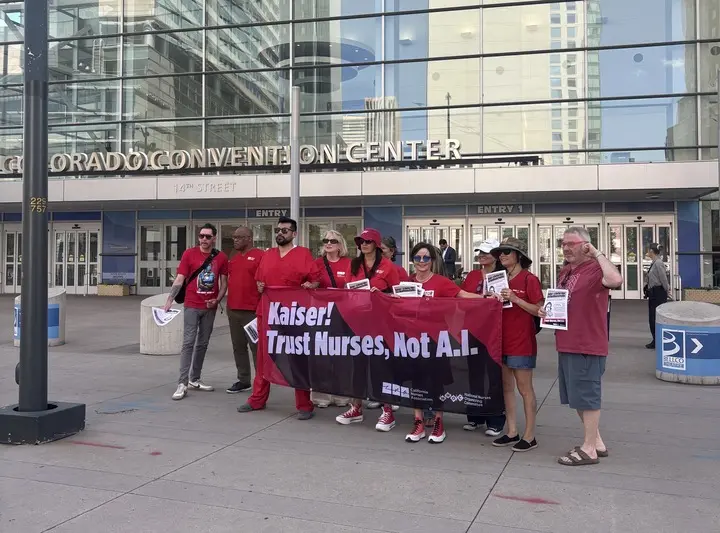
Yet, just outside the venue doors—baking in the oppressive 97-degree Denver heat—a starkly different narrative unfolded. A contingent of frontline nurses, represented by the California Nurses Association (CNA) and affiliated with National Nurses United, gathered in active protest. Their grievance was not merely theoretical; it targeted the rapid, corporate deployment of artificial intelligence to automate staffing models and clinical judgment calls without meaningful input from the healthcare workers at the bedside.
This dramatic juxtaposition highlights a pivotal chasm in contemporary medicine: the widening gap between executive leadership’s push for technological transformation and the frontline workforce’s growing anxiety over job security, patient safety, and professional autonomy. As healthcare systems nationwide race to integrate machine learning, algorithms, and automated workflows to combat rising operational costs, the fundamental question remains: Who holds the power to define the terms of AI’s integration into patient care—the boardroom executives maximizing efficiency, or the clinicians closest to the patients?
Detailed Chronology: The Denver Clash and the Battle of Narratives
The Inside View: Adams’ Vision for Value-Based Care and Risant Health
Greg Adams’ keynote address at the AHA Leadership Summit was intended to showcase operational triumph. Rather than treating day-to-day survival and long-term systemic transformation as mutually exclusive choices, Adams argued that mounting cost pressures in the U.S. healthcare sector have rendered incremental change obsolete.
"We don’t always get to choose the moment we lead," Adams told the audience of healthcare executives, positioning Kaiser Permanente’s aggressive strategic maneuvers as a necessary evolution for the entire industry.
A centerpiece of his address was the burgeoning success of Risant Health, a nonprofit organization spun out by Kaiser Permanente in 2023. Designed explicitly as a vehicle to acquire and operate nonprofit health systems under Kaiser’s proven value-based care frameworks, Risant has quickly expanded its footprint. Following Risant’s acquisition of Geisinger and Cone Health in 2024, Kaiser’s operational methodologies have been exported across state lines with immediate, measurable impacts.
According to Adams, over 70% of Geisinger’s primary care physicians have actively adopted Kaiser’s value-based guidelines. This structural alignment has reportedly freed up hundreds of specialty appointments, cut Geisinger’s length-of-stay metrics by nearly 15% on a case-mix-adjusted basis, and slashed emergency department (ED) boarding times by half.
Adams attributed these efficiency gains heavily to an "intelligent triage" system. This automated tool dynamically diverts patients who might otherwise flood emergency departments toward more appropriate pathways, such as urgent care, primary care, or virtual medical visits. Far from cutting into revenues, Adams argued, lowering unnecessary emergency utilization has freed up vital hospital capacity to serve a larger, more vulnerable patient population.
The Outside View: Nurses Sound the Alarm on Automation and Labor
While conference attendees digested Adams’ metrics of efficiency, the scene outside the Colorado Convention Center told a story of profound labor apprehension. Brandishing signs and voicing deep-seated grievances, nurses from California health facilities made it clear that corporate efficiency often comes at a steep human cost.
"Kaiser is one of the biggest and most influential health care systems in the country," noted Natalie Rommel, a registered nurse at Kaiser’s Roseville, California facility. "That’s the reason our CEO is speaking at this conference, and it’s the reason why we have to demand better from them as the nurses at the bedside."
The core of the nurses’ protest centered on how Kaiser Permanente is deploying artificial intelligence within its hospitals. Terah Deason, a nurse at Kaiser’s Santa Rosa, California hospital and a key member of the Northern California bargaining team currently negotiating a new union contract, laid out the operational realities driving the demonstration.
"Kaiser is making billions and billions of dollars in profit, and they are investing a lot of that money into AI," Deason stated during an interview. "The issue with that is that they’re using AI to determine all kinds of things that nurses would normally determine, such as how many nurses we need in a day on the floor. They’re using AI to assess how patients are actually feeling and what kind of treatment they’re going to get… Basically, the concern is that they’re going to use AI to start to replace us."
Deason and his fellow union members articulated a fear that extends beyond simple job displacement into the realm of labor suppression. By positioning algorithms and automated software as entities capable of performing complex clinical assessments and workforce scheduling, health system executives risk rendering human nurses increasingly "disposable."
Crucially, the union’s stance is not a blanket rejection of technological innovation. Deason clarified that frontline workers acknowledge the potential benefits of AI in medical settings. However, they argue that clinicians must hold regulatory and operational power over how and when these tools are implemented.
The Leadership Response: Bridging the Bargaining Table
Addressing the demonstration briefly before diving into his scheduled conference session, Greg Adams acknowledged the brewing labor tension.
"We’re in the middle of bargaining. They are concerned about AI and their ability to be involved in the decision making around AI," Adams told the summit attendees. "And I want them to know, because they may come in, that we’re fully committed to their being present to the work that we’re doing around AI, and we all must own that AI as a part of healthcare and a part of our future."
Later that evening, Kaiser Permanente issued a formal statement to media outlets, reinforcing Adams’ conciliatory tone. The health system emphasized its respect for nursing professionals and highlighted ongoing collective bargaining sessions as the appropriate venue for resolving workflow disputes.
"We believe nurses, as clinicians, should have a voice in the use of AI and other evolving health care technologies in their practice, and we are committed to ensuring our nurses and other clinicians do so," the corporate statement read. "We look forward to continuing those discussions directly through the collective bargaining process."
Supporting Context & Metrics: The Risant Health Experiment and Industry-Wide AI Friction
Deconstructing the Risant Health Expansion
The friction at the AHA Leadership Summit cannot be viewed in isolation; it occurs against a backdrop of sweeping structural consolidation across American healthcare. Kaiser Permanente’s creation and scaling of Risant Health represent a bold attempt to commercialize integrated, value-based care on a national scale.
Traditional fee-for-service healthcare models reward volume—the more procedures performed, the higher the revenue. Value-based care models, conversely, reward health outcomes and cost containment, incentivizing systems to keep patients healthy and out of acute-care facilities. By acquiring regional powerhouses like Geisinger and Cone Health, Risant is attempting to graft Kaiser’s integrated delivery model onto diverse, traditional healthcare ecosystems.
The metrics cited by Adams—such as a 15% reduction in length of stay and a 50% drop in emergency department boarding—signal that these value-based methodologies are yielding powerful financial and operational dividends. However, these metrics also underscore the heavy reliance on predictive algorithms, automated routing, and data-driven resource allocation. When health systems prioritize throughput and length-of-stay reduction, frontline workers often bear the psychological and physical burden of meeting these aggressive algorithmic benchmarks.
A Broader Industry Trend: Legal and Regulatory Pushback
The ideological clash between healthcare administrators and clinical workers over artificial intelligence is not unique to Kaiser Permanente. Across the broader healthcare landscape, the rush to deploy automated technologies is running headfirst into regulatory scrutiny, ethical dilemmas, and employee resistance.
Just weeks prior to the Denver summit, a prominent legal battle erupted at another premier American medical institution. A former research operations director at the Mayo Clinic filed a formal lawsuit against the health system, alleging she was demoted and subsequently terminated after repeatedly raising internal flags regarding AI development projects. According to the lawsuit, Mayo’s fast-tracked artificial intelligence initiatives were allegedly cutting critical corners on patient privacy, data governance, and clinical safety.
These parallel sagas—Kaiser nurses protesting automated clinical judgment on the streets of Denver, and a Mayo Clinic whistleblower taking legal action over data safety—reveal a systemic vulnerability. As health systems race to capture the market advantages of generative AI, predictive analytics, and automated administrative workflows, the governance structures ensuring accountability are routinely challenged from within.
Official Statements and Stakeholder Perspectives
To fully comprehend the depth of this ideological divide, examining the precise language used by key stakeholders is essential:
-
Greg Adams (CEO, Kaiser Permanente):
"We don’t always get to choose the moment we lead… We’re in the middle of bargaining. They are concerned about AI and their ability to be involved in the decision making around AI. And I want them to know… that we’re fully committed to their being present to the work that we’re doing around AI, and we all must own that AI as a part of healthcare and a part of our future."
-
Natalie Rommel (Kaiser Registered Nurse, Roseville, CA):
"Kaiser is one of the biggest and most influential health care systems in the country. That’s the reason our CEO is speaking at this conference, and it’s the reason why we have to demand better from them as the nurses at the bedside in Kaiser facilities."
-
Terah Deason (Kaiser Registered Nurse, Santa Rosa, CA & Bargaining Team Member):
"Kaiser is making billions and billions of dollars in profit, and they are investing a lot of that money into AI… They’re using AI to determine all kinds of things that nurses would normally determine, such as how many nurses we need in a day on the floor… Basically, the concern is that they’re going to use AI to start to replace us… We do recognize that [AI] does have its uses. That there are times when it can be very useful in helping us, but we should be the one to determine how it’s used, and we should be the one to determine when it’s appropriate."
-
Kaiser Permanente Corporate Statement:
"We believe nurses, as clinicians, should have a voice in the use of AI and other evolving health care technologies in their practice, and we are committed to ensuring our nurses and other clinicians do so. We look forward to continuing those discussions directly through the collective bargaining process."
Future Outlook: Navigating the Intersection of Technology and Clinical Autonomy
The standoff in Denver serves as a definitive case study for the future of American healthcare delivery. Artificial intelligence possesses the undeniable capacity to revolutionize medical diagnostics, streamline burdensome administrative paperwork, optimize patient triage, and alleviate the crushing burnout currently plaguing medical professionals. From an executive vantage point, failing to adopt these technologies quickly equates to falling behind in an increasingly competitive and financially strained market.
Yet, the vehement protests mounted by Kaiser nurses highlight a profound truth: Healthcare is, at its core, a human-centric endeavor. Algorithms can analyze historical triage patterns, predict length-of-stay metrics, and recommend staffing ratios based on historical data, but they cannot hold a frightened patient’s hand, intuitively sense a subtle clinical deterioration that defies standard parameters, or advocate ethically for equitable patient care in real-time.
As contract negotiations between Kaiser Permanente and the California Nurses Association progress, the resulting agreements may establish a vital legal and operational precedent for the entire healthcare sector. If labor unions successfully secure binding contract language mandating clinician oversight and participatory design in AI deployment, it could set a national standard for ethical technological integration. Conversely, if executive directives override frontline concerns, healthcare may witness an acceleration of workforce alienation, heightened attrition rates, and dangerous erosion of bedside trust.
Ultimately, the events at the AHA Leadership Summit pose an inescapable challenge for healthcare leaders nationwide: As artificial intelligence accelerates deeper into the clinical sanctuary, the industry must decide whether technology will serve as a tool that empowers the healing hands at the bedside, or a wedge that drives them away. The answers forged in upcoming collective bargaining sessions and courtrooms will shape the character of modern medicine for generations to come.
