


Executive Overview
In the high-stakes theater of enterprise software and artificial intelligence startups, few buzzwords carry as much gravitational pull as the "Forward-Deployed Engineer" (FDE). The allure is undeniable. Borrowing a page from Palantir—a juggernaut growing at an 84% clip with over $5 billion in revenue—many modern founders are eager to adopt the model of embedding technical talent deep within customer organizations to "just figure it out with them."
However, the term "Forward-Deployed Engineer" has become an amorphous catch-all, obscuring wildly different operational realities. According to early-stage venture capital insights from former Palantir FDE Kabir Sial, applying the original Palantir FDE playbook to a standard early-stage software startup is a recipe for organizational friction.
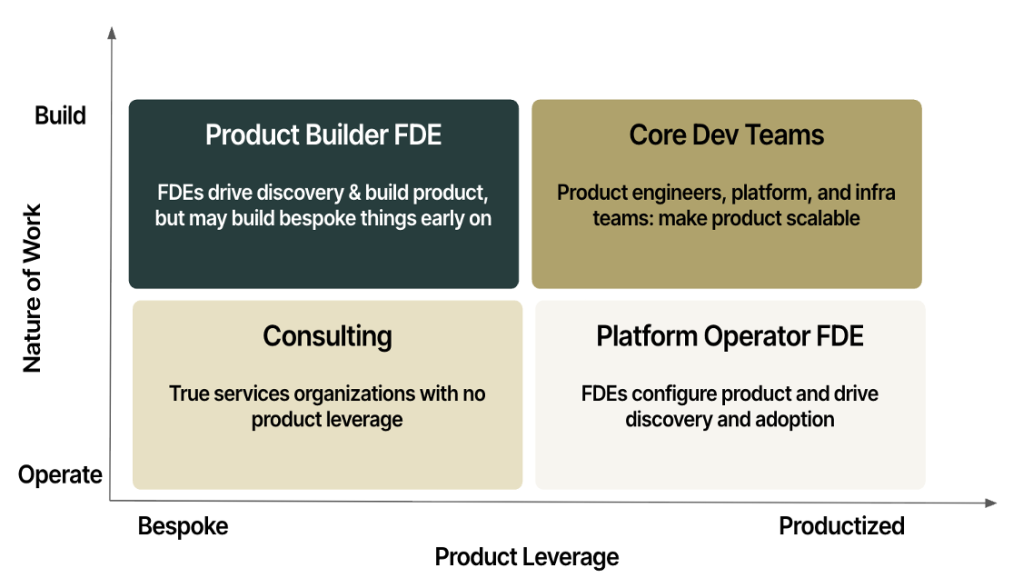
Fundamentally, the FDE role splits into two distinct archetypes: the product builder and the platform operator. Conflating the two can lead to bloated engineering roadmaps, exhausted teams, and stagnating growth. Founders must explicitly identify which bucket their business model demands. Choosing incorrectly risks trapping a startup in custom service loops, while choosing correctly can act as the catalyst for smooth, scalable enterprise expansion.

Detailed Chronology and Evolution of the FDE Model
To understand how the FDE role reached its current crossroads, one must examine its origins and subsequent evolution across the technology landscape.
The Origins: The Trench-Work Era of Palantir
The FDE archetype was pioneered by data analytics giant Palantir. In its formative years, the company faced markets where enterprise software was neither intuitive nor plug-and-play. Legacy systems, siloed databases, and intense security requirements meant that selling a product wasn’t just a matter of handing over an API key.
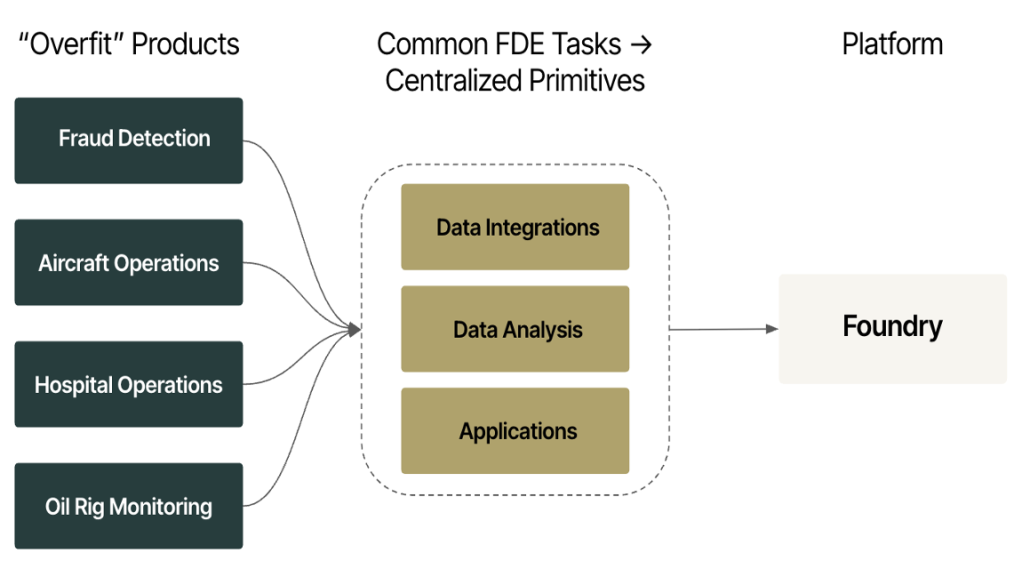
Palantir deployed software engineers directly into the operational environments of government intelligence agencies and Fortune 500 boardrooms. These engineers did not merely configure software; they lived alongside the users, ingested messy data sources, built bespoke connectors, and wrote custom frontend applications for specific workflows like fraud detection and dynamic pricing. This unscalable, boots-on-the-ground development formed the crucible in which Palantir’s enterprise ontology was forged.
The Shift: The Rise of AI-Native Startups
As the generative AI boom accelerated, early-stage startups rediscovered the FDE model. Armed with modern AI coding assistants that make shipping features faster than ever, founders looked to replicate Palantir’s hyper-customized deployment strategy.
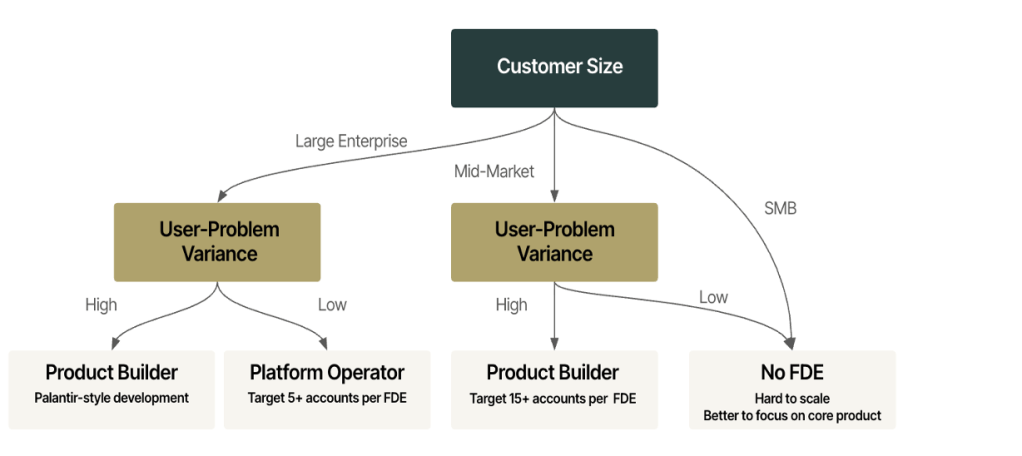
However, early-stage startups operate under vastly different capital, talent, and product constraints than a multi-billion-dollar enterprise. Maintaining highly custom features for every client pulls precious engineering cycles away from core platform development. Consequently, the industry has experienced a gradual bifurcation. While a few companies still require the heavy-duty engineering firepower of the OG product builder, the vast majority of modern startups are quietly migrating toward the platform operator model—scaling their FDE-to-account ratios from Palantir’s historical 1:1 or 1:2 models up to 1:10. Even Palantir itself has evolved its FDE deployment strategies to emphasize scalable operational leverage over pure custom development.
Supporting Context & Metrics: Defining the Two FDE Archetypes
Distinguishing between the two FDE profiles requires a deep dive into their respective operational metrics, north stars, and day-to-day responsibilities.
1. The Product Builder (The OG Palantir Version)
- North Star: Do whatever it takes to solve the user’s problem.
- Core Function: FDEs are responsible not just for making the platform work, but for discovering what to build and writing actual software in service of the customer.
- When to Hire:
- Fortune 500 Scale Customers: Large enterprises bring legacy infrastructure and complex regulatory environments that demand "out-of-platform" engineering work, such as bespoke data pipelines, custom UIs, and specialized backends.
- Multitude of ICPs and Workflows: If a startup serves a broad, heterogeneous range of Ideal Customer Profiles (ICPs), the product will rarely be walk-up usable on day one. Product builders create the short-term, hacky solutions that ultimately reveal long-term product-market fit.
- Ideal Candidate Profile: High-ownership, missionary software engineers or technical product managers who possess an intrinsic desire to ship products directly to end-users.
2. The Platform Operator (Solutions + Technical Customer Success)
- North Star: Make the existing product work for the customer—deploy, configure, and operationalize it.
- Core Function: FDEs configure the core platform, manage account relationships, and drive user adoption. While this resembles traditional solutions engineering, technical account management, or customer success, modern platform operators are increasingly expected to build prototypes, configure evaluation metrics, and implement Model Context Protocols (MCPs).
- When to Hire: When a startup has achieved a repeatable product-market fit, a standardized core platform, and needs to scale its deployment footprint without building bespoke software for every client.
- Ideal Candidate Profile: Professionals with strong technical fluency (data analysis, advanced SQL, workflow automation), high product intuition, and natural relationship-building skills. Strong backgrounds include technical customer success, solutions engineering, software engineering, product management, and management consulting.
Official Perspectives and Expert Analysis
Industry observers and venture capitalists emphasize that hiring the wrong FDE archetype can paralyze an early-stage company.
According to Kabir Sial, the primary danger for fast-growing companies lies in letting the "custom product surface area" cannibalize the core product. When product builder FDEs are deployed into environments that only require platform operation, they spend their days writing code that serves a single customer, creating technical debt that compounds over time.
Conversely, founders attempting to build complex enterprise software for Fortune 500 clients cannot rely solely on light-touch platform operators. Large enterprises suffer from profound organizational inertia; moving them away from entrenched tools like Excel requires immense trust. That trust is rarely won through slide decks or generic SaaS onboarding flows; it is earned through unscalable, hands-on engineering intervention.
Furthermore, recruitment strategy must align with organizational culture. Attracting elite software engineers to an FDE role that amounts to little more than glorified technical customer support is notoriously difficult. Founders must clearly delineate whether they are hiring professionals to support existing development teams or empowering them to actively shape and build the product roadmap.
Future Outlook: The Next Generation of FDE Deployment
As the enterprise software landscape continues to mature in the age of intelligent automation, the role of the Forward-Deployed Engineer will continue to transform.
- AI-Driven Leverage: With code generation and automated testing reaching unprecedented levels of sophistication, the boundary between the product builder and the platform operator will blur. Platform operators will increasingly possess light coding capabilities, allowing them to spin up custom integrations and prototypes without pulling resources from the core engineering team.
- Standardization of Ontologies: Just as Palantir utilized FDEs to refine its enterprise ontology, modern vertical AI startups will use early FDE engagements to map industry-specific workflows into reusable, modular platform components. Once these patterns are identified, they will be centralized into the application layer, reducing the need for perpetual custom engineering.
- Strategic Specialization: Founders will move away from treating "FDE" as a monolithic title. Companies will intentionally segregate their deployment teams into specialized tiers—retaining small, elite squads of product builders for complex, high-value enterprise accounts, while deploying scalable armies of platform operators to drive high-volume adoption across mid-market and SMB segments.
Ultimately, scaling smoothly rather than spinning your wheels depends on matching your FDE strategy to your company’s maturity, customer complexity, and product vision. By clearly defining whether your business needs a product builder or a platform operator, you can build a resilient, high-leverage organization poised for sustainable growth.
