

Executive Overview
In the modern landscape of Python development, writing clean, maintainable, and efficient code is paramount. For years, developers faced a tedious rite of passage when creating data-centric classes: writing repetitive, boilerplate "dunder" (double underscore) methods such as __init__, __repr__, and __eq__. These methods added dozens of lines of mechanical code to simple models, obscuring business logic and increasing the surface area for human error.
The introduction of Python dataclasses transformed this paradigm. Initially viewed as a simple syntactic shortcut to eliminate repetitive initialization routines, dataclasses have evolved into a cornerstone of robust Python architecture. They provide a declarative, concise way to manage state while retaining the full power of object-oriented programming.
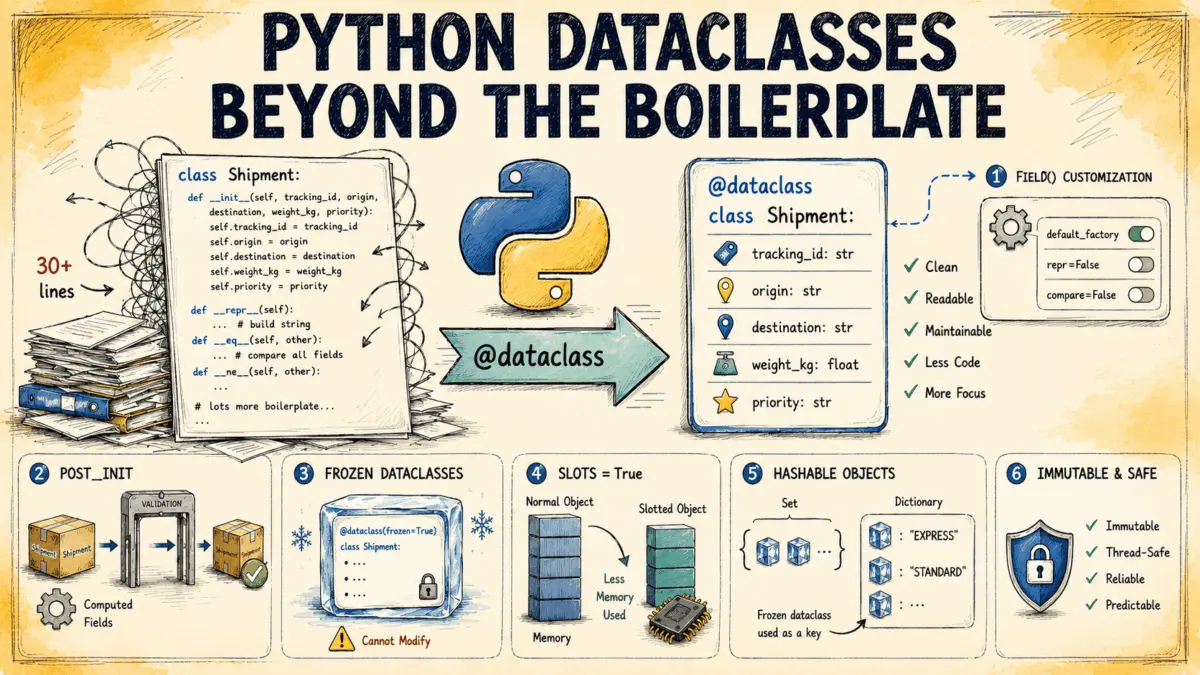
However, stopping at the basic @dataclass decorator leaves much of their engineering potential untapped. Advanced features like custom field configurations, __post_init__ hooks, immutability (frozen=True), and memory optimization (slots=True) elevate dataclasses from simple syntactic sugar to powerful design patterns. This article explores how developers can harness these advanced features to build production-grade domain models that are secure, highly performant, and exceptionally clean.
Detailed Chronology: The Evolution of Python Data Modeling
To understand the architectural significance of dataclasses, it is helpful to examine how Python developers historically managed data structures and the chronological progression that led to modern conventions.
1. The Raw Class Era (__init__ and Boilerplate)
In early Python iterations, representing structured data required writing explicit classes. Every attribute had to be declared manually within an __init__ method, followed by verbose representations for debugging (__repr__) and comparison logic (__eq__).
- The Problem: A simple data container with five attributes easily stretched past 30 lines of code. This code was entirely structural, containing zero domain logic, which made it tedious to write and difficult to maintain as schemas evolved.
2. The collections.namedtuple Innovation
Recognizing the need for lightweight data structures, Python introduced namedtuple in version 2.6. This allowed developers to create immutable, tuple-like objects with named fields in a single line of code.
- The Limitation: While
namedtupledrastically reduced boilerplate, it lacked flexibility. Tuples are inherently immutable and positional, meaning developers could not easily add default values, methods, or mutable fields without hacking around core limitations.
3. The Rise of typing.NamedTuple
With the arrival of Python 3.6 and type hints, NamedTuple brought type safety and class-like syntax to tuples.
- The Limitation: Despite supporting type annotations and method definitions,
NamedTupleremained bound to the underlying tuple data structure. Instances were still immutable and indexed like tuples, making them poorly suited for complex domain models requiring state mutation, validation, or internal administrative fields.
4. PEP 557 and the Introduction of Dataclasses (Python 3.7)
Introduced in Python 3.7 via PEP 557, dataclasses struck the ideal balance. They provided the automatic generation of boilerplate methods (similar to namedtuple) while preserving the flexibility of standard mutable classes. Developers could finally define attributes using standard type annotations while letting the interpreter handle the construction logic behind the scenes.
5. Modern Enhancements: Slots and Immutability (Python 3.10+)
Recent Python releases have systematically supercharged dataclasses. Python 3.10 introduced native support for slots=True, slashing memory overhead by eliminating instance dictionaries. These continuous enhancements have cemented dataclasses as the default choice for data transfer objects (DTOs), API payloads, and domain-driven design models.
Supporting Context & Metrics: Why Dataclasses Matter in Production
When scaling applications—particularly data-heavy Extract, Transform, Load (ETL) pipelines, microservices, and asynchronous event streams—architectural choices directly impact CPU cycles, memory footprints, and developer velocity.
Eliminating Cognitive Overhead
In a traditional Python class, code reviews often get bogged down by checking whether __eq__ correctly compares every attribute or if __repr__ exposes sensitive internal data. By delegating method generation to the @dataclass decorator, codebases become significantly more declarative. Developers read the attributes and instantly understand the schema of the object, reducing onboarding friction for new engineers.
Memory Footprint and Optimization Metrics
A hidden performance trap in Python is the instance dictionary (__dict__). By default, every standard Python object allocates a dictionary to store its attributes dynamically. For applications managing millions of records in memory, this dictionary overhead accumulates rapidly.
- Standard Dataclass Overhead: A typical dataclass instance relies on
__dict__, consuming approximately 296 bytes of baseline overhead per object just for structural metadata. - Slotted Dataclass Optimization: By passing
slots=Trueto the decorator (available in Python 3.10+), Python stores attributes in a fixed-size array instead of a dynamic dictionary. The structural overhead drops to roughly 72 bytes per instance—a 75% reduction in baseline memory consumption.
For a data processing pipeline handling 1,000,000 concurrent records, this single architectural adjustment saves hundreds of megabytes of RAM, directly reducing cloud infrastructure costs and garbage collection pressure.
Technical Deep Dive: Mastering Advanced Dataclass Features
To transition from basic usage to enterprise-grade implementation, developers must master four core advanced capabilities of Python dataclasses: field() configuration, lifecycle hooks via __post_init__, immutability via frozen=True, and memory management via slots=True.
1. Granular Control with field()
The field() function serves as the escape hatch from default annotation behavior, allowing developers to fine-tune individual attributes.
Avoiding Mutable Default Gotchas
A classic Python pitfall is assigning mutable objects (like lists or dictionaries) as default argument values in function signatures or class attributes. Doing so causes all instances to share a single, mutable reference. Dataclasses prevent this by strictly requiring a default_factory for mutable defaults:
from dataclasses import dataclass, field
from datetime import datetime

@dataclass
class Shipment:
    tracking_id: str
    origin: str
    destination: str
    weight_kg: float
    priority: str = "standard"
    route_stops: list[str] = field(default_factory=list)
    created_at: datetime = field(default_factory=datetime.utcnow)
Each newly instantiated Shipment receives an isolated list instance generated by the zero-argument default_factory, preventing shared-state bugs.
Hiding Internal State from Repr and Comparison
Real-world models often require internal metadata (such as audit logs, cache flags, or database primary keys) that should not factor into business logic comparisons or clutter debugging logs. This is managed via repr=False and compare=False:
@dataclass
class Shipment:
    tracking_id: str
    origin: str
    destination: str
    weight_kg: float
    priority: str = "standard"
    _internal_audit_notes: str = field(default="", repr=False, compare=False)
Two shipments with identical routing data will evaluate as equal, even if their internal audit notes differ, and debugging prints remain focused strictly on logistics data.
2. Validation and Computed Fields via __post_init__()
The automatically generated __init__ method invokes __post_init__() immediately after assigning all fields. This lifecycle hook is the ideal location for input validation and computing derived attributes.
Enforcing Robust Input Validation
By catching invalid data during object construction, developers eliminate entire classes of runtime errors downstream:
VALID_PRIORITIES = "economy", "standard", "express", "critical"

@dataclass
class Shipment:
    tracking_id: str
    origin: str
    destination: str
    weight_kg: float
    priority: str = "standard"

    def __post_init__(self):
        if self.weight_kg <= 0:
            raise ValueError(f"weight_kg must be positive, got self.weight_kg")
        if self.priority not in VALID_PRIORITIES:
            raise ValueError(f"Invalid priority: self.priority!r")
Synchronizing Derived Fields
Computed properties that depend on initialization parameters can be safely calculated and locked in using field(init=False):
FREIGHT_RATES = "economy": 1.20, "standard": 1.85, "express": 3.40, "critical": 6.00

@dataclass
class Shipment:
    tracking_id: str
    origin: str
    destination: str
    weight_kg: float
    priority: str = "standard"
    freight_cost: float = field(init=False)

    def __post_init__(self):
        if self.weight_kg <= 0:
            raise ValueError("Weight must be positive.")
        self.freight_cost = round(self.weight_kg * FREIGHT_RATES[self.priority], 2)
This guarantees that freight_cost is always synchronized with the base metrics, eliminating stale data bugs.
3. Immutability and Hashability with frozen=True
Passing frozen=True transforms a dataclass into an immutable value object. Any subsequent attempt to modify an attribute raises a FrozenInstanceError.
@dataclass(frozen=True)
class RouteSegment:
    from_hub: str
    to_hub: str
    distance_km: float
    carrier: str
Because frozen dataclasses are immutable, Python automatically generates a __hash__() method. This allows instances to be safely stored in sets or used as dictionary keys in caching layers—an operation that fails with a TypeError on mutable dataclasses.
Official Statements & Industry Adoption
Engineering leaders across the Python ecosystem have increasingly standardized on dataclasses for data-transfer architectures.
"Dataclasses strike the optimal balance between explicit type declarations and concise syntax. They eliminate the boilerplate that plagued traditional Python domain modeling while preserving the full flexibility of object-oriented design."
— Core Python Developer Community Consensus (PEP 557)
Enterprise frameworks have similarly embraced this paradigm. Modern libraries like Pydantic have integrated native dataclass support, bridging the gap between lightweight Python syntax and aggressive runtime validation. Meanwhile, serialization tools such as dacite and marshmallow-dataclass make mapping raw JSON API payloads directly into structured, type-safe domain models seamless.
Future Outlook
As Python continues its ascent in enterprise software, data science, and artificial intelligence infrastructure, the emphasis on code clarity and runtime efficiency will only intensify.
Future iterations of Python and typing standards are expected to build upon the foundation laid by dataclasses. We can anticipate deeper static analysis integration, more robust runtime reflection capabilities, and optimized serialization performance out of the box. Mastering advanced dataclass patterns today ensures that engineering teams are well-positioned to write maintainable, high-performance, and resilient Python applications for years to come.
