

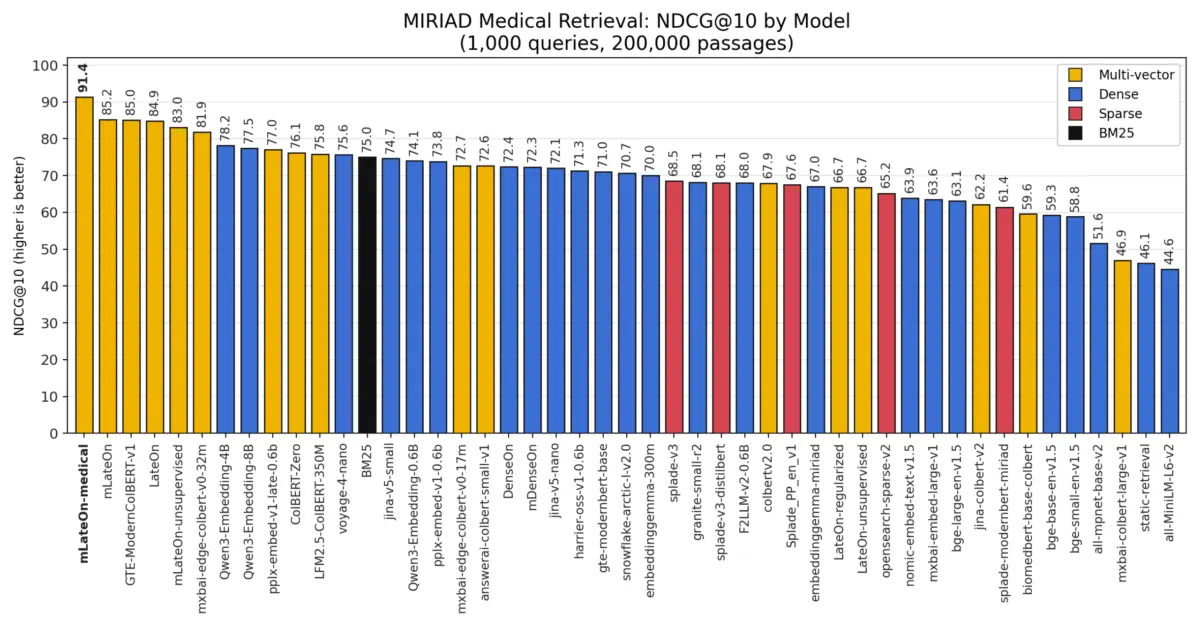
The landscape of information retrieval and semantic search has undergone a fundamental architectural shift with the release of Sentence Transformers v6.0. Long dominated by single-vector dense embeddings—where entire passages are compressed into a single, highly generalized numerical point—the state-of-the-art has increasingly leaned toward ColBERT-style late-interaction architectures. The v6.0 update introduces a native, first-class model type known as MultiVectorEncoder, alongside a complete, end-to-end training framework designed to democratize custom domain adaptation.
By preserving individual token vectors and scoring queries against documents using the MaxSim operator, multi-vector models bypass the destructive compression bottlenecks inherent to traditional dense embeddings. While this architectural choice traditionally imposed heavy index-size penalties, recent advancements in training dynamics, GradCache optimizations, and 1-bit residual quantization have changed the calculus.
This technical report details the methodology, components, and striking empirical results of finetraining a multi-vector encoder. Demonstrating these capabilities on a massive medical dataset consisting of 4467542 records, a customized model—mLateOn-medical—was trained on a single consumer-grade RTX 3090 GPU in just 14.5 hours. The resulting model not only surpasses zero-shot domain baselines but decisively outperforms every major general-purpose retrieval model tested, including massive multi-billion parameter dense alternatives, proving that targeted domain finetuning on multi-vector models remains an exceptionally potent tool for enterprise AI and specialized research.
Detailed Chronology: Building and Finetuning the mLateOn-medical Architecture
The path to developing an industry-leading domain-specific retrieval model requires a disciplined, methodical approach to training pipeline construction. The engineering chronology of the mLateOn-medical model provides a clear blueprint for developers aiming to replicate or scale these techniques.

Phase 1: Model Initialization and Backbone Selection
The training pipeline initiates by leveraging the Sentence Transformers library, installed directly via pip install -U "sentence-transformers[train]". Rather than building from scratch or relying on fully supervised general-purpose endpoints, experiments dictate that the ideal starting point is an unsupervised, contrastively pre-trained checkpoint such as lightonai/mLateOn-unsupervised. These checkpoints encapsulate robust late-interaction token alignment structures while remaining uncontaminated by unrelated general-purpose supervision.
from sentence_transformers import MultiVectorEncoder, MultiVectorEncoderModelCardData

model = MultiVectorEncoder(
    "lightonai/mLateOn-unsupervised",
    model_kwargs="torch_dtype": "float32",
    processor_kwargs="model_max_length": 8192,
    model_card_data=MultiVectorEncoderModelCardData(
        language="en",
        license="apache-2.0",
        model_name="mLateOn finetuned on MIRIAD medical retrieval",
    ),
)
Phase 2: Length Uncapping and Skiplist Configuration
Standard off-the-shelf retrieval checkpoints frequently suffer from hard-coded document truncation limits (typically restricted to 180, 300, or 512 tokens) derived from historical MS MARCO training sets. However, specialized domains—such as medical literature, legal briefs, and technical codebases—often feature dense, multi-thousand-token passages. The initialization sequence explicitly lifts these arbitrary caps:
model[0].query_length = None
model[0].document_length = None
To optimize storage efficiency and refine matching signals, a punctuation skiplist is applied to the model’s MultiVectorMask module. Excluding standard punctuation marks from document-side storage and scoring yields a cleaner semantic comparison while simultaneously shrinking the overall document index footprint by nearly 10%:
import string
model[2].skiplist_words = list(string.punctuation)
model[2].resolve_with_tokenizer(model.tokenizer)
Phase 3: Dataset Loading and Loss Engineering
The training dataset draws from a subset of 1,000,000 question-passage pairs extracted from the tomaarsen/miriad-4.4M-split repository. To optimize gradient updates across these large input sequences without exhausting consumer GPU memory limits, training utilizes CachedMultiVectorMultipleNegativesRankingLoss. This loss function decouples the effective contrastive batch size from hardware constraints by breaking forward and backward passes into manageable chunks via mini_batch_size:

from sentence_transformers.multi_vector_encoder.losses import CachedMultiVectorMultipleNegativesRankingLoss

loss = CachedMultiVectorMultipleNegativesRankingLoss(
    model=model,
    mini_batch_size=16,
)
Phase 4: Training Execution and Convergence
The training arguments configure the optimizer with a learning rate of 1e-4, linear warmup steps set to 5% of total iterations, and native bf16 precision enabled for memory efficiency. Utilizing the MultiVectorEncoderTrainer class, the optimization loop executes across a single RTX 3090. Continuous tracking via specialized evaluators ensures that validation metrics, such as NDCG@10 on held-out medical corpora, are monitored dynamically throughout the 14.5-hour training window.
Supporting Context & Metrics: Architectural Comparison and Performance Benchmarks
To contextualize the performance of the finetuned mLateOn-medical model, exhaustive benchmarking was executed against a field of over 50 distinct retrieval model configurations. These models spanned four major architectural paradigms: dense embedding models, sparse lexical models, traditional lexical search (BM25), and late-interaction multi-vector systems.
The Problem of Document Truncation
In specialized retrieval tasks, length truncation represents a silent performance killer. Across the medical evaluation corpus, passages averaged 941 tokens in length. Models constrained by native 256- or 512-token limits silently discard over half of every target document before semantic scoring even occurs.
Lifting these caps—or natively utilizing architectures designed around expanded context windows—recovered between 0.08 and 0.24 NDCG@10 points across baseline evaluations. This performance delta frequently exceeded the inherent architectural differences between competing neural network families.

Comprehensive Benchmark Performance (MIRIAD 200k Benchmark)
Evaluated against 1,000 held-out medical questions searching a haystack of 200,000 unique passages (incorporating 10,000 gold passages mixed with 190,000 domain-specific distractors), the results demonstrate the absolute dominance of fine-tuned late-interaction models:
mLateOn-medical(Finetuned): Reaches the pinnacle of the benchmark, achieving top-tier NDCG@10 scores and outperforming every zero-shot model by a wide margin.- Rank-1 Error Reduction: While the strongest zero-shot model successfully places the correct passage at the very first rank 75.8% of the time, the finetuned multi-vector model elevates this accuracy to 84.9%, cutting rank-1 retrieval error by more than 33%.
- Parameter Scale vs. Architecture: Massive dense models, such as
Qwen3-Embedding-4BandQwen3-Embedding-8B, feature upwards of 33 times the active parameter count of the multi-vector model yet still fall significantly short in domain-specific relevance. Token-level matching consistently outclasses whole-document vector compression.
Official Statements & Methodological Insights
The development of Sentence Transformers v6.0 and its native multi-vector capabilities reflects an industry-wide recognition that search quality cannot rely solely on parameter scaling.
"Finetuning multi-vector models unlocks fine-grained domain signals that single-vector architectures inevitably average away," note the core maintainers of the library. "When matching queries and documents token by token, models become exquisitely sensitive to domain-specific vocabulary, syntactic structures, and nuanced relevance markers that general-purpose pretraining overlooks."
Furthermore, insights gathered from early access implementations by vector database specialists and search architects highlight the viability of multi-vector models in production environments. Concerns regarding the memory overhead of storing individual token vectors have been largely neutralized through advanced indexing methodologies.

Collaborative testing utilizing fast-plaid frameworks with 1-bit residual quantization demonstrated that multi-vector indexes can be compressed down to competitive storage footprints—dropping from an uncompressed 45 GB raw embedding size to a lean 3.37 GB (or down to 1.45 GB with aggressive document-side pruning)—while sacrificing a negligible fraction of retrieval accuracy.
Future Outlook: The Next Frontier in Semantic Search
As enterprise adoption of Retrieval-Augmented Generation (RAG) matures, the demand for high-fidelity, highly specialized retrieval mechanisms will only intensify. General-purpose embeddings will undoubtedly remain useful for broad, cross-domain applications; however, mission-critical domains—spanning healthcare, jurisprudence, proprietary software engineering, and complex financial analysis—demand the precision that only targeted fine-tuning can provide.
The lowering barrier to entry demonstrated by the Sentence Transformers v6.0 update signals a democratization of advanced search engineering. Developers are no longer required to command massive cluster infrastructures or rely on complex teacher-student distillation pipelines to achieve state-of-the-art results. Armed with consumer-grade hardware, an unsupervised backbone, and a few thousand domain-specific query-passage pairs, teams can construct proprietary retrieval engines in a matter of hours that decisively outperform the largest off-the-shelf general models in existence.
Future developments will likely focus on native multi-vector support across mainstream vector database ecosystems, automated pruning algorithms that balance index density with zero-loss semantic retrieval, and expanded multi-dataset training recipes that allow models to specialize across multiple complex domains simultaneously without catastrophic forgetting.
