

Executive Overview
For decades, the field of robotics has achieved breathtaking milestones in computer vision, mobility, and artificial intelligence. Yet, achieving a human-like sense of touch—a capability scientists refer to as haptic perception—has remained an elusive holy grail. When a human runs a fingertip over a U.S. penny, the nervous system effortlessly processes a complex symphony of physical data: the jagged ridges of the raised letters, the bearded profile of Abraham Lincoln, or the intricate, fluted columns of the Lincoln Memorial on the reverse side. Translating this intuitive, high-resolution physical awareness into a machine has historically required packing dense clusters of pressure and force sensors into impossibly small spaces.
Now, a collaborative team of European researchers spanning institutions in the United Kingdom and Italy has shattered previous limitations with a radically different approach. Rather than relying on rigid arrays of electronic taxels (tactile pixels), this multidisciplinary group has engineered a soft robotic fingertip that literally feels in color. By utilizing an unusual, mechanochromic synthetic skin that shifts wavelengths of light in real time when deformed, the fingertip generates high-resolution maps of topology, strain, and contact pressure with zero computational latency.
This breakthrough—developed by researchers at Queen Mary University of London, the University of Florence, the University of Trieste, and the University of Trento—bridges the gap between soft materials science and advanced optical computing. By embedding the intelligence directly into the material layer, the team has bypassed many traditional spatial and computational bottlenecks that have plagued robotic tactile sensing for generations. As this technology transitions from academic laboratories toward industrial validation, it promises to revolutionize everything from dexterous robotic manipulation in manufacturing to ultra-precise force feedback in minimally invasive robotic surgery.
Detailed Chronology: From Academic Journals to the Robotic Fingertip
The genesis of this vibrant breakthrough traces back to a serendipitous literature review conducted by Giacomo Sasso, a postdoctoral research associate working in the laboratory of Professor Federico Carpi at Queen Mary University of London. Sasso was originally investigating optics when he stumbled upon a landmark paper published in the prestigious journal Nature. That foundational study described a specialized "mechanochromic material"—a substance capable of altering its optical properties in response to mechanical stress.
Recognizing the potential applications for soft robotics, Sasso resolved to adapt the material. Following the exact fabrication methodology outlined in the Nature publication, he exposed a light-sensitive polymer film to a high-powered, 5-megawatt, 635-nanometer red laser for precisely seven minutes. The precise interaction of the laser beam generated an optical interference pattern that induced the film to polymerize in alternating density layers, establishing distinct refractive indices throughout the material.
This microscopic architecture is known as a Bragg reflector. In its resting state, the alternating densities and refractive indices within the polymer selectively reflect specific wavelengths of light. However, when the reflector experiences mechanical deformation—such as pressing against the surface of a coin, a leaf, or a human fingertip—its internal layers are stretched. As these layers become thinner, they reflect light of entirely different wavelengths.
Astonishingly, it took Sasso less than a week to successfully recreate and optimize this material within his laboratory. "From there, we started seeing how we could translate these color patterns into something that was useful for us," Sasso recalls. The realization quickly followed that the dynamic color output generated by the material contained all the necessary data to map the complex topology of touched objects.
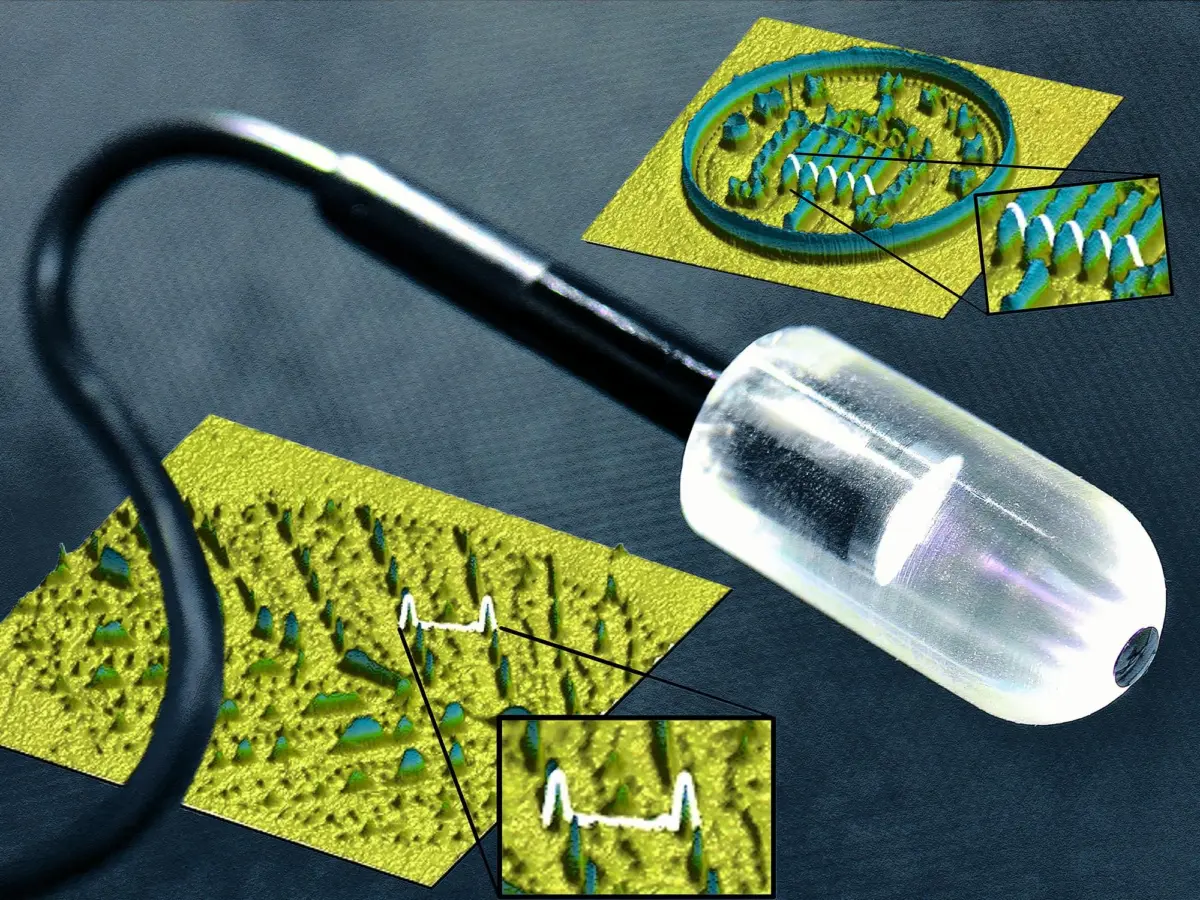
To transition this optical phenomenon into a functional robotic component, the research team constructed a specialized fingertip. The Bragg reflector was securely sandwiched between a rugged, protective outer layer of silicone and a transparent, fingertip-shaped inner core. Embedded directly within this transparent core are a miniature camera and an LED light source.
During operation, light from the internal LED shines forward through the clear polymer. When an external object deforms the fingertip, the underlying Bragg reflector bounces light back toward the embedded camera. The wavelength of this reflected light directly corresponds to the degree of deformation: minimal pressure registers as red, progressively shifting toward green, and culminating in a vibrant blue under maximum deformation.
To maximize the fidelity of this data, the team implemented crucial design adjustments. The exterior silicone layer was tinted black to drastically boost optical contrast, empowering the internal camera to cleanly translate shifting color gradients into precise topographical morphology. Furthermore, the deliberate structural rigidity of the camera housing enhanced localized deformation within the reflector, producing wider, more discernible shifts in reflected wavelengths. Through these optimizations, the resulting sensor achieved an impressive 100-micrometer spatial resolution operating with virtually zero computational latency.
Supporting Context & Metrics: The Engineering Challenges of Tactile Sensing
To understand why this colorful skin represents a paradigm shift, one must examine the fundamental hurdles of robotic touch. Human skin is an engineering marvel, simultaneously processing temperature, micro-textures, sheer forces, dynamic vibrations, and static pressure across the entire hand. Replicating this biological sensory suite in a machine is choked by severe physical constraints.
Space inside a robotic fingertip is fiercely contested. Incorporating multiple discrete sensors—such as capacitive, piezoresistive, or magnetic transducers—demands intricate wiring and dense component packing. This creates a painful engineering compromise: roboticists must constantly weigh spatial resolution against sensor complexity.
"And the answer to that is… that’s a really hard question. No one knows yet," notes Rich Walker, director of Shadow Robot, the United Kingdom’s longest-running robotics company, renowned for developing sophisticated robotic hands. Walker views Carpi’s optical fingertip as a refreshing alternative that expands the design toolkit available to robotic engineers.
While soft materials have been utilized in tactile sensing before—notably by companies like GelSight—Carpi’s technology stands apart due to its ability to extract rich, quantitative metrics regarding depth, strain, and physical dimensions directly from its generated topological maps. Conventional optical tactile sensors typically yield qualitative relative sizing, whereas the Bragg reflector system maps continuous physical deformation at the material level.
This structural philosophy represents a fundamental pivot in sensor design. As Sasso explains, "The core aspect of the sensor is that we’re essentially [moving toward] having the sensing element at the material level. The camera, which is a very highly optimized electronic component, is translating whatever the material is already doing directly into digital signals."
However, industry veterans urge pragmatic caution. Michael Wang, co-founder and chief scientist at Daimon Robotics—a firm specializing in vision-based sensing methodologies—acknowledges the ingenuity of the approach while highlighting perennial challenges in soft robotics: durability and integration.
"The practical and useful benefits, especially in the context of robot hands, remain to be tested and validated," Wang warns. Soft sensors, particularly those relying on silicone elastomers, are notoriously vulnerable to degradation. Repeated friction, environmental wear, and continuous mechanical stress can erode the material, altering its elastic properties and skewing the fidelity of the optical signals.
"Especially if you have the electronics embedded into the material layer itself, that becomes a very challenging engineering problem," Wang adds. "And I haven’t seen [many] good soft electronics materials that really can undergo long periods of usage."
Addressing these durability concerns, the research team emphasizes that their design isolates the delicate optical components. Because the Bragg reflector itself does not make direct frictional contact with external objects, the outer silicone layer serves as a robust protective barrier. Moreover, Sasso and Wang both note that chemical hardening agents and specialized coatings can be applied to the outer silicone sheath to drastically extend its operational lifespan in industrial settings.
Official Statements and Industry Perspectives
The unveiling of the color-sensing robotic finger has generated significant buzz across both academic and commercial robotics circles. Industry leaders recognize that moving away from rigid, point-by-point taxels toward continuous material-level sensing could unlock new dimensions of robotic dexterity.
Rich Walker of Shadow Robot captured the initial industry reaction with characteristic candor:
"To be honest, when they showed us this, we thought it was, and pardon my French, [expletive] cool, because it’s a distinctly different approach."
Walker emphasizes that the constant evolution of tactile sensing is vital for companies striving to build humanoid and dexterous robotic hands capable of operating in unstructured human environments. By offering a lightweight, high-resolution solution that eschews heavy wiring, the European consortium has provided a compelling new avenue for hardware developers.
From the perspective of optical integration, Michael Wang of Daimon Robotics points out that the true test of the technology will lie in its real-world implementation. While vision-based tactile sensing offers robust data streams, integrating a camera directly into a soft, deforming fingertip introduces unique calibration and thermal management hurdles. Nevertheless, Wang supports the exploration of novel physical modalities, noting that breakthroughs often arrive from unexpected intersections of optics and materials science.
Federico Carpi, leading the research initiative at Queen Mary University of London, remains optimistic about the trajectory of the technology. Reflecting on the collaborative nature of the project—which united experts from across the U.K. and Italy—Carpi underscores the clear path from foundational physics to practical deployment.
"There are significant developments that we expect with a clear path toward transition to real world applications," Carpi states.
Future Outlook: Beyond the Robotic Hand
With the foundational sensor architecture successfully proven and optimized in the laboratory, the research consortium is actively preparing for the next phase of development. Conversations are already underway with commercial partners interested in licensing and scaling the technology for industrial deployment.
Beyond standard industrial robotic hands and logistical grippers, the research team has set its sights on more specialized, high-stakes domains. Future iterations of the sensor are being engineered to map objects that do not lie flat against rigid surfaces. This capability could unlock transformative applications in medicine, particularly in the design of advanced surgical instruments.
In minimally invasive procedures, surgeons must often rely on visual cues alone, lacking the nuanced sense of touch necessary to accurately gauge tissue stiffness, detect embedded tumors, or map delicate internal organs. By integrating a high-resolution, color-shifting tactile sensor into surgical probes and catheters, medical robots could provide real-time topological and pressure mapping of biological tissues, drastically improving patient safety and procedural precision.
As the lines between optics, materials science, and artificial intelligence continue to blur, innovations like the color-sensing robot finger demonstrate that the future of robotics may well rely on teaching machines to perceive the physical world not through cold, calculating binary computations, but through a vibrant spectrum of shifting light.
