

Executive Overview
The landscape of domestic automation is undergoing a profound paradigm shift. For decades, the smart home industry has fixated on raw utility: turning off lights, adjusting thermostats, playing music, and executing precise, transactional voice commands. Yet, as modern society becomes increasingly digitized, an alternate crisis has quietly escalated—one defined not by operational inefficiency, but by profound social isolation.
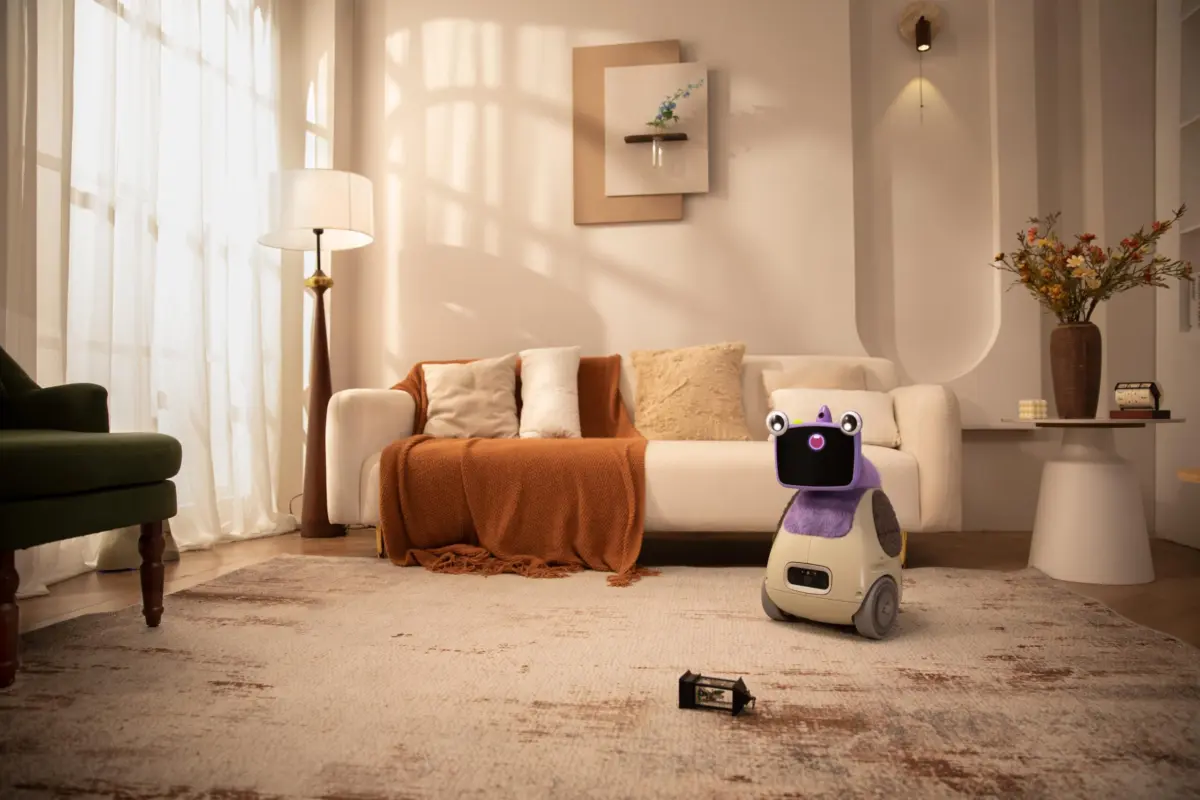
Enter the next generation of artificial intelligence: companion robotics engineered around what industry pioneers term "gentle intelligence." Rather than acting as static tools or task-oriented assistants, these systems are designed to provide persistent, emotionally resonant presence within the domestic sphere. Leading this charge is the OlloNi SS1 by Ollobot, a sophisticated family companion robot that bridges the emotional voids left by traditional communication technologies.
By prioritizing continuous coexistence over cold efficiency, localized edge-AI processing over vulnerable cloud reliance, and organic social bonding over forced human imitation, today’s AI companions are charting a transformative path. As the global AI companion market surges toward multi-billion-dollar valuations, these devices are no longer viewed as transient novelties, but as vital infrastructure for the modern household.
Detailed Chronology: From Novelty Toys to Autonomous Companions
To understand the sophisticated engineering of contemporary companion robots, one must trace the rocky evolutionary arc of the consumer robotics industry over the past decade.
Phase 1: The Initial Wave and the "Shelf-Sitting" Phenomenon (2017–2020)
Around 2017, the consumer market witnessed its first true commercial wave of interactive companion robots. These early units captured the public imagination: they possessed rudimentary personalities, rolled across hardwood floors, told jokes, and responded to vocal cues. Consumers eagerly welcomed them into their living spaces.

However, these pioneering devices were hamstrung by technological limitations. Powered by shallow natural language processing and rigid voice-command scripts, their interactions quickly grew repetitive. Once the initial novelty faded, millions of these units found a permanent home gathering dust on shelves. The fragility of the business models soon followed; as several early robotics startups went bankrupt and shuttered their cloud servers, users experienced a jarring phenomenon—their interactive devices transformed overnight into silent, bricked plastic husks. For many consumers, the experience was unsettlingly reminiscent of losing a pet, exposing the deep psychological vulnerability associated with consumer-level robotic attachment.
Phase 2: The Infrastructure Gap (2020–2024)
During the global shifts of the early 2020s, the societal demand for connection skyrocketed. Technology companies attempted to bridge the gap using standard digital tools: high-definition video conferencing platforms, smart speakers, and text-messaging applications.
Ultimately, these tools failed to solve fundamental isolation because they were built for communication, not presence. Video calls and messaging apps require scheduling, active participation, and cognitive effort. They do not inhabit space; they merely bridge distances episodically.
Phase 3: The Rise of Persistent, Edge-Driven Presence (Present and Beyond)
Today, the robotics industry has moved past the pitfalls of early iterations. Modern AI companion robots are engineered from the ground up using rigorous psychological research, clinical interaction models, and robust multi-chip hardware architectures. Devices like the OlloNi SS1 are designed to occupy physical space organically, adapting to human rhythms over months and years rather than executing isolated, transactional commands.
Supporting Context & Metrics: The Scale of Modern Isolation
The market trajectory of AI companions is driven by urgent socio-demographic realities. Social isolation and loneliness have been classified by health organizations as major public health crises, cutting across generations and economic brackets.

Demographic Realities of Isolation
- The Elderly Population: According to comprehensive public health studies, nearly one out of every three elderly adults resides entirely alone, lacking daily in-person companionship or immediate oversight.
- Globalized Workforces and Children: Research indicates that children whose parents have migrated for extended periods for work—leaving them in the care of relatives—are 2.5 times more likely to experience chronic loneliness compared to children whose parents remain in the home.
- Urban Professionals: Among working-age adults living alone in dense urban environments, subtle yet debilitating patterns of social isolation continue to rise, eroding mental well-being despite outward professional success.
Market Projections
Economic data highlights the explosive demand for technological interventions in this space. According to industry analyses from Grand View Research:
- The global AI companion market was valued at $36.8 billion.
- The sector is projected to expand dramatically from $48 billion to an estimated $318 billion by 2033.
- This trajectory represents a staggering compound annual growth rate (CAGR) of 31 percent from 2026 through 2033, making companion robotics one of the fastest-growing sectors in consumer technology.
Official Statements and Architectural Innovation: Inside the OlloNi SS1
Ollobot’s engineering philosophy marks a distinct departure from historical robotics trends. While much of the robotics industry has historically pursued hyper-realistic human imitation—building machines that speak, look, or behave precisely like people—the SS1 is designed around familiarity, safety, and long-term coexistence.
Multi-Subsystem Parallel Architecture
The OlloNi SS1 integrates several complex subsystems operating simultaneously:
- Visual Perception & Audio Processing: Equipped with a multi-chip AI 4K vision module, the robot supports advanced facial recognition and motion tracking. A 6-microphone array enables omnidirectional voice pickup across a range of up to 5 meters, ensuring reliable wake-word detection and far-field interaction.
- Advanced Indoor Mobility: The system navigates seamlessly across varied domestic surfaces, including hardwood floors, ceramic tiles, and low-pile carpets, with slope-climbing capabilities up to 3.5 degrees. Rather than remaining tethered to a single charging dock, the robot roams autonomously to remain near household members.
- The "Heart Module" Edge AI: To ensure lightning-fast response times and data privacy, much of the heavy AI processing occurs directly on the device. Powered by its proprietary "heart module" architecture featuring 16 GB of memory and 64 GB of local storage, the unit retains household memories and recognizes familiar faces locally.
- Endurance: Designed for all-day availability, the SS1 offers up to 12 hours of standby time and roughly 5 hours of active, continuous interaction on a single charge.
Tailored Household Scenarios
The versatility of the SS1 is best observed across three distinct domestic use cases:
- Elderly Individuals Living Alone: The system blends proactive engagement, fall-detection monitoring, and persistent presence. It addresses physical safety and emotional companionship simultaneously, alleviating the social friction of demanding that family members constantly check in.
- Children of Migrant or Remote Workers: The SS1 acts as a familiar companion attuned to a child’s moods, preferences, and daily routines. Its remote connection features allow working parents to maintain a natural, low-pressure presence without demanding scheduled video calls, while its automated life-recording features offer a comforting window into the child’s day.
- Single Urban Professionals: The robot quietly adapts to erratic daily schedules, builds an organic preference model over time, and delivers an ambient social presence devoid of social demands or expectations.
Nonverbal Communication and the "2+1" Display Model
To foster intuitive connection, the SS1 utilizes a distinctive "2+1" multi-display configuration. Two circular side displays function as expressive "emotional eyes," communicating nonverbal states such as curiosity, contentment, or attentiveness. Meanwhile, a separate primary display handles structured information and functional interactions. This separation allows emotional signaling and operational utility to run concurrently without visual clutter.

Privacy, Security, and Autonomous Documentation
As domestic robots gain the ability to perceive and record their environments, data privacy has become a paramount concern for consumers. Ollobot has addressed these anxieties through a multi-layered security framework.
Localized Memory and Hardware Safeguards
Unlike cloud-tethered smart home devices that constantly upload video feeds to external servers, the SS1 processes visual data primarily on-device. Household memories and facial recognition logs are stored locally within Ollobot’s proprietary ecosystem.
Furthermore, recognizing that software permissions alone can spark user skepticism, the engineering team incorporated a physical mechanical privacy cover for the camera lens. Users can physically block the optical sensor whenever visual monitoring is undesirable, providing absolute peace of mind at the hardware level.
Automated Life Recording and AI Vlogging
For families wanting to preserve spontaneous domestic moments, the SS1 includes an automated life-recording system driven by behavioral-event detection. The robot can autonomously detect moments of shared laughter, play, or family togetherness.
An integrated AI vlog engine then organizes these raw visual captures into professionally edited short-form video montages, complete with automated sequencing and background soundtrack generation. This eliminates the need for users to constantly pull out smartphones or operate intrusive cameras, preserving authentic memories effortlessly.

Future Outlook: The Maturation of "Gentle Intelligence"
The commercial maturation of AI companion robots marks a philosophical turning point in how society builds and integrates technology. We are moving away from an era where humans must constantly adapt to rigid software interfaces, and stepping into a future where technology adapts organically to human lives.
As devices like the OlloNi SS1 run on flexible operating systems with continuous over-the-air (OTA) updates, their capabilities will compound over time. More importantly, their behavioral profiles will diverge based on their environments. Two identical robots placed in two distinct households will, over the course of a year, evolve entirely unique personalities shaped by the distinct habits, voices, and rhythms of the families they serve.
This deep, long-term personalization separates transient technological gadgets from genuine domestic companions. By valuing emotional presence over mere operational utility, modern AI robotics is successfully closing the human connection gap in contemporary homes—ensuring that as our world becomes increasingly digital, our living spaces remain fundamentally human.
To learn more about the future of ambient robotics and family companion technology, visit Ollobot.
