

The landscape of open-weights artificial intelligence has reached a critical inflection point with IBM’s release of the Granite 4.2 reasoning model family. Distributed under the permissive Apache 2.0 license, this new generation marks a foundational shift for the IBM Granite ecosystem. While earlier iterations focused heavily on acting as reliable instruction-following conversational assistants, Granite 4.2 introduces explicit, system-level reasoning capabilities natively baked into every parameter tier.
Available in three distinct dense, decoder-only sizes—3B, 8B, and 30B parameters—Granite 4.2 is pre-trained from scratch on approximately 15 trillion tokens. The training paradigm relies on an intricate, multi-phase methodology that expands the effective context window to 512K tokens (with operational sequence lengths up to 131,072 tokens during inference). Furthermore, the models feature a versatile thinking/non-thinking switch, a low-effort thinking mode designed to conserve computational budgets on simpler tasks, and native tool-calling integrations built directly into the core architecture.
By marrying massive-scale pre-training with a multi-stage reinforcement learning (RL) pipeline that incorporates live, sandboxed agent environments, IBM has positioned Granite 4.2 as a robust challenger in both enterprise automation and complex mathematical and programmatic reasoning.

Detailed Chronology: The Engineering Pipeline
To understand how Granite 4.2 achieves its performance leap, one must examine its end-to-end engineering lineage. The creation of these models was broken down into three major computational epochs: Pre-Training, Supervised Fine-Tuning (SFT), and a multi-environment Reinforcement Learning curriculum.
1. Foundational Pre-Training & Context Extension
The models were trained from scratch across five distinct phases utilizing a cumulative corpus of roughly 15 trillion tokens:
- Phases 1 & 2: Foundational pre-training focusing on core linguistic, mathematical, and programmatic patterns using broad web-scale datasets.
- Phases 3 & 4: Mid-training epochs featuring progressive data annealing, transitioning the model away from raw internet text toward highly curated, premium-quality domain corpora.
- Phase 5: Long-context training extension, scaling the context window out to a massive 512K tokens.
2. Supervised Fine-Tuning (SFT) & Quality Control
The SFT phase transformed the raw base models into structured, safety-aligned assistants through a mixture of approximately 7.2 million samples (translating to ~100B tokens, with ~65B actively trainable). This mixture was split into two primary buckets: Agentic data (31.6%) and Non-agentic data (68.4%).

- Agentic Corpus: Focused on software engineering (69%), tool invocation (12.1%), terminal operations (8.0%), mathematics (3.5%), web search (0.8%), and general action execution (0.2%). Trajectories were harvested from an array of sophisticated harnesses, including OpenHands, SWE-agent, Terminus-2, and OpenCode.
- Non-Agentic Corpus: Encompassed instruction following (18.8%), general coding (18.8%), math (14.6%), multilingual datasets (7.0%), scientific domains (5.4%), reasoning tracks (3.0%), and safety benchmarks (0.8%).
To guarantee data purity, IBM utilized advanced LLM judges (including GPT-OSS-120B and Gemma 4) to filter out hallucinations, malformed tool schemas, and logical inconsistencies. Deduplication was executed globally via SHA-256 hashes across tool and message signatures. For the massive 30B model, an additional Phase 2 SFT was administered, upsampling software engineering and coding trajectories to cement complex development capabilities without eroding prior generalization.
3. The Multi-Stage Reinforcement Learning Curriculum
Rather than relying on a single, monolithic RL pass, IBM implemented a chained, multi-environment RL pipeline utilizing asynchronous GRPO (Group Relative Policy Optimization). Decoupling the generation workers from the training cluster allowed rollouts to continue uninterrupted while optimizer updates streamed downstream.
The curriculum progressed through the following chronological gates:

- RLVR (Reinforcement Learning with Verifiable Rewards): Multiple rounds utilizing ground-truth unit tests, exact-match scripts, and programmatic format checkers to maximize objective accuracy without a KL penalty.
- Skill Boosters: Focused interventions targeting specific shortcomings in instruction following, mathematical reasoning (GPQA), and advanced coding.
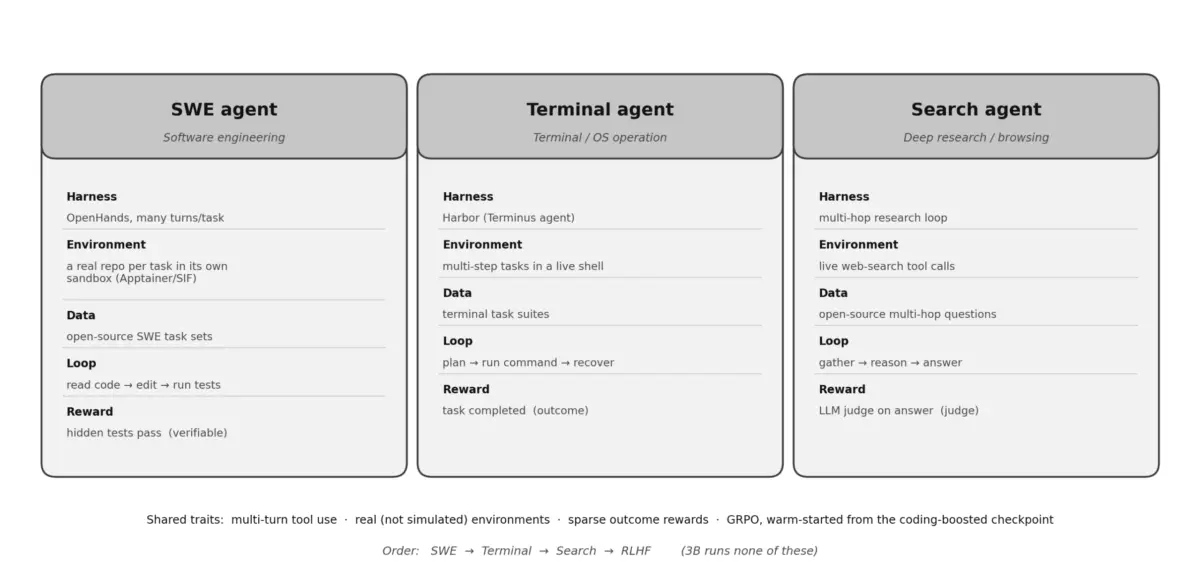
- Agentic RL (8B and 30B models only): A sequential environment block spanning Software Engineering (SWE), Terminal Operations, and Web Search, where models learned to execute multi-turn terminal commands, edit codebases, and retrieve live data inside sandboxed ecosystems.
- RLHF (Reinforcement Learning from Human Feedback): The terminal stage for all models, optimizing for human preference, robust jailbreak resistance, and reasoning-length penalization to curb unnecessary verbosity.
Supporting Context & Metrics
The architectural specifications of the Granite 4.2 family demonstrate a carefully balanced scaling strategy designed to maximize parameter efficiency across edge and data center deployments.
Model Architecture Breakdown
| Component | 3B Dense | 8B Dense | 30B Dense |
|---|---|---|---|
| Embedding Size | 2560 | 4096 | 4096 |
| Number of Layers | 40 | 40 | 64 |
| Attention Head Size | 64 | 128 | 128 |
| Attention Heads / KV Heads | 40 / 8 | 32 / 8 | 32 / 8 |
| MLP Hidden Size | 8192 | 12800 | 32768 |
| Activation Function | SwiGLU | SwiGLU | SwiGLU |
| Position Embedding | RoPE | RoPE | RoPE |
| Max Sequence Length | 131,072 | 131,072 | 131,072 |
Performance Benchmarks
Evaluated across a rigorous suite of industry-standard benchmarks, Granite 4.2 proves exceptionally potent in its respective classes:
- Reasoning (Pass@1): On the prestigious AIME25 mathematical benchmark, the 3B, 8B, and 30B models scored 78.33, 86.67, and 89.17 respectively, demonstrating elite-tier mathematical prowess even at lower parameter counts.
- Agentic Coding: On SWE-Bench Verified, the 8B model achieved 47.67%, while the flagship 30B model reached an impressive 57.00% resolve rate.
- Long Context: Evaluated via RULER at 128K tokens, the 30B model retained an 81.38% comprehension score, validating the efficacy of IBM’s long-context training phase.
Official Statements & Ecosystem Integration
The launch of Granite 4.2 is underscored by a commitment to open infrastructure and seamless interoperability. Because the models natively emit tool calls adhering to the OpenAI function-calling schema and run natively within vLLM and SGLang environments, they bypass the need for custom translation layers.

IBM’s engineering division noted that the integration of NeMo-RL and NeMo-Gym (developed in collaboration with NVIDIA on CoreWeave’s GB200 NVL72 infrastructure) was vital in scaling the agentic RL loops. By treating verification functions, terminal sandboxes, and web search engines as pluggable "Resources," the training pipeline successfully bridged the gap between static text prediction and dynamic, autonomous software engineering execution.
Furthermore, out-of-the-box compatibility with prominent terminal coding assistants—including OpenCode, Pi, and OpenHands—ensures that enterprise developers can immediately deploy Granite 4.2 into local workflows without proprietary software lock-in.
Future Outlook
Granite 4.2 signals a structural evolution in enterprise-grade open-weights artificial intelligence. By introducing tiered reasoning modes (thinking, low-effort, and non-thinking) alongside native agentic trajectories, IBM has addressed the two primary bottlenecks of modern LLM deployment: prohibitive compute costs on simple queries and a lack of reliable autonomy on complex workflows.

As organizations increasingly demand sovereign, auditable models capable of running locally or within private clouds (facilitated by the extensive GGUF, FP8, and FP4 quantization variants released alongside the base models), Granite 4.2 establishes a new benchmark for open reasoning systems. Future developments within the Granite roadmap will likely focus on further compressing agentic RL overhead, expanding multilingual proficiencies beyond the initial 12 supported languages, and pushing the boundaries of autonomous software engineering agents operating in enterprise production environments.
