

Executive Overview
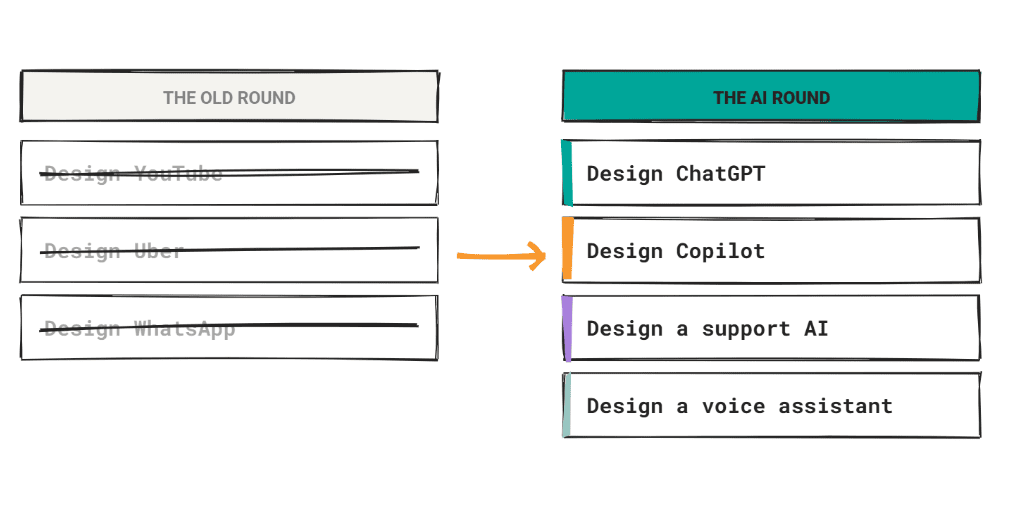
For decades, the standard rite of passage for software engineering candidates meant tackling traditional system design prompts: "Design YouTube," "Design Uber," or "Design WhatsApp." These classic challenges evaluated an engineer’s ability to build deterministic CRUD (Create, Read, Update, Delete) services capable of handling millions of concurrent users, database sharding, caching layers, and low-latency API gateways.
However, the tectonic shifts in software development driven by generative artificial intelligence have permanently altered tech hiring. Today, companies hiring AI Engineers, Applied Scientists, and GenAI Engineers are posing an entirely different set of questions: "Design ChatGPT," "Design a customer support AI," "Design GitHub Copilot," "Design an AI code reviewer," or "Design a legal document assistant."
This evolution highlights a critical industry gap. While thousands of engineers can seamlessly call an LLM API using Python, far fewer possess the architectural prowess required to design the surrounding infrastructure, optimize token consumption, enforce robust guardrails, and defend their engineering trade-offs under high-pressure interview conditions. This comprehensive guide breaks down the structural evolution of AI hiring, examines core architectural primitives, outlines a repeatable seven-step interview framework, and highlights real-world reference architectures to help engineers ace modern AI system design loops.
Detailed Chronology: The Paradigm Shift in Technical Hiring
The rapid maturation of the artificial intelligence job market between 2023 and 2026 fundamentally reshaped engineering recruitment. As large language models (LLMs) transitioned from experimental novelties to core enterprise revenue drivers, organizations rushed to integrate generative capabilities into their software products.
The Rise of the AI Engineer
According to recent workforce analytics, the AI Engineer role has reigned as the fastest-growing job title in the United States technology sector for consecutive years. Industry reports indicate that job postings for specialized AI engineering roles surged by 143% year-over-year entering 2025. LinkedIn data underscores this massive migration of talent, recording more than 75,000 new US-based AI job postings between 2023 and 2025. During the same period, the share of total technology market postings dedicated to AI and machine learning roles skyrocketed from 10% to an unprecedented 50%.
This explosive volume forced hiring managers to abandon legacy machine learning system design questions. Interviewers no longer prioritize deep knowledge of model internals—such as hyperparameter tuning, backpropagation calculus, or custom neural network architectures—because most product teams consume foundational models via APIs or open-weight deployments. Instead, modern interviews focus entirely on AI-first software engineering: how practitioners wrap foundational LLMs into resilient, scalable products, orchestrate complex agentic loops, integrate semantic retrieval mechanisms, and manage operational expenditure.
Supporting Context & Metrics: The Mechanics of AI System Design
Unlike traditional backend software engineering, where systems behave deterministically, AI system design deals with probabilistic, non-deterministic outputs constrained by strict latency budgets and volatile pricing structures.
Core Evaluation Criteria
When hiring managers and principal engineers evaluate candidates on AI system design, they test for specific competencies:
- Navigating Contradictory Pressures: Candidates must balance trade-offs among latency, operational cost, response quality, and user safety when these metrics pull in opposite directions.
- Architectural Justification: Naming components (e.g., "we’ll drop a vector database here") is no longer enough. Strong candidates must articulate why each layer exists and what catastrophic failures would occur if that layer were removed.
- Production-Grade Resilience: Senior-level interview loops typically drill deep into 3 to 5 specific failure modes, exploring past production incidents and operational anomalies rather than skimming a wide breadth of theoretical topics.
Critical Operational Metrics
Modern AI systems operate under severe financial and performance constraints. Consider the arithmetic of enterprise LLM deployment:
- Cost of Frontier Models: Premium, GPT-4-tier models typically cost roughly $10 per million input tokens and $30 per million output tokens, with response latencies ranging between 3 to 5 seconds. An enterprise agent managing 10,000 customer interactions daily—with each conversation averaging 5,000 tokens—can easily rack up token bills exceeding $7,500 per month on a single provider.
- The ROI of Model Routing: Because 60% to 80% of routine user requests can be resolved effectively by smaller, faster, and cheaper models, implementing intelligent model routing (reserving frontier models exclusively for complex reasoning tasks) routinely slashes operational costs by 40% to 70%.
- Hallucination Mitigation: Implementing a comprehensive Retrieval-Augmented Generation (RAG) pipeline cuts baseline model hallucinations by 40% to 71%. When paired with multi-layered guardrails, citation enforcement, and confidence scoring, overall hallucination risk can be suppressed by an astonishing 71% to 89%.
Official Industry Frameworks and Core Primitives
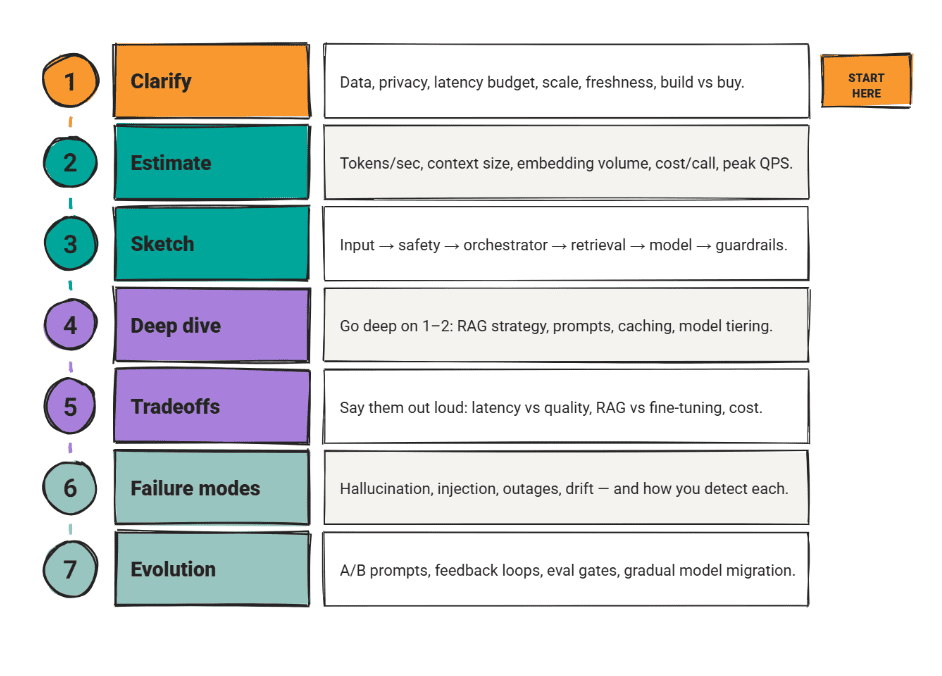
To eliminate the flawed strategy of memorizing isolated answers for dozens of distinct prompts, successful candidates adopt a reusable 7-step system design framework.

The 7-Step AI System Design Framework
- Clarify Requirements and Constraints: Spend the initial minutes defining functional requirements, non-functional targets (latency, concurrency), and strict compliance boundaries.
- Estimate Load and Capacity: Calculate daily active users, peak token throughput, compute requirements, and expected storage volumes for vector databases and logs.
- Sketch High-Level Architecture: Draw the end-to-end data flow from client intake to the orchestration layer, model gateway, and downstream execution environments.
- Deep Dive into Critical Components: Focus intensely on complex subsystems like retrieval pipelines, caching layers, or agentic loops.
- Analyze Trade-offs: Explicitly contrast cost versus accuracy, latency versus thoroughness, and synchronization versus asynchronous processing.
- Plan for Failure Modes & Observability: Address prompt injections, provider outages, data drift, and monitoring metrics.
- Scale and Evolve: Discuss how the architecture adapts to multi-tenant isolation, fine-tuning strategies, and emerging model architectures.
The Five Essential Primitives
Every modern AI system design prompt relies on a core set of modular primitives that engineers must be able to draw, explain, and defend:
- Retrieval-Augmented Generation (RAG): Comprises a query encoder, a dense or sparse retriever fetching a ranked document corpus, and a generator conditioned on both query and context. Production RAG incorporates document chunking strategies, vector embeddings, caching, evaluation logging, and strict data access boundaries.
- Model Routing & Cost Optimization: Intelligent proxies that classify incoming user intents and direct them to the most cost-effective model tier, combining semantic caching, prompt compression, and streaming to preserve margins.
- Guardrails: Dual-layered defenses. Pre-LLM guardrails handle input validation, PII redaction, and prompt-injection shielding. Post-LLM guardrails enforce JSON output schemas, refusal policies, and factual grounding checks.
- Evaluation & Observability: Comprehensive logging frameworks capturing model versions, retrieval metadata, tool traces, latency, and cost per request via prompt hashes. Combines offline LLM-as-judge evaluations with online faithfulness and relevance metrics.
- Agentic Loops: Orchestration patterns for autonomous agents (e.g., coding assistants, research bots) involving request intake, context assembly, reasoning, action validation, sandboxed execution, and state updates.
Future Outlook & Reference Architectures
To stand out in competitive hiring loops, candidates should ground their designs in real-world reference architectures rather than academic abstractions.

Case Study: GitHub Copilot’s FIM Architecture
A prime example of an elite production architecture is GitHub Copilot. Copilot’s integrated development environment (IDE) extension extracts code immediately before and after the cursor, synthesizing contextual signals such as open tabs, local imports, and language metadata to construct a highly targeted prompt.
Utilizing Fill-in-the-Middle (FIM) prompting, Copilot gathers neighboring file paths and structural headers, routing the payload through Azure-hosted infrastructure. FIM provides approximately a 10% relative lift in completion acceptance rates compared to simple prefix-only prompting. Furthermore, GitHub employs secondary scoring models to evaluate code quality and safety asynchronously before displaying suggestions to the developer.

Common Interview Pitfalls to Avoid
Even technically brilliant engineers frequently stumble in AI system design interviews due to avoidable behavioral and architectural mistakes:
- Designing Before Clarifying: Jumping straight into drawing boxes without nailing down functional and non-functional requirements is the single most frequently cited failure in interview debriefs.
- Listing Components Without Reasoning: Mentioning vector databases, rerankers, and guardrails like buzzwords without explaining the systemic consequences of removing them signals shallow understanding.
- Ignoring Cost and Latency: Neglecting token economics and response time boundaries produces incomplete, commercially unviable architectures.
- Omitting Failure Modes: Failing to proactively address hallucinations, adversarial prompt injections, and API rate-limiting leaves glaring holes in your defense.
Conclusion
The evolution of the AI system design interview marks the maturation of generative artificial intelligence as an enterprise engineering discipline. By mastering a repeatable 7-step framework, deeply understanding foundational primitives—such as RAG, model routing, guardrails, evaluation, and agentic loops—and grounding your designs in real-world production architectures, you can transform intimidating prompts into structured, solvable engineering challenges.
