

Executive Overview
The global race to revolutionize supply chain logistics is increasingly taking to the skies, and India is rapidly emerging as a primary crucible for autonomous drone innovation. In a landmark development for the unmanned aerial vehicle (UAV) sector, Airbound—an ambitious three-year-old Indian autonomous drone startup—has successfully secured $37 million in fresh capital. This latest Series A financing round brings the young company’s total cumulative fundraising to nearly $50 million, underscoring intense investor confidence in its radical vision: matching, and ultimately undercutting, the cost of moving goods by road through ultra-efficient aerial transport.
The funding round was spearheaded by prominent venture capital firm Greenoaks, with strategic participation from retail delivery giant DoorDash, high-profile investor Lachy Groom, Lightspeed Venture Partners, and Humba Ventures. This massive capital injection arrives less than a year after Airbound closed an $8.65 million seed round.
Founded in 2023 by then-teenager Naman Pushp—now the company’s Chief Executive Officer—Airbound is attacking one of the most stubborn unit-economic hurdles in aviation: payload-to-weight ratios. Conventional aircraft and traditional delivery drones often expend the vast majority of their energy budget just carrying their own heavy airframes, making high-frequency, short-haul deliveries prohibitively expensive. By inverting this dynamic through proprietary engineering, a radically lightweight rocket-tail architecture, and an uncompromising focus on manufacturing efficiency, Airbound aims to position itself not merely as a regional drone operator, but as the foundational original equipment manufacturer (OEM) for global aerial logistics—the "Boeing of the drone era."
Detailed Chronology
Genesis and Early Milestones (2023)
Airbound was established in 2023 with a singular, disruptive thesis: autonomous aerial delivery will never achieve true mass adoption until the cost of flight drops to parity with terrestrial trucking. Under the leadership of Naman Pushp, the company assembled a lean, highly technical team in Bengaluru, choosing to keep vital research, development, and manufacturing entirely in-house rather than outsourcing core engineering components.
Initial Deployments and Real-World Validation (2024–2025)
Moving quickly from computer-aided design (CAD) models to physical flight testing, Airbound amassed over 13,000 autonomous test and operational flights across the southern Indian technology hub of Bengaluru and the city of Guntur.
A pivotal milestone in the startup’s operational timeline was its partnership with Narayana Health, a major Indian healthcare network. On a dedicated route between healthcare facilities, Airbound deployed a single active drone to transport critical diagnostic samples over a 2.5-mile stretch. While ground transport for such samples typically languishes for three to five hours due to the logistics of batching shipments for trucks, Airbound’s autonomous flight routinely completes the journey in just seven minutes.
Building upon this success, Narayana Health designed its newly opened Banashankari hospital in Bengaluru completely devoid of an on-site diagnostic laboratory or blood bank. Instead, the facility relies entirely on Airbound’s autonomous drone network to bridge the gap with centralized diagnostic labs—a real-world validation of how aerial infrastructure can permanently alter architectural and operational paradigms in healthcare.
The Capital Infusion Wave (Late 2025–2026)
Following its rapid technical validation, Airbound secured an $8.65 million seed round in late 2025 to accelerate its research into ultra-cheap, scalable payload delivery. The momentum carried directly into its recently finalized $37 million Series A round led by Greenoaks, providing the financial runway necessary to scale its engineering output, expand manufacturing infrastructure, and pursue large-scale municipal logistics integration.
Supporting Context & Metrics
Engineering the Future: The Physics of Ultra-Cheap Flight
The core structural bottleneck of the broader drone delivery industry has always been unit economics. Traditional drones are heavy, battery-intensive, and mechanically complex, driving the cost per delivery miles higher than traditional ground couriers.
Airbound’s engineering philosophy directly combats this inefficiency. Traditional aircraft waste massive amounts of energy supporting their own heavy structural weight. Airbound’s answer is to design vertical-flight drones engineered to weigh significantly less than the actual cargo they transport.
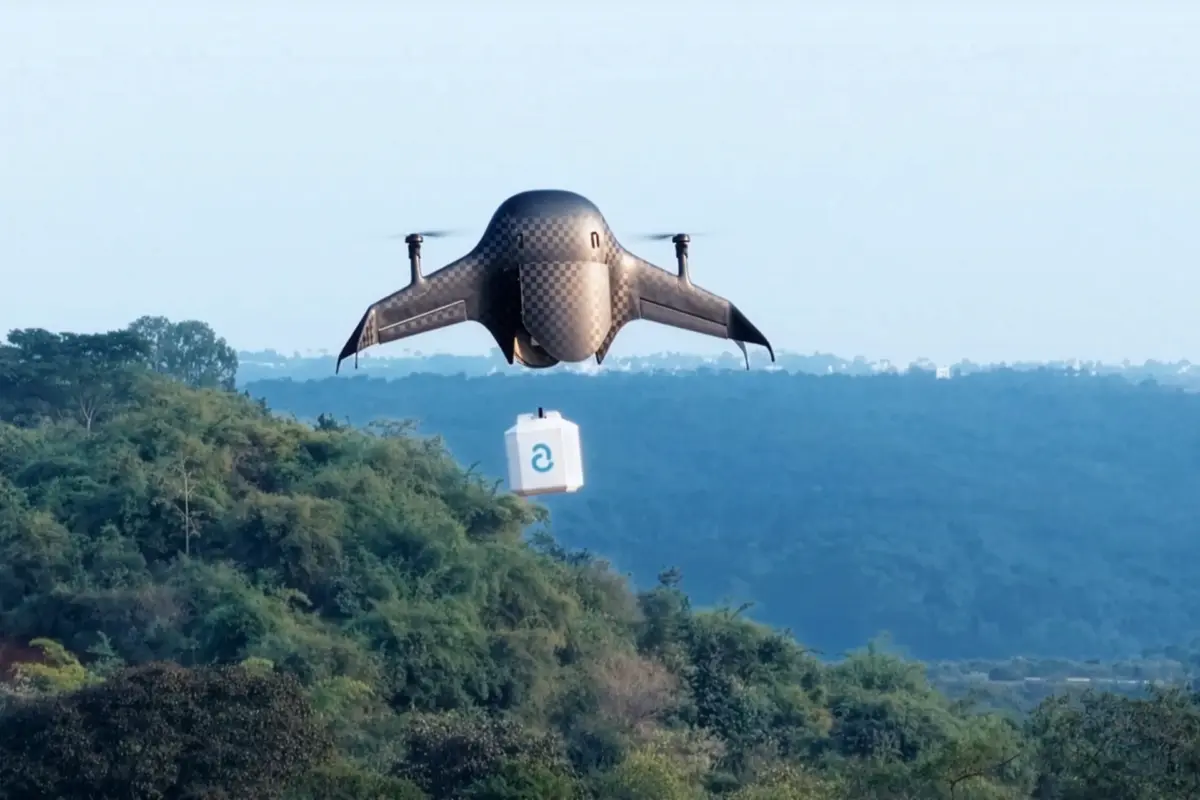
- The TRT Model: Airbound’s current generation drone, designated the TRT, weighs approximately 3.3 pounds (1.5 kg) yet possesses the structural integrity and propulsion power to lift a payload of roughly 2.2 pounds (1 kg).
- Next-Generation Scaling: The startup is actively developing its next-generation aircraft, expected to weigh roughly 6.6 pounds while scaling its carrying capacity up to 11 pounds (5 kg).
- Propulsion and Form Factor: Airbound utilizes a rocket-inspired "tail-sitter" vertical takeoff and landing (VTOL) architecture. The aircraft rests vertically on its tail for liftoff and landing, eliminating the need for traditional runways or expansive launch infrastructure, before seamlessly transitioning mid-air into an efficient horizontal cruise flight.
Manufacturing and Localized Operations
Airbound operates out of a sprawling 43,000-square-foot manufacturing and R&D facility located in Bengaluru. By keeping the fabrication of airframes, avionics, and core flight-control systems in-house, the company maintains strict quality control over its supply chain. While CEO Naman Pushp has opted not to disclose exact output figures or total cumulative aircraft production, he has assured industry observers that manufacturing capacity will not act as a scaling bottleneck as the enterprise expands.
Comparative Market Landscape
The Indian drone ecosystem is bustling with activity, featuring firms such as Skye Air Mobility, TSAW Drones, and Garuda Aerospace developing diverse logistics and agricultural monitoring solutions. However, Airbound has deliberately chosen to differentiate its business model. Rather than focusing exclusively on becoming a consumer-facing delivery brand or courier fleet operator, Airbound’s strategic vision is to supply the underlying hardware.
"We want to build towards a world where everything has cost parity with trucking," Pushp stated, emphasizing the company’s ambition to function as an industry-standard aircraft provider akin to major commercial aviation manufacturers.
Official Statements & Industry Perspectives
The rapid ascent of Airbound has drawn keen attention from top-tier venture capitalists and logistics strategists who view the company’s payload-to-weight optimization as a potential industry inflection point.
Reflecting on the overarching business strategy, CEO Naman Pushp elaborated on the company’s long-term worldview during interviews regarding the $37 million Series A deployment:
"We want to build towards a world where everything has cost parity with trucking. The goal is to be a giant in a few decades, not to make revenue as soon as we can."
Addressing the structural identity of Airbound within the global aviation hierarchy, Pushp highlighted the firm’s ambition to avoid competing directly with retail operators:
"That’s the Boeing role — the aircraft airlines everywhere rely on, not the airline itself."
Industry analysts point out that while consumer sentiment and venture capital enthusiasm around drone delivery experienced a cooling-off period globally following early over-promises, startups that successfully solve the fundamental unit economics—bringing operational costs down to literal cents per package—will unlock trillions of dollars in urban and rural supply chain efficiencies. The backing of DoorDash and Greenoaks indicates that major consumer delivery networks see immense strategic value in integrating ultra-lightweight, runway-independent VTOL technology into their future fulfillment loops.
Future Outlook & Strategic Horizons
The Three-City Andhra Pradesh Network
Looking ahead, Airbound’s most aggressive commercial milestone is its unfolding partnership with the state government of Andhra Pradesh. The startup has signed a landmark framework agreement to design and deploy an extensive drone logistics network connecting three major cities across the state.
This ambitious initiative targets a staggering throughput of up to 10,000 commercial flights per day, servicing a hybrid mix of retail, e-commerce, and healthcare deliveries. Achieving this volume will require an active fleet ranging between 250 and 1,000 operational aircraft, depending heavily on average route lengths, though company projections lean toward an initial deployment closer to 250 units.
Crucially, the agreement does not rely on direct government subsidies or traditional procurement contracts. Instead, the Andhra Pradesh government is collaborating directly with Airbound to formulate and streamline the progressive regulatory frameworks required to support high-density, automated aerial logistics corridors. Revenue for the network will be generated organically by commercial enterprises utilizing the infrastructure for their day-to-day shipping needs.
Navigating Regulatory and Commercial Frontiers
Despite robust technological readiness and substantial financial backing, Airbound acknowledges that the path to ubiquitous commercial deployment is fraught with challenges. The most formidable barrier facing the company is not hardware engineering or manufacturing velocity, but regulation.
Specifically, obtaining widespread regulatory certifications for Beyond Visual Line of Sight (BVLOS) operations remains a prerequisite for scaling automated delivery networks across municipal and regional boundaries. Because regulatory frameworks for autonomous urban air mobility are still maturing globally, Airbound remains largely pre-revenue despite employing a skilled workforce of over 150 personnel.
Nevertheless, leadership remains entirely unfazed by short-term monetization pressures. Armed with nearly $50 million in total funding, a robust technological roadmap, a proven healthcare deployment track record, and deep-pocketed institutional backing, Airbound is methodically laying the structural groundwork to transform low-cost aerial logistics from speculative science fiction into an everyday economic reality.
