

Executive Overview
In the rapidly evolving landscape of generative artificial intelligence, the ultimate bottleneck for large language model (LLM) deployment has long ceased to be pure computational capacity. Instead, it is a hardware-bound constraint rooted deep within memory bandwidth architectures.
During the text generation or "decode" phase, an LLM must continuously stream its entire weight matrix from dynamic random-access memory (DRAM) into static random-access memory (SRAM) for every single token produced. This memory-bound paradigm creates a frustrating ceiling on interactive user experiences, leaving powerful models bottlenecked by hardware data transfer speeds rather than raw logic processing.
To address this challenge, Liquid AI has officially released DSpark draft model checkpoints for three foundational models within its LFM2.5 family: LFM2.5-1.2B-Instruct, LFM2.5-2.6B, and LFM2.5-8B-A1B.
By introducing a sophisticated speculative decoding path that trades a negligible increase in memory footprint for dramatic, exponential decoding speedups, Liquid AI has achieved a technological breakthrough. Crucially, this performance enhancement is delivered without compromising output quality or accuracy.
Out-of-the-box support for industry-standard deployment frameworks like llama.cpp and SGLang means developers can immediately deploy these optimized checkpoints across diverse hardware ecosystems—ranging from enterprise-grade NVIDIA H100 GPU clusters down to localized edge devices like the M4 Max MacBook Pro.
Detailed Chronology & Technical Architecture: How DSpark Works
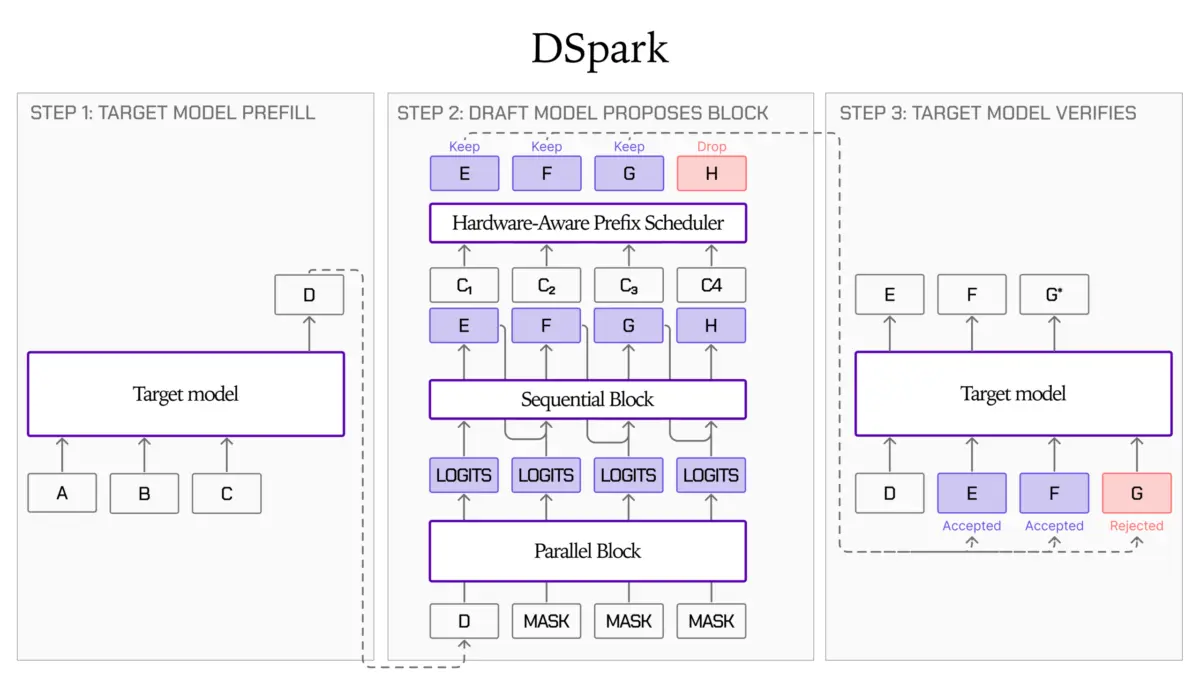
Speculative decoding has emerged as one of the most promising methodologies for mitigating the memory-bound nature of the LLM decode phase. The traditional approach relies on a lightweight "draft" model to rapidly generate a sequence of candidate tokens. Subsequently, the primary "target" model evaluates and verifies these candidates in a single, highly parallelized forward pass. By validating multiple tokens simultaneously, the system amortizes the heavy cost of loading weight matrices across an entire batch of verified text.
Over the past year, the artificial intelligence community has iterated rapidly on speculative architectures, moving from foundational frameworks to highly specialized models like EAGLE-3 and DFlash. Building upon this lineage, the new DSpark framework synthesizes three advanced architectural components to streamline generation.
The Training and Architectural Recipe
To construct the LFM2.5 DSpark checkpoints, Liquid AI adopted the core DSpark training recipe while augmenting it with a vastly expanded, highly diverse training data mix. This mix spans Supervised Fine-Tuning (SFT), general chat logs, complex programming code generation, and multi-turn function-calling datasets.
Extensive ablation studies conducted by the engineering team led to the selection of simplified, attention-only draft models featuring five specialized layers alongside a block size configuration of nine. Rather than selecting model checkpoints based on the lowest training loss—which can sometimes overfit the drafter to superficial patterns—Liquid AI evaluated all checkpoints across 15 full training epochs, ultimately selecting the iteration that yielded the highest token acceptance rate.

The resulting draft models are remarkably lightweight, hovering around ~300M parameters each. Below is the precise parameter breakdown across the LFM2.5 DSpark model components:
| Component | LFM2.5-1.2B-Instruct | LFM2.5-8B-A1B | LFM2.5-2.6B |
|---|---|---|---|
| Decoder Stack (5 layers) | 241.2M | 241.2M | 241.2M |
| Hidden-state Projection | 21.0M | 21.0M | 21.0M |
| Markov Head | 33.6M | 65.5M | 65.5M |
| Norms + Confidence Head | 27.5k | 27.5k | 27.5k |
| Total Parameters | 295.7M | 327.7M | 327.7M |
Guaranteeing Quality Parity
A persistent concern among machine learning engineers adopting speculative decoding is whether acceleration introduces degradation in reasoning capabilities or exact-match accuracy. DSpark solves this through strict mathematical verification rules.
Under greedy decoding paradigms, a draft token is accepted exclusively if it matches the target model’s precise probability distribution. If the target model rejects a proposed token, its own calculated token immediately takes its place in the sequence. Consequently, the final emitted text sequence is mathematically identical to baseline greedy decoding by construction. Standard benchmark metrics—such as pass@1 and exact-match scores—remain entirely uncompromised.
Supporting Context & Quantitative Performance Metrics
Liquid AI’s rollout features native, day-one support for two major inference backends: llama.cpp (utilizing an official codebase integration coupled with experimental Metal kernels for Apple Silicon) and SGLang (built directly on top of the upstream SGLang DSpark implementation).
To rigorously evaluate real-world performance, Liquid AI benchmarked the models across five distinct datasets—MATH500, HumanEval, MBPP, GSM8K, and MT-Bench—utilizing a block size of 9, a batch size of 1, and a temperature setting of 0. Testing was split between a cloud-tier NVIDIA H100 80GB GPU (running BF16 precision) and an edge-tier M4 Max MacBook Pro (running FP16 GGUF weights with up to 256 output tokens).
1. LFM2.5-2.6B Performance
For the mid-tier LFM2.5-2.6B model, speedups on edge hardware are exceptionally pronounced. On the M4 Max MacBook Pro, throughput scales into a regime that drastically outpaces standard proprietary cloud infrastructure. Furthermore, in complex multi-tool scenarios, DSpark slashes overall execution latency by an average of 57%.
| Dataset | Acceptance Rate (out of 10) | Speedup on H100 (BF16) | Speedup on M4 Max (FP16 GGUF) |
|---|---|---|---|
| MATH500 | 5.42 | 3.06x (326 → 1000 tok/s) | 2.25x (61 → 137 tok/s) |
| HumanEval | 4.54 | 2.56x (326 → 835 tok/s) | 2.63x (61 → 161 tok/s) |
| MBPP | 4.71 | 2.64x (326 → 861 tok/s) | 2.11x (62 → 132 tok/s) |
| GSM8K | 4.32 | 2.22x (312 → 693 tok/s) | 2.36x (60 → 143 tok/s) |
| MT-Bench | 5.07 | 2.87x (325 → 933 tok/s) | 1.99x (62 → 123 tok/s) |
| Mean | 4.81 | 2.67x (323 → 864 tok/s) | 2.27x (61 → 139 tok/s) |
2. LFM2.5-1.2B-Instruct Performance
The smaller 1.2B instructor variant demonstrates substantial variance in dataset acceptance rates, leading to performance speedups that fluctuate by up to 52% depending on the semantic distribution of the underlying text. Nonetheless, average throughput gains remain impressive across both local and server environments.
| Dataset | Acceptance Rate (out of 10) | Speedup on H100 (BF16) | Speedup on M4 Max (FP16 GGUF) |
|---|---|---|---|
| MATH500 | 6.02 | 2.56x (668 → 1712 tok/s) | 2.62x (140 → 366 tok/s) |
| HumanEval | 5.31 | 2.26x (664 → 1499 tok/s) | 2.87x (136 → 389 tok/s) |
| MBPP | 5.52 | 2.37x (667 → 1578 tok/s) | 2.74x (137 → 375 tok/s) |
| GSM8K | 4.34 | 1.67x (624 → 1041 tok/s) | 2.73x (140 → 381 tok/s) |
| MT-Bench | 3.90 | 1.66x (657 → 1091 tok/s) | 1.72x (137 → 237 tok/s) |
| Mean | 5.02 | 2.10x (656 → 1384 tok/s) | 2.54x (138 → 350 tok/s) |
3. LFM2.5-8B-A1B Performance
Interestingly, while the Mixture-of-Experts (MoE) LFM2.5-8B-A1B model achieves remarkably high token acceptance rates—peaking at over 8.5 on MT-Bench—on-device edge speedups are temporarily bounded to an average 18% improvement. Liquid AI attributes this performance gap to current architectural limitations within the MoE implementation of llama.cpp‘s Metal backend. Verifying multiple candidate tokens simultaneously activates a wider array of mixture experts, temporarily increasing weight traffic overhead on local unified memory architectures compared to standard single-step decodes.
| Dataset | Acceptance Rate (out of 10) | Speedup on H100 (BF16) | Speedup on M4 Max (FP16 GGUF) |
|---|---|---|---|
| MATH500 | 8.27 | 3.18x (428 → 1362 tok/s) | 1.21x (93 → 112 tok/s) |
| HumanEval | 7.02 | 2.58x (426 → 1100 tok/s) | 1.12x (91 → 101 tok/s) |
| MBPP | 6.93 | 2.64x (426 → 1122 tok/s) | 1.09x (89 → 97 tok/s) |
| GSM8K | 4.02 | 1.29x (385 → 496 tok/s) | 1.44x (90 → 129 tok/s) |
| MT-Bench | 8.52 | 3.02x (426 → 1288 tok/s) | 1.04x (87 → 90 tok/s) |
| Mean | 6.95 | 2.54x (418 → 1074 tok/s) | 1.18x (90 → 106 tok/s) |
Implementation & Integration Guide
Deploying the LFM2.5 DSpark models into production workflows requires minimal friction thanks to direct integrations with SGLang and llama.cpp.

Deploying with SGLang
To initialize a server utilizing SGLang with native DSpark support, developers can execute the following command structure via the official repository PR #31041:
python -m sglang.launch_server
  --model-path LiquidAI/LFM2.5-2.6B
  --speculative-algorithm DSPARK
  --speculative-draft-model-path LiquidAI/LFM2.5-2.6B-DSpark
  --speculative-draft-attention-backend flashinfer
  --disable-radix-cache --mem-fraction-static 0.75 --port 30000
Once initialized, applications can query the standard OpenAI-compatible API endpoint hosted at http://localhost:30000/v1. The system automatically extracts block size configurations directly from the draft model’s config.json.
Deploying with llama.cpp
For local inference and edge deployments using llama.cpp (PR #27383), servers can be spun up using sidecar metadata configurations:
llama-server -m LFM2.5-2.6B-F16.gguf
  -md LFM2.5-2.6B-DSpark-F16.gguf
  --spec-type draft-dspark --spec-draft-n-max 10 --spec-draft-n-min 0
  -fa on -ngl 99
Because speculative verification is fully deterministic, standard greedy output remains completely unblemished, while real-time diagnostic performance data is surfaced directly via response timings (draft_n versus draft_n_accepted).
Future Outlook & Industry Implications
The release of the LFM2.5-DSpark model family marks a significant maturation point for efficient AI inference engineering. By proving that lightweight, attention-only draft models can deliver over a 3x throughput multiplier on high-end server accelerators like the NVIDIA H100—while simultaneously driving local hardware interactions to unprecedented speeds—Liquid AI has established a new benchmark for model optimization.
Looking forward, the implications for enterprise applications and local edge computing are profound. As backend software frameworks continue to optimize memory traffic handling for Mixture-of-Experts (MoE) architectures on consumer-grade unified memory, edge speedups for models like LFM2.5-8B-A1B are expected to catch up to their cloud-tier counterparts.
Developers can access the complete suite of DSpark draft model checkpoints immediately via Hugging Face in both Safetensors and optimized GGUF formats. As the ecosystem adopts these tools, the boundary between cloud-level responsiveness and localized offline intelligence continues to dissolve.
Citation
For academic research or professional engineering references, please cite this work as follows:
@articleliquidAI2026dspark,
  author = Liquid AI,
  title = LFM2.5-DSpark: Up to 3.2x Faster Inference from H100 to MacBook,
  journal = Liquid AI Blog,
  year = 2026,
  note = www.liquid.ai/blog/lfm2.5-dspark,
