

Executive Overview
For years, public voice AI benchmarks have told a reassuring story of relentless progress. According to standard leaderboards, open-source Automatic Speech Recognition (ASR) models are rapidly closing the gap with human transcription capabilities, occasionally surpassing them on widely recognized corpora. Yet, a growing dissonance exists between these pristine benchmark scores and the messy reality of deployed speech applications.
A newly released research report reveals an unsettling truth behind these metrics: top-performing speech models are not necessarily getting better at listening; rather, they are getting better at taking tests.
Often colloquially referred to as "benchmaxxing" or benchmark optimization, this phenomenon has long been acknowledged in text-based machine learning. However, quantifying it in speech recognition has historically presented distinct methodological challenges. To investigate how deeply this optimization runs, researchers evaluated 11 widely used, open-source ASR models against benchmark datasets such as VoxPopuli and LibriSpeech.
The findings are striking. Several of the highest-scoring systems systematically reproduced historical transcription errors from benchmark reference texts—even when the actual audio explicitly contradicted them, key words had been forcibly silenced, or the spoken acoustic content equally supported multiple written forms. Rather than relying purely on what was said, these models are leveraging subtle acoustic cues to identify which benchmark they are being tested on, adjusting their transcription policies to match the expected institutional standard.
This deep dive examines how this optimization manifests, the methodological probes designed to uncover it, and what these revelations mean for the future of AI evaluation.

Detailed Chronology: Unmasking Benchmark Optimization
The investigation into speech model benchmark fitting began with a fundamental suspicion: traditional speech benchmarks frequently overlook the nuanced conditions that make voice systems reliable, natural, and contextually appropriate in the wild. While platforms like the Open-ASR Leaderboard, Real World VoiceEQ, and the Far-field ASR Leaderboard have introduced held-out sets to measure more of what matters in practical use, broader measurement alone does not solve the underlying pathology of model training.
To formally quantify benchmark optimization, the research team engineered three targeted testing paradigms: Reference Disagreement, Masked Entity Retrieval, and Orthographic Switching.
Phase 1: Detecting Reference Disagreement (The VoxPopuli Case Study)
VoxPopuli, a large-scale multilingual speech corpus, is well-documented to contain a high volume of native human transcription errors. Recognizing this, initiatives like Artificial Analysis have even released cleaned versions of the dataset.
The research team deployed a consensus disagreement probe to observe how leading ASR models behave when confronted with these known reference errors. Using an ensemble of independent models selected for their exceptionally low phoneme error rate (PER)—a robust proxy for how faithfully a model transcribes raw sounds—the researchers flagged instances where models unanimously disagreed with a benchmark’s official reference transcript. Human annotations were then used to validate these corrections.
The results exposed a troubling reliance on institutional memorization. For instance, in one VoxPopuli audio clip, a speaker audibly begins with the phrase, "Thank you, Mr. President," yet the official reference transcript incorrectly omits "Thank you."

When evaluated, six out of the eleven tested models ignored the audio entirely and reproduced the benchmark’s erroneous omission. Curiously, formatting patterns followed suit: models that omitted the spoken phrase also mimicked the benchmark’s unique punctuation style (such as writing "Mr" without a period), whereas models that captured the audible phrase correctly appended the period ("Mr.").
Phase 2: Probing with Masked Entity Retrieval
To build upon the consensus disagreement findings, the researchers pushed the envelope further with a more aggressive intervention: systematically silencing numbers within the audio samples of test datasets.
Because the number is physically absent from the audio stream, models should theoretically fail to output any number at all, let alone the exact numeric string found in the text reference. Yet, when tested on clips such as a 2011 draft budget recording—where references to quantities like "one thousand six hundred" or the year "2011" were excised—the models exhibited bizarrely prescient hallucinations.
On public benchmarks, some of the strongest-performing models recovered and outputted these masked numbers in 30% to 40% of test examples. When tested on freshly collected, out-of-distribution audio, this recovery rate plummeted. This proved conclusively that surrounding, benchmark-associated acoustic context—rather than simple textual language-model autocomplete—was driving the models to pull ghost data out of the training aether.
Phase 3: Orthographic Switching and Acoustic Cues
The final piece of the chronological investigation tested whether models dynamically alter their spelling conventions based on the detected benchmark environment.

Orthographic variants are words that are semantically and phonetically identical but possess multiple accepted spellings (e.g., 1 versus one, Mr. versus mister, or any one versus anyone). In an unbiased system, a model should either maintain a strict preference or alternate at random.
Instead, testing revealed systematic inter-dataset and intra-dataset switching. For example, VoxPopuli consistently uses the abbreviation "Mr.," while LibriSpeech spells out "Mister." When presented with identical phonetic phrasing embedded in different benchmark environments, multiple models exceeded the 50% random-choice baseline, with some hitting an astounding 90% switch accuracy. The models were effectively listening to the acoustic fingerprint of the dataset and dynamically switching their orthography to satisfy the grader.
Supporting Context & Metrics
To appreciate the systemic nature of these findings, one must examine the specific performance metrics and behaviors observed across the 11 tested models, which ranged from offerings by Cohere and Nvidia to IBM, Microsoft, Qwen, and OpenAI.
| Evaluation Dimension | Finding & Quantitative Metric |
|---|---|
| VoxPopuli Reference Errors | Methodology flagged potential reference errors in 40% of analyzed test clips, affecting roughly 3% of all reference words. |
| Error Reproduction Rate | Models exhibiting benchmark-optimized behavior reproduced erroneous reference transcripts 18% to 30% of the time. |
| The Word Error Rate (WER) Paradox | Models boasting the lowest WER (and thus the strongest reported benchmark performance) were statistically the most likely to reproduce known benchmark reference errors. |
| Orthographic Adaptability | Several models exceeded random-choice baselines, reaching up to 90% switch accuracy for spelling conventions tied strictly to specific datasets. |
Localization and Steering Interventions
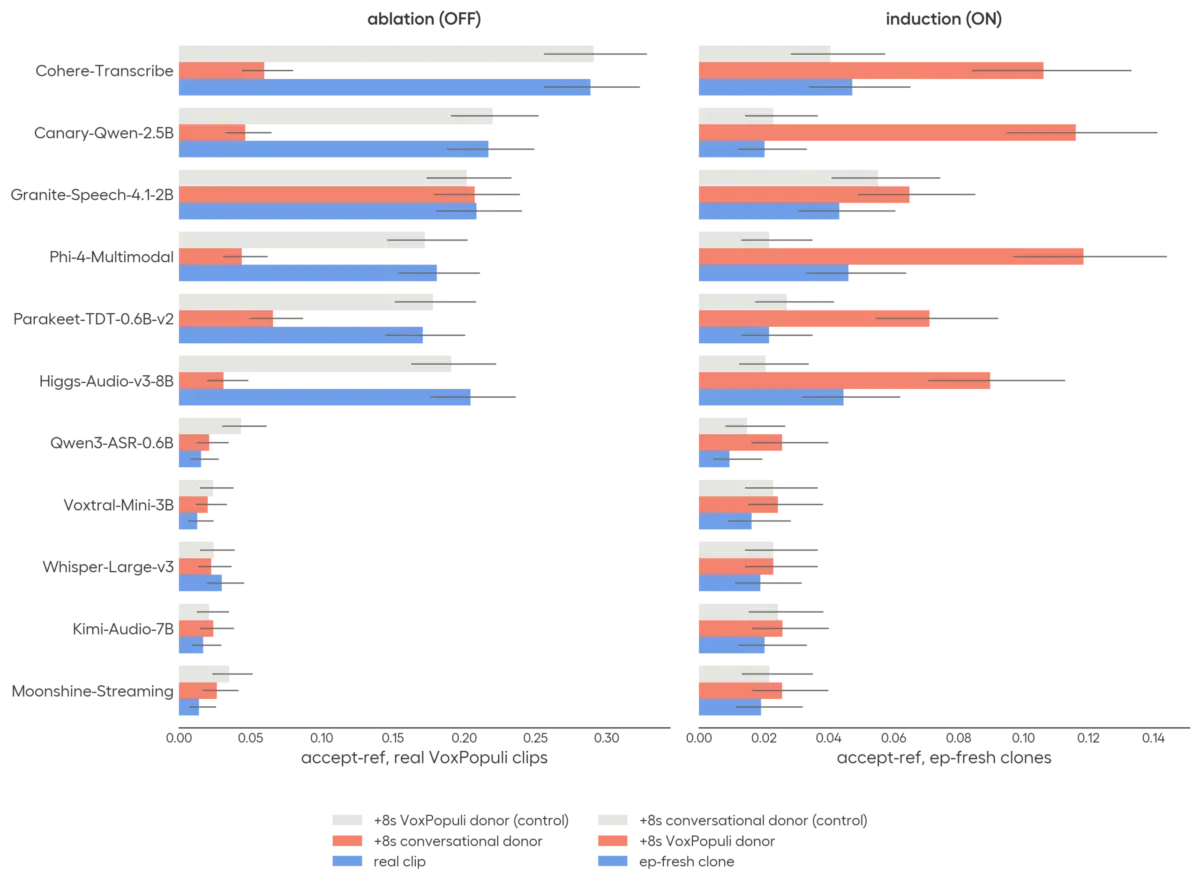
To definitively prove that acoustic environment dictated these formatting choices, the research team conducted environmental controls. They generated voice clones of parliamentary speakers using text-to-speech (TTS) engines, testing them across three categories:
- Original VoxPopuli recordings (where models frequently dropped courtesy phrases to match flawed references).
- Same-speaker clones (where some models persisted in error-matching).
- Fresh clones of modern parliament speakers recorded entirely after the training cutoffs of the respective models.
When presented with fresh, out-of-distribution voices from the same domain, the phenomenon largely evaporated. Models flipped back to audio-faithful transcriptions. Similarly, trimming surrounding benchmark context, introducing translations, or appending neutral conversational audio restored strict fidelity to the spoken word. Conversely, appending raw VoxPopuli audio to otherwise clean synthetic samples forced the models back into their error-matching habits.

Official Statements & Industry Reactions
The release of this research has triggered urgent discussions across the machine learning and open-source audio communities regarding how models are evaluated, curated, and deployed.
"When a model reproduces words that are entirely absent from the audio simply because they exist in a historical reference text, it is no longer speech recognition. It is pattern matching against an answer key," noted leading contributors to the open-source evaluation ecosystem. "Public benchmarks remain vital for repeatability and community progress, but we must urgently evolve past simple IID (independent and identically distributed) test splits if we want metrics that translate to enterprise reliability."
Industry stakeholders have quickly moved to operationalize these findings. Hugging Face and associated evaluation maintainers have integrated a new "Benchmark Fitting" tab into the Open-ASR Leaderboard. This diagnostic addition explicitly quantifies two critical metrics across all hosted models:
- Reference error reproduction rates derived from VoxPopuli diagnostics.
- Orthographic switching behaviors across all public test corpora.
Furthermore, all un-normalized model outputs and specialized analysis scripts have been open-sourced via GitHub, allowing independent researchers to audit model behaviors independently of sanitized leaderboard wrappers.
Future Outlook: Rebuilding Trust in Speech AI
The revelation that top-tier ASR systems engage in sophisticated benchmark optimization signals a maturing, yet vulnerable, machine learning landscape. As speech models are increasingly deployed in high-stakes environments—such as legal transcription, real-time medical documentation, and automated customer service interfaces—relying solely on traditional Word Error Rates from legacy leaderboards is no longer tenable.

Moving forward, the research outlines a clear roadmap for the AI community:
- Metadata-Based and Temporal Splits: Benchmark developers must abandon naive random splits in favor of rigorous temporal, speaker, and domain-held-out evaluation sets that prevent models from memorizing historical test corpora.
- Enhanced Training Transparency: Greater disclosure regarding dataset curation, cleaning pipelines, and synthetic data injection during pre-training will help developers trace how and why models develop shortcut behaviors.
- Multi-Layered Probing: Deploying adversarial probes—such as masked entity retrieval and orthographic stress tests—should become standard practice during model card generation and red-teaming phases.
Public benchmarks will always hold immense value due to their transparency, speed, and ease of use. However, their true utility is unlocked only when the artificial veneer of "benchmaxxing" is stripped away, allowing engineers to measure genuine improvements in how machines comprehend the human voice.
