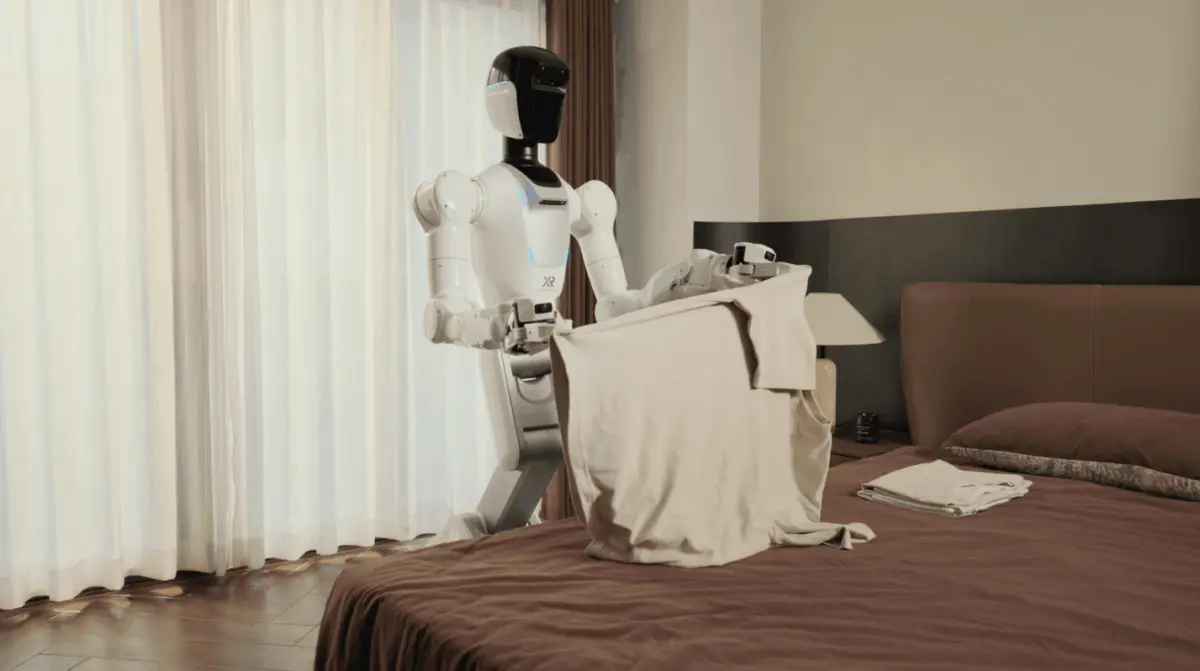
While large language models (LLMs) unlocked a universal framework for digital artificial intelligence—where pretraining on broad datasets predictably yields generalized capabilities—robotics has long struggled to find its equivalent "recipe." For decades, physical robotic systems have been engineered as fragmented assemblies of disconnected perception, planning, and control modules. These siloed architectures rarely aggregate into a cohesive intelligence that a robot can seamlessly transfer from one complex task to another, or from one mechanical chassis to a completely different machine.
Entering this high-stakes frontier is X Square Robot, a prominent Chinese embodied-AI enterprise that has made an unusually explicit, bold wager: the definitive recipe for general-purpose robotics is an integrated, end-to-end foundation stack. This architecture spans the foundational interaction data a robot learns from, an advanced world model predicting real-world physical dynamics, and an action model unifying perception, planning, reasoning, and decision-making to execute tangible mechanical behaviors. Moreover, the company maintains that this entire technological stack must be openly built, validated, and released to the global research community.
With a soaring valuation now surpassing 20 billion yuan (approximately US $2.9 billion), X Square Robot reflects the surging investor confidence in scalable training infrastructure, robust data pipelines, and unified foundation models as the ultimate long-term differentiators in embodied AI. As the company opens up its source code and proprietary world models for public scrutiny, the robotics community stands at a pivotal crossroads, shifting from isolated laboratory demonstrations toward scalable, dependable real-world deployment.
Detailed Chronology & Technological Evolution
The journey toward a unified embodied-AI stack did not happen overnight; it is the culmination of several parallel computing and algorithmic trends maturing simultaneously.
Phase One: The Convergence of Modalities
Historically, roboticists treated vision, language, and physical control as entirely distinct computational problems. However, the maturation of multimodal foundation models over the past several years changed the equation. It finally became computationally feasible to model what a robot sees, what language instruction it receives, and how its motor actions alter the physical environment within a single, unified architectural framework. Compute clusters and distributed training infrastructure finally reached the scale required to process long-horizon, multi-embodiment data streams.
Phase Two: Redefining Data Collection via Human Skill Transfer
Recognizing that data—rather than sheer parameter count—is the ultimate bottleneck for general-purpose robotics, X Square Robot disrupted conventional data collection methodologies. Traditional teleoperation forces human operators to control robots directly within the constraints of the machine’s specific kinematics, latency parameters, and camera viewpoints. This results in demonstrations that are inherently slower, stiffer, and severely restricted in diversity.
To bypass this expensive scaling law, the company developed the QUANXTA Zero Series, utilizing its Universal Manipulation Interface (UMI) data collection system. Instead of teleoperating hardware, human demonstrators wear a wearable rig equipped with custom dual grippers. This approach captures genuine human dexterity—focusing on contact dynamics, timing, finger coordination, and error recovery—before any behavior is compressed onto a specific robotic embodiment.
Phase Three: Engineering for Quality Over Scale
Rather than accepting raw recorded trajectories at face value, X Square Robot instituted a rigorous closed-loop inspection process characterized by physical playback. A statistical sample of recorded trajectories is replayed directly on a physical robot. Only those runs that successfully and cleanly complete the task are marked as valid data.
For instance, if a mechanical gripper closes a fraction of a second too early—pushing an object away while technically executing a "grasping" motion—it is filtered out of the dataset. By combining a vast volume of cost-effective, robot-free human demonstrations with a sparse anchor of high-quality real-robot data, the company achieves performance comparable to purely robot-collected datasets at roughly one-twentieth (1/20) of the collection cost.
Phase Four: The Architectural Split of WALL-WM and Wall-OSS-0.5
With clean data secured, X Square Robot deployed its proprietary architecture: the World Unified Model. This framework orchestrates two complementary yet independent model families sharing a unified codebase:
WALL-WM (World Model): Replaces fixed-duration time windows with action-grounded semantic events (e.g., reaching, grasping, placing), coupling a text-to-video backbone with a freshly initialized action network.
Wall-OSS-0.5 (Action Model): A vision-language-action (VLA) model designed to execute complex robotic trajectories before any task-specific fine-tuning occurs, ensuring that pretraining yields genuine, transferable mechanical intelligence.
Supporting Context & Metrics
Evaluating the validity of X Square Robot’s claims requires examining the specific engineering metrics and architectural choices underpinning their technology stack.
~85% data-validity rate; reduces data collection costs by ~20x compared to standard teleoperation.
X-Tokenizer
Semantic interface mapping continuous motion to discrete tokens aligned with language features.
High stability against noise; enables cross-embodiment transfer without retraining.
WALL-WM
Event-driven world modeling coupled with a text-to-video visual prior.
Supports both variable-length long-horizon reasoning and fixed-length real-time control chunks.
Wall-OSS-0.5
Joint optimization of discrete action tokens, language grounding, and continuous control.
Capable of zero-shot real-robot execution prior to downstream task fine-tuning.
The Mechanics of X-Tokenizer
A major hurdle in cross-embodiment learning is that robotic hardware varies wildly in control frequency, mechanical compliance, latency, and actuator precision. X Square Robot tackled this via the X-Tokenizer. While conventional systems convert continuous motion into discrete tokens that text-based models cannot interpret, X-Tokenizer frames tokenization as a semantic interface. Upper-level codes represent the high-level intent of a motion (e.g., "reaching"), while lower-level codes capture fine-grained adjustments. This design provides remarkable stability: adding minor noise to an action barely alters the intent code, allowing a single tokenizer to be deployed across disparate robot models without tedious retuning.
Official Statements & Insights
To further elucidate the company’s strategic trajectory, engineering philosophy, and long-term vision, the X Square Robot core development team addressed critical technical questions regarding the state of embodied AI:
On the Shift in Robotics Architecture: "It is not one breakthrough but several trends maturing together. Foundation models gave us a shared representation across vision, language, and action… Two years ago these ingredients existed separately. Today they are mature enough to work as one system."
On Data Quality Versus Quantity: "Errors in robot data are far more expensive than in language data. A small timing or contact error can change what a demonstration means. Data quality sets the ceiling on how good a policy can be. In our experience a smaller, cleaner dataset often beats a much larger, noisier one."
On the Necessity of Zero-Shot Deployment: "Pretraining should produce capability, not just a good starting point. If a model is only useful after heavy fine-tuning, then most of the intelligence still lives in the downstream supervision… A well-pretrained robot should already know how to approach, grasp, move, avoid obstacles, and correct itself."
On the Ultimate Challenge for Home Robotics: "Benchmarks measure competence, like whether a model can finish a task. Homes demand reliability, safe and consistent operation over time in a place that changes every day… The missing piece is not a higher one-time success rate: it is robust recovery."
Future Outlook & Industry Implications
As X Square Robot continues to scale its valuation and aggressively open-source core elements of its stack—including the WALL-WM codebase and the Wall-OSS-0.5 model family—the broader robotics landscape faces a profound transformation.
Moving From Benchmarks to Real-World Resilience
Up to this point, the embodied AI community has been heavily driven by high-visibility, curated laboratory demonstrations. However, as independent researchers begin to stress-test these open-source models across diverse hardware platforms and chaotic real-world environments, the true test of general-purpose robotics will emerge.
The transition from controlled lab environments to unstructured human spaces (such as residential homes and dynamic warehouses) hinges less on raw, one-shot task success and more on fault recovery. As the X Square Robot team emphasizes, real environments do not automatically reset themselves when an error occurs. A dependable robotic assistant must possess the situational awareness to recognize when it is uncertain, gracefully halt or ask for human intervention, and restore the physical environment to a safe state.
The Open-Source Imperative
By releasing foundational layers of its World Unified Model openly, X Square Robot is signaling that embodied intelligence is too massive a challenge for any single enterprise to solve in isolation. True generalization requires diverse real-world tasks, multi-embodiment deployment feedback, and rigorous community-driven validation.
If this open-source gamble pays off, the industry may finally transition from fragmented, custom-engineered robotic islands toward a standardized, universally interoperable foundation stack—ushering in an era where general-purpose robots can move fluidly from industrial assembly lines straight into everyday human environments.