In the modern landscape of aerial robotics, the sensory profile of a drone has long been defined by aggression. Standard multirotors—from consumer quadrotors to industrial mapping rigs—are typically characterized by linear, mechanical flight dynamics, uncanny hovering stability, and, most prominently, the high-pitched, angry buzz of rapidly spinning rotor blades. These auditory and visual cues render traditional unmanned aerial vehicles (UAVs) entirely conspicuous, making them literal affronts to the natural environments they traverse.
However, a team of roboticists at Northwestern University is fundamentally shifting this paradigm. Presented at the Robotics: Science and Systems (RSS) 2026 conference in Sydney, Australia, their latest innovation introduces a radical departure from conventional multirotor design: Phantom Twist, a micro-drone engineered to be virtually invisible to the human eye during flight.
By leveraging the physiological limitations of human vision alongside advanced computational optimization, the research team has developed an aerial platform that achieves an order of magnitude lower visibility than a standard quadrotor of equivalent size. Rather than relying on radar-absorbent materials or traditional military stealth coatings, Phantom Twist achieves its ghost-like presence through optical illusion, high-speed rotation, and a minimalist structural layout designed from the ground up by algorithms.
While the concept of spinning-flight drones—often inspired by falling botanical seeds like maples—is not entirely new, Phantom Twist represents the first time computational design has been explicitly harnessed to minimize visual perceptual similarity. The implications of this research span far beyond academic novelty. If engineers can successfully pair this low-visibility architecture with noise-mitigation technologies, the resulting micro-drones could unlock entirely new frontiers in non-invasive wildlife observation, covert ecological research, and delicate aerial surveillance.
Detailed Chronology: The Evolution of Phantom Twist
The development of Phantom Twist did not happen in a vacuum; it is the culmination of years of iterative research into minimalist flight mechanics and perceptual optimization.
Phase I: Exploring Minimalist and Spinning Flight
For years, roboticists have looked to nature to solve complex aerospace engineering challenges. Insects, birds, and even falling seeds have served as blueprints for micro-air vehicles. Previous milestones in this subfield include ultra-compact platforms like Piccolissimo and various samara-style monocopters that rely on continuous rotation to generate both lift and stability.
These early iterations demonstrated that a single-motor, spinning drone could achieve controlled flight without traditional ailerons, rudders, or complex swashplates. By pulsing motor speed dynamically during each rotation, a spinning drone can vector its thrust in any desired direction, while the rotational momentum itself provides inherent passive stability.
Phase II: Recognizing the Human Factor
Despite these mechanical successes, the visual footprint of a spinning drone remained problematic. While a rapidly rotating object blurs, poorly designed components can create solid, opaque rings that easily catch the human eye.
The breakthrough moment for the Northwestern team came when they shifted their focus from pure mechanical efficiency to human neurobiology. Human eyes do not process visual information instantaneously; they require an integration window—typically around 100 milliseconds—to capture, process, and send a complete visual scene to the brain. When an object moves faster than this integration threshold, the human visual system is forced to average the motion across the background. This physiological phenomenon, known as persistence of vision, turns a fast-moving, sparsely built object into a transparent, ghostly blur.
Phase III: Algorithmic Optimization and RSS 2026
Recognizing that human intuition is poorly equipped to balance the competing physical constraints of stable flight with the complex optical interactions of spinning components, the Northwestern team turned to computational design.
Led by researcher Michael Rubenstein—alongside colleagues Jingxian Wang, Chen Yu, David Matthews, Emma Alexander, and Sam Kriegman—the team built an automated optimization pipeline. Starting with a design space of approximately 20,000 feasible configurations, the algorithm iteratively tested component placements against a human-aligned perceptual metric. The resulting platform, dubbed Phantom Twist, was officially debuted at RSS 2026, marking a significant leap forward in visual stealth robotics.
Supporting Context & Metrics: How Invisibility Works
To understand how Phantom Twist achieves its near-invisible state, one must examine both the physics of its flight mechanism and the sophisticated metrics used to quantify its visual footprint.
Anatomy of a Ghost Drone
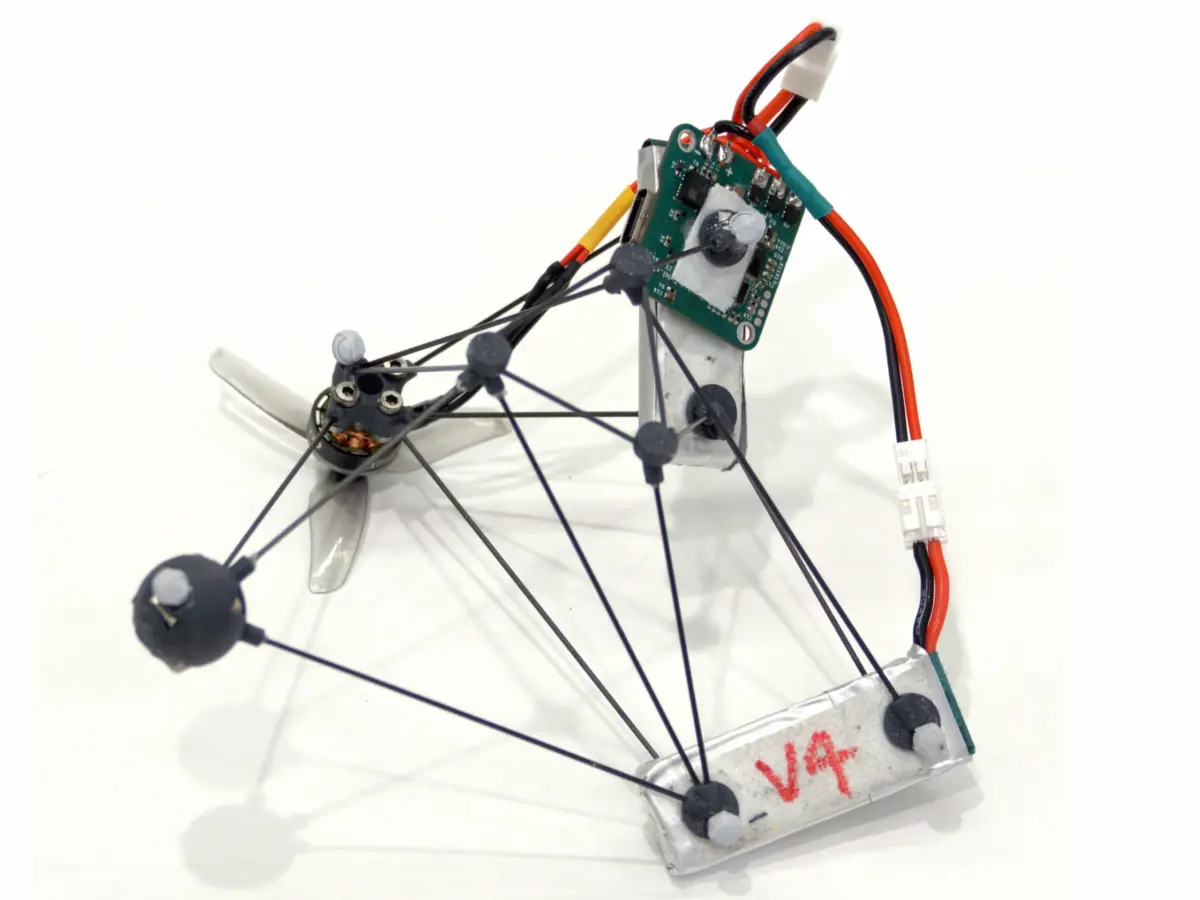
Phantom Twist is a masterclass in minimalist engineering. Stripped of all non-essential mass, the drone comprises:
A single micro-motor and propeller assembly
A pair of compact batteries
A central flight controller
Strategic counterweights (which can theoretically be swapped out for operational payloads or sensors)
A network of ultra-thin, 0.8-millimeter carbon fiber rods acting as structural bones
A specialized mechanical connector interfacing with a handheld launching mechanism
The drone operates by spinning at speeds between 15 and 25 hertz (900 to 1,500 revolutions per minute). At this velocity, the sparse structural elements—cleverly arranged to maximize empty space—virtually vanish against most natural backgrounds.
Quantifying Stealth: The LPIPS Metric
To objectively measure and optimize visibility, the research team utilized a metric known as LPIPS (Learned Perceptual Image Patch Similarity). Widely used in computer vision and generative AI research, LPIPS calculates the perceptual difference between two visual inputs.
In the context of Phantom Twist, the optimization algorithm compared two images:
A clean, pristine background image.
The exact same background image overlaid with a simulation of the spinning drone in flight.
The lower the LPIPS score, the closer the composite image is to the original background, meaning the drone is successfully blending into its environment.
The metrics speak volumes:
Phantom Twist (Optimized Algorithmic Design): Achieves an astonishing LPIPS score of 0.0104.
Phantom Twist (Human-Designed Baseline): Roughly twice as visible, registering an LPIPS score of around 0.2.
Conventional Quadrotor (Equal Size): Over 10 times more visible than the optimized design, marred by solid hulls, large overlapping propellers, and conspicuous frames.
Current Limitations and Control Paradigms
Despite its impressive optical performance, Phantom Twist is not yet an autonomous field agent. The prototype currently relies on an external optical tracking system to maintain spatial awareness and stability. Consequently, its flights are restricted to controlled laboratory environments. Furthermore, while the physical carbon-fiber structure and circuit boards are heavily optimized, electrical wiring and power leads still require further algorithmic refinement to strip away the last remaining vestiges of optical interference.
Official Statements and Expert Insights
The intersection of robotics, human perception, and computational design has generated significant academic discussion.
Reflecting on the sheer complexity of designing for low visibility, lead researcher Michael Rubenstein noted the limitations of traditional human engineering:
"The design space is high dimensional," Rubenstein explained during the team’s presentation at RSS 2026. "It’s very difficult for a human to reason through all the trade-offs between the physical constraints required for stable flight and the visual appearance of the spinning drone, and I don’t think we would have easily arrived at this low-visibility design ourselves."
Discussing how the computational pipeline ultimately makes intuitive sense after the fact, Rubenstein added:
"The automated pipeline prefers placements where components don’t visually overlap as it spins, or where the components are too close to the center of rotation."
Looking toward the horizon of practical applications, Rubenstein highlighted an unexpected bonus of the drone’s rotational architecture. Rather than treating rotation merely as a mechanism for flight and stealth, it could actively enhance the drone’s environmental awareness:
"An interesting possibility is mounting a camera on the spinning body. As the vehicle rotates, it could capture imagery in every direction, effectively creating a 360-degree view of its surroundings that could be used for onboard navigation and control."
Future Outlook: Beyond the Laboratory
The successful demonstration of Phantom Twist at RSS 2026 opens up compelling avenues for the future of UAV engineering. However, transitioning from a tethered, lab-bound optical experiment to a field-ready autonomous drone presents both engineering hurdles and profound ethical questions.
Scaling to Real-World Environments
The immediate technical hurdle for Rubenstein and his colleagues is breaking Phantom Twist out of the controlled optics lab. Having successfully deployed outdoor-capable spinning drones in past research projects, the team remains optimistic about adapting those robust localization and stabilization algorithms to the Phantom Twist platform. Equipping the micro-drone with onboard inertial measurement units (IMUs) and lightweight edge-processing hardware will be critical for untethering it from external camera systems.
Addressing the Acoustic Elephant in the Room
Visual stealth is only half the battle. As noted in the foundational design constraints of aerial robotics, drones carry an unmistakable acoustic signature—often likened to the buzzing of angry bees. For an invisible drone to operate successfully in sensitive environments, the high-pitched noise of its propeller and motor must be mitigated.
Fortunately, researchers across the globe are making strides in alternative propulsion mechanisms, such as solid-state ionocraft and micro-scale electrostatic thrusters that operate with virtually zero moving parts. Marrying low-visibility mechanical structures with silent or ultra-low-noise propulsion represents the ultimate holy grail for micro-UAV design.
Operational Horizons: Wildlife Conservation and Surveillance
When asked about the practical applications of a stealthy micro-drone, the conversation inevitably bifurcates into dual-use concerns. On one hand, the implications for covert military surveillance, intelligence gathering, and perimeter security are immediate and substantial.
On the other hand, the ecological and civilian applications are profoundly inspiring. Rubenstein points specifically to wildlife monitoring as an area of immense potential:
"A less-intrusive drone could observe animals while minimizing its impact on their natural behavior."
This sentiment resonates strongly within modern conservation biology. Traditional wildlife surveys utilizing loud, conspicuous quadrotors frequently startle animals, altering their natural migration patterns, foraging habits, and social structures. Large mammals—such as elephants, which have been documented displaying stress responses to the sound of standard drone rotors—would drastically benefit from an aerial observer that is both visually transparent and acoustically subdued.
As computational design tools continue to mature, Phantom Twist serves as a striking proof-of-concept. By letting algorithms reimagine what an aerial vehicle looks like when stripped of human aesthetic biases, Northwestern University has given us a glimpse into a future where the skies are populated by machines we literally cannot see coming.