

Executive Overview
The enterprise artificial intelligence landscape is undergoing a fundamental paradigm shift. The initial wave of generative AI focused on passive, chat-based interfaces—essentially advanced text predictors designed to assist human operators on a prompt-by-prompt basis. Today, the industry is transitioning toward Agentic AI: autonomous software agents capable of executing complex, multi-step business workflows end-to-end across heterogeneous systems, databases, APIs, and human stakeholders.
For enterprise leaders, the promise of Agentic AI is profound. It represents a shift from simple task assistance to complete workflow automation. However, deploying these autonomous agents at scale introduces a fresh set of challenges. While early-stage pilots often focus purely on Large Language Model (LLM) accuracy, operationalizing a fleet of production-grade agents reveals that inference is only one piece of a much larger puzzle.
To run agents efficiently, predictably, and cost-effectively, organizations must treat Agentic AI not as an isolated machine learning challenge, but as a complex systems-level engineering problem. The ideal platform requires a carefully balanced architecture: robust CPU capacity, resilient data access layers, policy-aware tool execution frameworks, comprehensive observability, advanced memory management, and highly scalable infrastructure.
To demystify these dependencies, Intel recently conducted thousands of rigorous Agentic AI workload experiments. Utilizing and extending open-source benchmarking frameworks, researchers isolated LLM variability to analyze how underlying system architectures handle the unique, bursty demand of agent fleets. Their findings offer a practical, data-driven blueprint for enterprise architects and technology leaders preparing to scale the next generation of digital workers.
Detailed Chronology: Unpacking Intel’s Experimental Methodology
To move beyond theoretical assumptions, Intel’s engineering teams sought to stress-test agentic workloads under realistic enterprise conditions. Their goal was to understand where system bottlenecks occur when agents transition from simple single-user demos to scaled, multi-agent enterprise fleets.
+-----------------------------------------------------------------------------------+
|                            INTEL EXPERIMENTAL PIPELINE                            |
+-----------------------------------------------------------------------------------+
|                                                                                   |
|  [ Terminal-Bench Harness ] ---> [ Deterministic Record-Replay ]                  |
|                                         |                                         |
|                                         v                                         |
|                          [ Decoupled LLM Variability ]                            |
|                                         |                                         |
|                                         v                                         |
|                          [ Heterogeneous Workload Mix ]                           |
|                    (Compilation, DB Ops, Ray Tracing, etc.)                       |
|                                         |                                         |
|                                         v                                         |
|                        [ Telemetry & Profiling Extraction ]                       |
|                                                                                   |
+-----------------------------------------------------------------------------------+
The Tool: Extending Terminal-Bench
Intel initiated its research by leveraging and extending Terminal-Bench, an open-source benchmarking harness specifically designed to evaluate AI agents executing tasks within command-line and terminal environments.
While the standard Terminal-Bench framework evaluates an agent’s ability to solve problems, Intel extended it with deep profiling, telemetry, and replay capabilities. This extension allowed engineers to capture precise system-level metrics—such as CPU cycles, memory allocation, context-switching overhead, and I/O latency—directly correlating them with agent activities.
Isolating the LLM: Deterministic Record-Replay
One of the primary challenges in benchmarking agentic systems is the non-deterministic nature of LLMs. If an LLM returns a slightly different response or takes a few milliseconds longer to generate tokens from one run to the next, it introduces system-level variability that obscures infrastructure performance.
To solve this, Intel implemented a deterministic record-replay mechanism. During initial runs, the exact responses from the LLM were recorded. In subsequent benchmarking runs across different hardware configurations and densities, these recorded responses were replayed identically. By removing LLM generation variance from the equation, Intel isolated the pure system overhead—allowing architects to see exactly how tool execution, data retrieval, and task orchestration impacted the underlying hardware.
A Diverse, Enterprise-Grade Workload Mix
To ensure the findings were highly relevant to real-world corporate environments, the benchmarking suite utilized an intentionally broad and demanding task mix. Rather than focusing solely on text generation, the agents were tasked with executing:
- Software Development Tasks: Code compilation, syntax testing, and regression analysis.
- Data Operations: Complex database queries, transactional rollbacks, and Boolean logic interpretation.
- Mathematical & Computational Workloads: Linear algebra, data compression, and machine learning training steps.
- Media Processing: Video transcoding and ray-tracing operations.
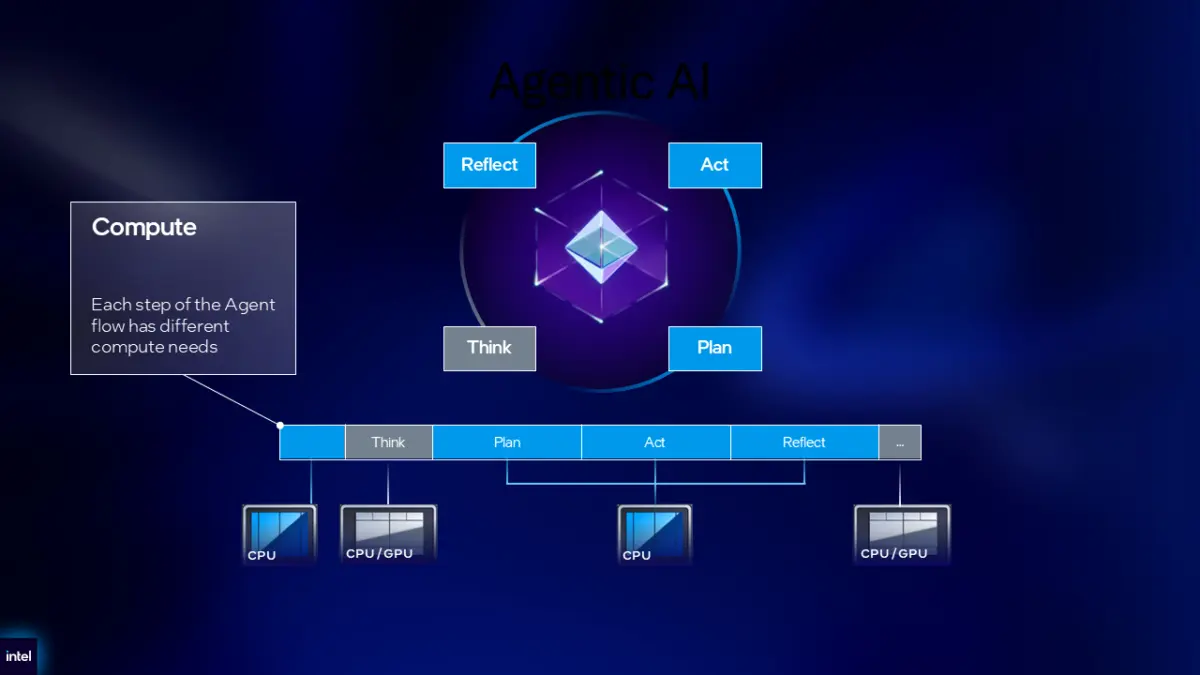
This heterogeneous mix simulated a true enterprise environment where agents do not just "think" (inference), but actively "do" (execute heavy computational tasks on local runtimes).
Supporting Context & Metrics: The Six Pillars of Agentic Observability
Enterprise IT operators cannot manage what they cannot measure. Historically, AI metrics have been model-centric, focusing on parameters like tokens per second or time to first token (TTFT). While these metrics matter for LLM providers, they fail to capture the health, efficiency, and cost of an enterprise agent fleet.
To bridge this gap, Intel’s research highlights six critical enterprise metrics that platform teams must track to monitor system performance, gauge agent capacity, and manage scaling costs:
+----------------------------------------------------------------------------------+
|                     SIX PILLARS OF ENTERPRISE AGENT METRICS                      |
+----------------------------------------------------------------------------------+
|  1. Task Completion Rate   | Percentage of workflows successfully executed       |
|                            | end-to-end without human intervention.              |
+----------------------------+-----------------------------------------------------+
|  2. P95 Task Latency       | The time boundary within which 95% of tasks finish, |
|                            | exposing tail-end system bottlenecks.               |
+----------------------------+-----------------------------------------------------+
|  3. Agent Density          | The ratio of active agents to available vCPUs,       |
|                            | indicating system saturation thresholds.            |
+----------------------------+-----------------------------------------------------+
|  4. Sustained Task Duration| The average time an agent takes to resolve a        |
|                            | multi-step workflow under concurrent load.          |
+----------------------------+-----------------------------------------------------+
|  5. Cost Per Task          | Total infrastructure and API cost amortized over    |
|                            | successfully completed business tasks.              |
+----------------------------+-----------------------------------------------------+
|  6. Retry/Error Frequency  | How often agents must retry failed tool calls or    |
|                            | API requests due to system timeouts.                |
+----------------------------------------------------------------------------------+
By shifting the focus to these operational metrics, enterprise IT departments can answer the core questions of AI operations: Is the system performing reliably? How many digital agents can the current infrastructure support? What is the most cost-effective path to scale?
Three-Dimensional Architecture: Plan, Scale, and Monitor
Intel’s thousands of test runs crystallized into three key architectural dimensions that should guide any enterprise deployment of Agentic AI.
1. Plan in Terms of Agent Density, Not Agent Count
When sizing traditional VM or container workloads, architects look at total instance counts. In the agentic era, Intel advises a different metric: Agent Density, defined as the number of active agents per virtual CPU (vCPU).
Intel’s testing demonstrated that Agent Density is the single most reliable predictor of system saturation. For instance, running 10 agents on an 8-vCPU system yielded virtually identical performance profiles, latency curves, and resource contention patterns as running 20 agents on a 16-vCPU system. This linear relationship gives architects a highly portable way to calculate capacity across different cloud instance sizes and hardware generations.

                  Interactive Workloads (e.g., Copilots)
                  +-----------------------------------+
                  | Lower Density (More vCPUs/Agent)  | ---> Focus: Low Latency
                  +-----------------------------------+
                                   vs.
                     Batch Workloads (e.g., IT Ops)
                  +-----------------------------------+
                  | Higher Density (Fewer vCPUs/Agent)| ---> Focus: Max Throughput
                  +-----------------------------------+
Furthermore, the optimal density target is directly tied to the business use case:
- Interactive Copilots: User-facing assistants require rapid response times. To protect the user experience, architects should design for lower agent density, ensuring ample CPU headroom is immediately available for sudden bursts of activity.
- Batch Workflows: Background IT processes, automated security audits, and data reconciliation pipelines can tolerate minor delays. These workloads should be packed at higher agent density to maximize hardware utilization and lower the total cost of ownership (TCO).
2. The Fallacy of Average CPU Utilization
One of the most dangerous traps for operations teams is relying on average CPU utilization as a primary health indicator for Agentic AI platforms.
AI agents exhibit a highly "bursty" computational footprint. An agent’s lifecycle typically consists of:
- Idle/Waiting Phase: The agent waits for an LLM to generate a response or for an external API to return data. During this time, CPU utilization drops to near zero.
- Execution Burst: Upon receiving the payload, the agent executes local code, parses data, runs tests, or transforms files. This phase demands immediate, intense CPU cycles.
CPU %
 ^
100|      /                 /
   |     /                 /         <-- High-intensity local execution bursts
   |    /                 /
 0 +---+------+-----------+------+---> Time
     Waiting    Executing   Waiting
Because of this alternating pattern, a system’s average CPU utilization might look perfectly healthy (e.g., 45%), even while individual agents are experiencing severe queuing delays during execution bursts.
Intel’s research proves that P95 Task Latency is a far superior leading indicator of system distress. If P95 latency begins to spike, it indicates that execution bursts are queuing up, degrading the user experience long before average CPU metrics show any sign of trouble.
3. Scale Out by Default, Scale Up by Exception
When an agentic platform reaches its performance threshold, platform teams must choose whether to scale up (adding more cores, memory, or accelerator capacity to a single node) or scale out (adding more nodes to a distributed cluster).
Intel’s empirical data strongly suggests that scaling out should be the default strategy for enterprise Agentic AI.
+-----------------------------------------------------------------------------+
|                          SCALING DECISION MATRIX                            |
+-----------------------------------------------------------------------------+
|   SCALE OUT (Default Strategy)             SCALE UP (Exceptional Cases)     |
|   - Semi-independent agent tasks           - Highly parallel compute tasks  |
|   - Modest, localized execution bursts     - Shared state limits partitioning|
|   - High availability requirements         - Memory locality is critical    |
|   - Keeps target agent-per-vCPU ratio      - Complex software licensing     |
+-----------------------------------------------------------------------------+
Because agents typically operate as semi-independent units with modest individual compute bursts, distributing them across a broader horizontal cluster improves overall fault tolerance, ensures high availability, and preserves the target agent-to-vCPU ratio.
Scaling up should be reserved for specific exceptions: when agents are performing highly parallelized local calculations, when state-sharing requirements prevent workload partitioning, or when software licensing models penalize distributed nodes.
Official Statements & Industry Context
The implications of Intel’s research extend far beyond hardware specifications; they challenge how the industry thinks about the economics of AI.
In past industry analyses, the narrative around AI infrastructure has been dominated by specialized accelerators like GPUs. However, Intel’s systematic testing reveals that as AI becomes agentic, the non-inference portions of the workload—orchestration, file system operations, API calls, and local code execution—reintroduce traditional general-purpose compute bottlenecks.
According to enterprise systems architects reviewing the data, this shift marks a return to balanced system design. While GPUs or dedicated accelerators remain critical for hosting massive foundational models, the orchestration layers, tool runtimes, and agent databases run optimally on modern CPU architectures.
Moreover, this research redefines the ideal enterprise persona for Agentic AI. The technology is moving out of the hands of the "experimental prompt engineer" chasing novelty, and into the purview of the accountable IT operations leader. This persona is tasked with a clear mandate: improve cycle times, maintain strict service-level agreements (SLAs), enforce data governance, and scale AI adoption without letting infrastructure costs spiral out of control.
Future Outlook: The Era of the "Agentic Swarm"
As enterprises transition from experimental pilots to production deployments, the complexity of managing these systems will only grow. The future of enterprise productivity lies in "agentic swarms"—networks of specialized, autonomous agents that communicate, negotiate, and collaborate to solve cross-departmental business problems.
In this upcoming paradigm, the infrastructure demands will scale exponentially. A single business goal—such as onboarding a new supplier or processing a complex insurance claim—may trigger dozens of sub-agents, each spawning its own computational bursts, database queries, and tool executions.
To survive and thrive in this agentic future, enterprises must lay a solid foundation today. This means moving away from ad-hoc deployments and toward standardized platforms built on:
- Predictable CPU capacity capable of handling rapid, concurrent execution bursts.
- Advanced observability frameworks that prioritize task-level latency over misleading system averages.
- Hybrid scaling strategies that balance local CPU efficiency with distributed cloud capacity.
Ultimately, the true value of Agentic AI will not be measured by the sophistication of an LLM’s prose, but by the reliability, speed, and cost-efficiency with which autonomous software agents can execute real work. By applying systems-level engineering discipline to AI infrastructure, enterprise leaders can confidently move their AI initiatives from experimental novelties to core drivers of business value.
