

Executive Overview
The convergence of artificial intelligence, high-performance actuators, and advanced material science is rapidly transforming robotics from a discipline of isolated laboratory demonstrations into an ecosystem of dynamic, real-world deployment. In this week’s comprehensive survey of global robotics development—curated by the engineers and researchers at IEEE Spectrum—we bear witness to a technological inflection point. From humanoid systems performing complex laparoscopic teleoperation in vivo to quadrupedal robots leaping across hazardous terrain at unprecedented velocities, the boundary between theoretical mechanics and operational utility is dissolving.
This edition of Video Friday highlights several critical breakthroughs across academia and industry:
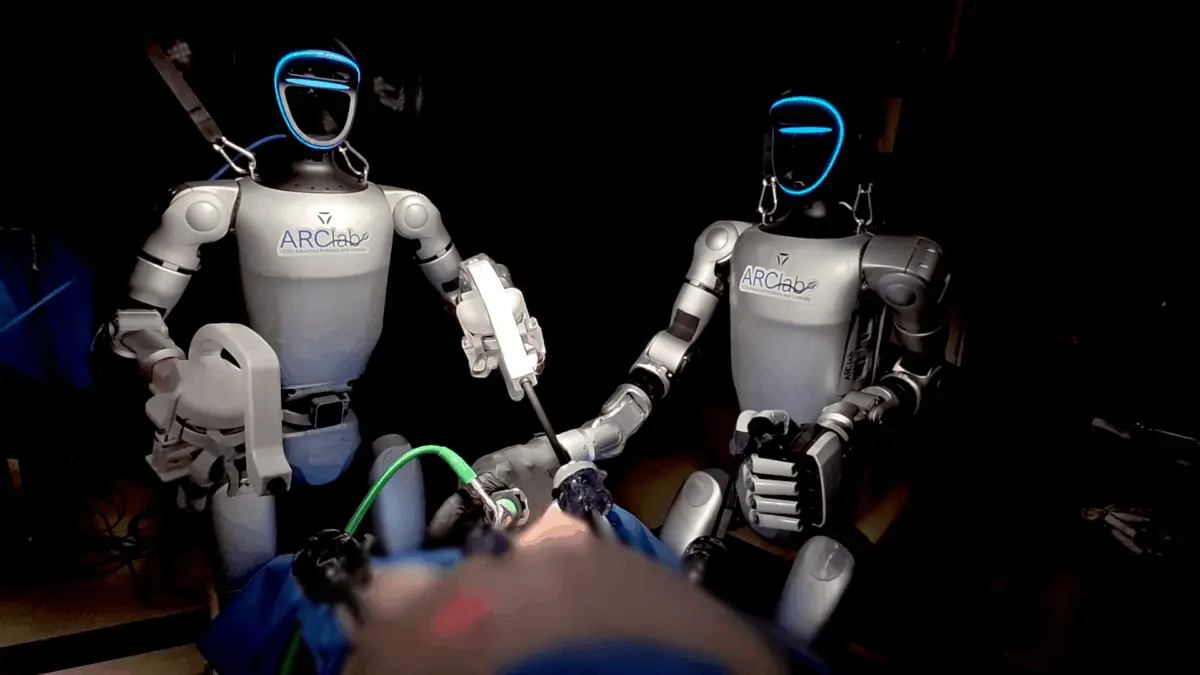
- Surgical Robotics: Researchers at UC San Diego have evaluated contemporary humanoid technology for laparoscopic surgery, demonstrating the feasibility of using general-purpose robotic platforms in clinical environments.
- Generalist AI Models: Sunday Robotics and Astribot have unveiled advanced models—ACT-2 and Lumo-2—aimed at solving the elusive challenge of generalized embodied robot learning across unstructured, novel environments.
- High-Speed Locomotion: KAIST’s DRCD Lab has pushed quadrupedal agility to new extremes with APT-RL, allowing the HOUND platform to clear complex hurdles at speeds reaching 6 meters per second.
- Autonomous Mobile Manipulation: Systems from LimX Dynamics and Boston Dynamics are bridging the gap between isolated mechanical tricks and long-horizon, untethered real-world labor, highlighted by Atlas’s recent high-profile demonstrations.
- Multifluid Robotics: EPFL’s Laboratory of Intelligent Systems (LIS) has successfully decoded the mechanics of wing-propelled diving birds using an amphibious robot capable of seamless transitions between aerial flight and underwater swimming.
As the robotics community looks ahead to premier global gatherings—including the Summer School on Multi-Robot Systems in Prague (July 2026), Actuate 2026 in San Francisco, the Humanoids Summit in Seoul, and IROS 2026 in Pittsburgh—the imperative to transition from closed-loop testing to robust, general-purpose deployment has never been more pronounced.
Detailed Chronology of Breakthroughs
The past week’s releases trace a clear evolutionary path across multiple specialized domains. Below is a structured chronology of the most significant robotic platforms, frameworks, and demonstrations showcased globally.
1. Humanoid Systems in the Operating Room: UC San Diego
- The Innovation: A systematic evaluation of contemporary humanoid hardware deployed for laparoscopic surgical tasks.
- Methodology: Researchers developed a humanoid-based laparoscopic teleoperation framework utilizing general-purpose surgical instruments. Testing progressed systematically from benchtop characterization and dry-lab user studies—involving surgeons of varying experience levels—to rigorous in vivo porcine studies.
- Significance: By quantifying technical feasibility, task execution metrics, and clinical readiness relative to legacy surgical platforms (such as the da Vinci system), this study provides an objective, evidence-based baseline. It underscores the immense potential of utilizing generalized humanoid architectures in medicine while clearly delineating the hurdles—such as latency, tactile feedback limitations, and regulatory certification—that remain before commercial clinical deployment.
2. Generalization at Scale: ACT-2 and Sunday’s Laundry Challenge
- The Innovation: Sunday Robotics premiered ACT-2, positioned as a milestone robotics model engineered to unify broad environmental generalization with high-performance execution.
- Demonstration: Accompanying the model release, Sunday Robotics published an extraordinary three-hour uninterrupted video featuring Memo, a robotic system tasked with folding laundry in entirely "never seen environments."
- Significance: Long-horizon tasks like laundry folding have historically plagued roboticists due to the infinite variations in fabric deformation, lighting, and spatial clutter. Demonstrating competence over hours of continuous, unedited operation points toward a future where household robotics can handle domestic entropy without bespoke programming.
3. Boston Dynamics and the "Porch Gap"
- The Innovation: Boston Dynamics released new footage illustrating the deployment of the Spot quadruped for final-mile package delivery.
- Significance: While quadrupeds have long mastered uneven terrain, the primary bottleneck for commercial last-mile delivery is no longer purely mechanical traversal. As the engineering team notes, the true challenge lies in human-robot coexistence—specifically, ensuring autonomous delivery units operate efficiently without driving human coworkers and customers to distraction.
4. High-Speed Quadrupedal Agility: KAIST HOUND and APT-RL
- The Innovation: Researchers at the KAIST DRCD Lab introduced APT-RL (Action Pretrained Transformer-based Reinforcement Learning), a unified framework designed for high-speed, multiskill quadrupedal locomotion.
- Performance Metrics: Utilizing a single policy trained via onboard perception and computation, the KAIST HOUND platform successfully navigated stairs, hurdles, stepping-stones, gaps, and fallen branches. Most impressively, HOUND achieved an instantaneous peak speed of 4.25 meters per second while traversing a 60-centimeter step, and 6 meters per second during a drop-down transition on a three-step staircase.
- Significance: Traditional quadrupeds often rely on distinct, hard-coded control modes for different gaits. APT-RL demonstrates that a transformer-based reinforcement learning policy can dynamically select and execute seamless gait transitions at high velocities entirely on edge-compute hardware.
5. Embodied Intelligence: Astribot’s Lumo-2
- The Innovation: Astribot officially introduced Lumo-2, its next-generation latent world-action model tailored for generalist embodied robot learning.
- Significance: World models—which allow artificial intelligence to internally simulate the physical consequences of actions before executing them in reality—represent the bleeding edge of robotic cognition. Lumo-2 aims to bridge the gap between abstract machine learning representations and physical motor control in unstructured environments.
6. Live-Action Mobility: Atlas and LimX Dynamics
- The Demonstration: Following the high-profile live performance of Boston Dynamics’ Atlas at the FIFA World Cup 2026, engineering leads detailed the rigorous coordination required to bring dynamic humanoid performance out of the lab and onto the pitch.
- Parallel Breakthroughs: Simultaneously, LimX Dynamics released footage of a long-horizon mobile manipulation task executed by a humanoid robot. Emphasizing no teleoperation and no cuts, the demonstration ranks among the few complete records of untethered, autonomous long-horizon manipulation achieved to date.
7. Bio-Inspired Amphibious Robotics: EPFL LIS
- The Innovation: Researchers at EPFL’s Laboratory of Intelligent Systems unveiled a robotic platform mimicking wing-propelled diving birds (such as guillemots and puffins).
- Scientific Insights: Wing-propelled diving birds navigate both fluid dynamics and aerodynamic constraints by flapping their wings through air and water. Historically, the exact morphological and kinematic parameters enabling this dual-medium locomotion were poorly understood. EPFL’s flapping-wing robot successfully demonstrated aerial flight, swimming, plunge diving, and water egress.
- Significance: The study proved that frequency adaptation, variable wing flexibility, and powerful actuation allow for seamless fluid transitions without requiring mechanical wing or leg folding. Furthermore, researchers identified that tail-body distance and egress angles are critical variables for successfully breaking the water-air boundary.
Supporting Context & Metrics
To appreciate the scale of innovation presented across these platforms, it is valuable to examine the underlying computational and mechanical parameters driving modern robotics:
| Platform / Project | Primary Domain | Key Innovation / Metric | Significance |
|---|---|---|---|
| UC San Diego Humanoid Surgeon | Medical Robotics | In vivo porcine validation of general-purpose laparoscopic teleoperation. | Establishes a comparative baseline between humanoid hardware and legacy surgical systems. |
| Sunday Robotics (ACT-2) | Domestic AI | 3-hour continuous laundry folding in novel environments. | Proves long-horizon reliability and generalization in unstructured household settings. |
| KAIST HOUND (APT-RL) | Quadruped Locomotion | Peak speed of 6 m/s during stair drop-down transitions; 4.25 m/s over 60cm steps. | Demonstrates unified reinforcement learning policies for high-speed dynamic agility. |
| Astribot Lumo-2 | Embodied AI | Next-generation latent world-action model. | Enhances predictive physical reasoning for generalist robotic agents. |
| LimX Dynamics Humanoid | Mobile Manipulation | Continuous, unedited long-horizon autonomous manipulation (zero teleop). | Proves commercial readiness in complex, sequential pick-and-place tasks. |
| EPFL LIS Diving Robot | Bio-Inspired Robotics | Seamless aerial-to-aquatic transition via flapping-wing dynamics. | Solves multi-fluid locomotion constraints without complex morphing appendages. |
Official Statements and Expert Insights
The integration of artificial intelligence into physical hardware has sparked rigorous dialogue among leading researchers regarding the safety, scalability, and ethical dimensions of advanced robotics.
On Humanoid Surgical Integration (UC San Diego):
"In this work, we present a systematic evaluation of contemporary humanoid technology for laparoscopic surgical tasks… Together, our study provides an evidence-based assessment of the current capabilities and limitations of humanoids for surgical applications, highlighting both their promise and the key technical challenges that must be addressed before clinical deployment."On High-Speed Quadrupedal Control (KAIST DRCD Lab):
"Quadrupedal locomotion in complex environments requires multiple motor skills, stable gait transitions, and perceptive control over a broad range of speeds. APT-RL is a unified framework for high-speed, multiskill locomotion. A single policy selects and selects between gaits and motor skills using only onboard perception and computation."On Autonomous Long-Horizon Manipulation (LimX Dynamics):
"No teleoperation. No cuts. Long take. One of the world’s few complete demonstrations of long-horizon mobile manipulation, bringing fully autonomous humanoid robots another step closer to us."On Bio-Inspired Multi-Fluid Locomotion (EPFL LIS):
"Wing-propelled diving birds flap their wings to move through air and water, yet the wing morphology and kinematics that enable this behavior remain poorly understood… These results clarify how birds (and robots) balance multifluid locomotion constraints."
Future Outlook
The trajectory of robotics over the remainder of 2026 points toward three converging horizons: generalization, autonomy, and cross-domain utility.
- The Medical Frontier: While surgical teleoperation is currently dominated by specialized master-slave systems, the validation of humanoid architectures by teams like UC San Diego suggests a future where multi-purpose robotic labor could democratize access to advanced surgical assistance, provided regulatory frameworks can adapt to general-purpose machine learning in clinical settings.
- Edge-Computed Agility: The success of frameworks like KAIST’s APT-RL highlights the shift away from centralized computing clusters toward edge-native, real-time reinforcement learning. As onboard perception and computation mature, robots will increasingly handle high-velocity, unpredictable physical terrain without human intervention.
- The Path to Standardization: As industry players converge on upcoming international fora—such as IROS 2026 in Pittsburgh and the Humanoids Summit in Seoul—the discourse is shifting from isolated technical stunts (such as running, jumping, or kicking soccer balls) to rigorous benchmarking, safety certification, and commercial integration.
The era of the "robot next door"—whether assisting in the operating room, folding laundry in unseen households, or navigating complex industrial and natural landscapes—is no longer a distant theoretical construct. It is being forged, one video frame at a time, in research laboratories and industrial facilities across the globe.
