

Executive Overview
The engineering of robotic systems for extraterrestrial deployment represents one of the most formidable frontiers in modern science. In the harsh, high-stakes vacuum of outer space, traditional dependencies—such as optical cameras, real-time human intervention, and predictable environmental physics—often fail. To overcome these limitations, the next generation of aerospace engineers must design autonomy systems that can operate entirely blind to visual cues yet remain precise enough to construct critical infrastructure in zero gravity.
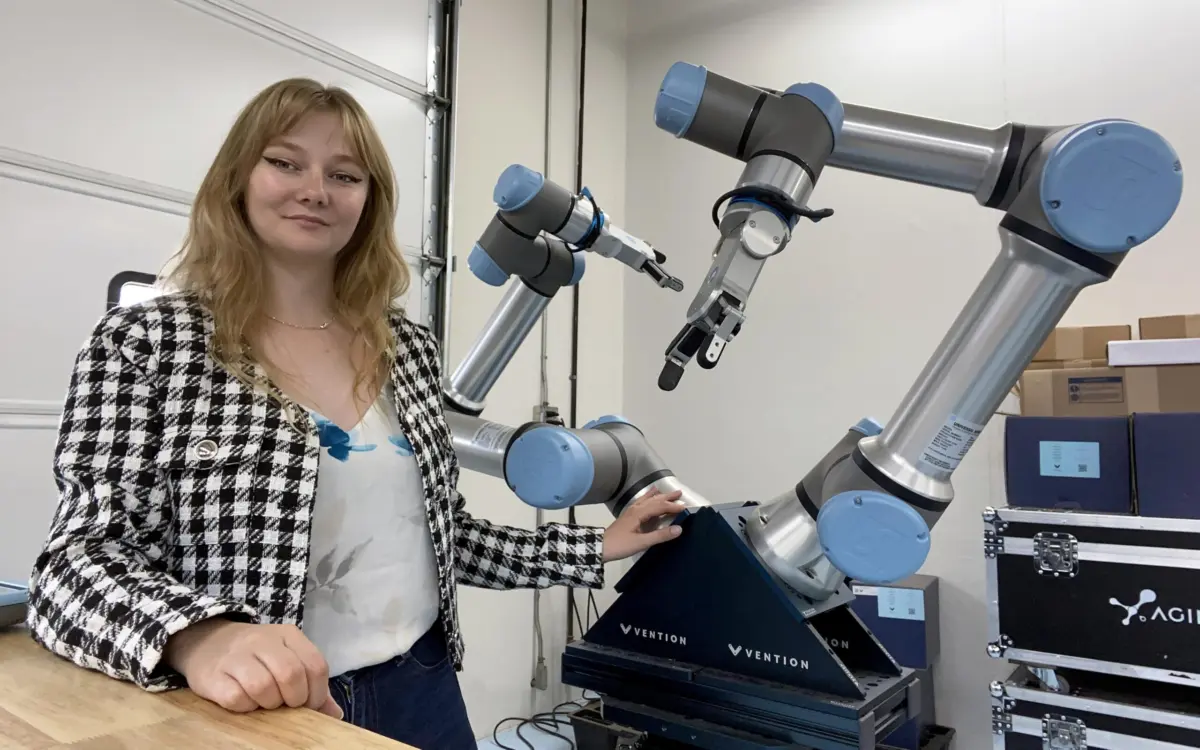
Enter Sarah Downs, an IEEE graduate student member and a Ph.D. candidate in electrical engineering at Texas A&M University. Downs has developed a pioneering force-based control algorithm designed to equip NASA robotic manipulators with the fine-motor dexterity required to execute complex space-assembly tasks. Her work directly tackles the classic "peg-in-hole" robotics challenge, enabling a robotic arm to precisely insert an antenna into a satellite housing using only torque feedback and touch, completely bypassing the need for optical guidance systems.
This long-form investigative profile examines Downs’s remarkable trajectory: from a Tulsa teenager inspired by NASA’s Mars rovers to a collegiate leader revitalizing her university’s IEEE branch, and ultimately to a vanguard researcher collaborating with NASA and the U.S. Air Force. Her research bridges the gap between terrestrial robotic autonomy and the rigorous demands of deep-space operations, signaling a paradigm shift in how we manufacture, maintain, and assemble assets beyond Earth’s atmosphere.
Detailed Chronology: From Tulsa LEGO Leagues to Texas A&M Labs
A Childhood Spark: The Inspiration of Mars Exploration
Sarah Downs’s journey into the upper echelons of aerospace robotics began long before she set foot in a university laboratory. Growing up in Tulsa, Oklahoma, Downs was a quintessential inquisitive teenager, drawn naturally to the mechanics of how things work. Her early passion for Science, Technology, Engineering, and Mathematics (STEM) was cemented when she joined her middle school’s First Lego League team, competing in the international robotics program from 2014 to 2016.
Simultaneously, a steady diet of PBS specials documenting the exploits of NASA’s Mars rovers, Spirit and Opportunity, coupled with the live broadcast of the Curiosity rover’s harrowing 2011 landing, ignited a lifelong fascination with space exploration. Watching these mechanical pioneers operate millions of miles away planted a singular ambition in the young student: she wanted to build robots for NASA.
Navigating Adversity and Finding Financial Security
Behind Downs’s academic drive lay a grounding reality. In 2015, when Downs was just 13 years old, her father—a safety advisor in the oil and gas industry—tragically passed away from a heart attack. The sudden loss left her mother to care for Downs and her brother, who has autism. To support the family, her mother returned to college to earn a bachelor’s degree in business.
"We didn’t have much income, and my mom was always worried about money," Downs recalls. "That made me more aware of having a successful career, in a monetary sense."
This economic pressure forged a pragmatic edge in Downs’s career planning. She recognized early on that her deep-seated passion for robotics could intersect with practical financial security. Rather than treating engineering as a purely academic pursuit, she viewed it as a vital vehicle for long-term stability and family support.
Technical Foundations at Tulsa Tech and the University of Tulsa
Determined to accelerate her technical education, Downs enrolled in a vocational extension program at Tulsa Tech during her final two years of high school. Splitting her time between traditional high school classes and hands-on engineering training, she honed her aptitude for electrical components within the school’s robotics club.
Upon graduating in 2020, she accepted scholarships to attend the University of Tulsa (UTulsa). Initially undecided between electrical and mechanical engineering, her preference for working with compact, intricate electronic circuits ultimately led her to choose electrical engineering (EE).
Her undergraduate career culminated in a highly successful senior capstone project. Alongside two classmates, Downs designed a lunar lander interactive exhibit for the Tulsa Air and Space Museum. The exhibit utilized three computer monitors and a game controller to simulate virtual missions across four celestial bodies: the Moon, Venus, Mars, and Saturn’s largest moon, Titan. The installation remains open to museum visitors, serving as a testament to her early collaborative design capabilities. Downs earned her bachelor’s degree in electrical engineering in 2024 and immediately transitioned into UTulsa’s EE master’s program.
Supporting Context & Metrics: Overcoming the Void
The Institute for Robotics and Autonomy and Assistive Tech
Before embarking on her landmark NASA project, Downs spent a formative year in UTulsa’s newly established Institute for Robotics and Autonomy. Originally intended to begin her two-year NASA commitment immediately, government funding delays temporarily stalled the aerospace initiative.
Channeling her engineering skills toward earthly challenges, Downs was inspired by her grandmother, who had been wheelchair-bound due to severe arthritis. Downs engineered a robotic arm designed to assist older adults and individuals with mobility impairments in living independently. The system could autonomously identify and manipulate household objects—such as retrieving grocery items from shopping bags and placing them neatly onto shelves—demonstrating her versatility across both medical and aerospace domains.
Solving the Peg-In-Hole Problem Without Vision Systems
By 2025, government funding for the NASA and U.S. Air Force collaborative project finally cleared, launching Downs into her master’s thesis research. The core objective was solving one of robotics’ most persistent hurdles: the peg-in-hole problem, specifically adapted for satellite assembly in space.
Typically, robotic assembly systems rely heavily on optical cameras and computer vision to align components. However, in the harsh, high-radiation, and variable-lighting environment of low Earth orbit or deep space, optical systems are vulnerable to failure, glare, occlusion, and latency issues.
To circumvent this vulnerability, Downs engineered a touch-sensitive, force-based insertion process. Operating a robotic arm equipped with a torque sensor on its gripper, the machine loosely grasps an antenna and "feels" the precise micro-feedback generated by contact with the satellite chassis. Through continuous force-torque feedback loops, the robot guides the antenna precisely into its target housing and holds it steady while adhesion bonds the components.
Managing Zero-Gravity Dynamics
Executing this delicate maneuver in zero gravity introduces a severe physical complication: reaction torques.
"Without gravity, you now have to consider the arm’s reaction torques on the satellite to avoid flinging it into space," Downs explains. In the absence of gravitational drag, any uncontrolled motion or excessive force applied by the robotic arm during insertion could impart momentum, sending the satellite spinning uncontrollably into the void.
To neutralize this risk, Downs formulated complex mathematical algorithms to calculate and execute targeted reverse thrusts, counteracting the kinetic force generated by the robot’s movements. This synthesis of mechanical control, sensor feedback, and real-time computation represents a major advancement in automated orbital manufacturing.
Official Statements and Institutional Perspectives
Mentorship from NASA Veterans: The RAD Lab and Space Institute
Following the completion of her master’s degree, Downs transitioned to Texas A&M University to pursue her Ph.D. in electrical engineering. She is currently completing her doctoral thesis within the Robotic Space Simulator project at Texas A&M’s Robotics and Automation Design (RAD) Lab, which specializes in extreme-environment robotics.
Her doctoral advisor is Robert Ambrose, a distinguished NASA veteran who founded the RAD Lab in 2022. Ambrose also serves as the associate director of the university’s Space Institute in Houston, a premier research facility located strategically adjacent to NASA’s Johnson Space Center.
Reflecting on her philosophy of science and engineering, Downs emphasizes humility and continuous learning:
"Don’t stop asking questions. Especially in engineering, don’t pretend like you know everything, because science is about constantly wanting to learn and listen."
Demystifying Robotics: The Denavit-Hartenberg Foundation
Despite the staggering complexity of her research, Downs maintains a grounded perspective on the underlying nature of mechanical systems. She frequently notes that robots are simultaneously more simple and more complicated than the general public assumes.
"I think robots are both more and also less complicated than people think," Downs says. "Really, all you need to start programming a robot is its Denavit-Hartenberg parameters, and you can do a lot with that. Fundamentally, all robot manipulators start there. But we’re still learning so much about how robots interact with their environment. Even something simple to us, like manipulating a pen, is still incredibly complex for robots."
Future Outlook: Networking, IEEE Leadership, and NASA Ambitions
Breaking Out of the "Engineering Bubble"
Beyond her technical achievements, Downs has distinguished herself as an exceptional academic leader and community builder. Joining the Institute of Electrical and Electronics Engineers (IEEE) in 2020 as an undergraduate freshman amidst the isolating throes of the COVID-19 pandemic, she recognized the psychological and professional toll of students remaining isolated in their academic "bubbles."
Stepping up as president of UTulsa’s IEEE student branch from 2022 to 2024, Downs transformed the organization. Under her leadership, meeting frequency doubled from occasional gatherings to bi-weekly events. She orchestrated professional development sessions, alumni networking dinners, and hands-on technical workshops covering soldering, 3D printing, CAD modeling, and résumé building.
Her initiatives yielded dramatic results: executive board membership surged from roughly five students to 25 by 2023, while her annual soldering workshop drew an impressive attendance of approximately 80 students. Today, she continues to serve as an IEEE graduate advisor for UTulsa’s student branch, witnessing firsthand how strategic professional networking directly translates into job placements for graduating engineers.
"Networking is very important, especially in today’s tough job market," Downs notes. "It’s a lot about who you know and how people observe your work ethic."
Toward an Extraterrestrial Career
With her sights firmly set on graduation, Downs is positioning herself for a career at the vanguard of aerospace exploration. Upon earning her Ph.D., her ultimate professional aspiration is to join NASA full-time, contributing to the development of autonomous rovers capable of sophisticated sample collection on Mars, or advanced robotic manipulators tasked with maintenance and construction aboard orbital space stations.
As humanity looks toward long-term habitation on the Moon, crewed missions to Mars, and the widespread commercialization of low Earth orbit, the demand for reliable, autonomous assembly systems has never been more urgent. Through her groundbreaking research in force-feedback manipulation, mathematical compensation for zero-gravity dynamics, and unwavering commitment to collaborative scientific inquiry, Sarah Downs is not merely building tools for tomorrow’s space program—she is actively engineering the physical framework of humanity’s future among the stars.
