
Executive Overview
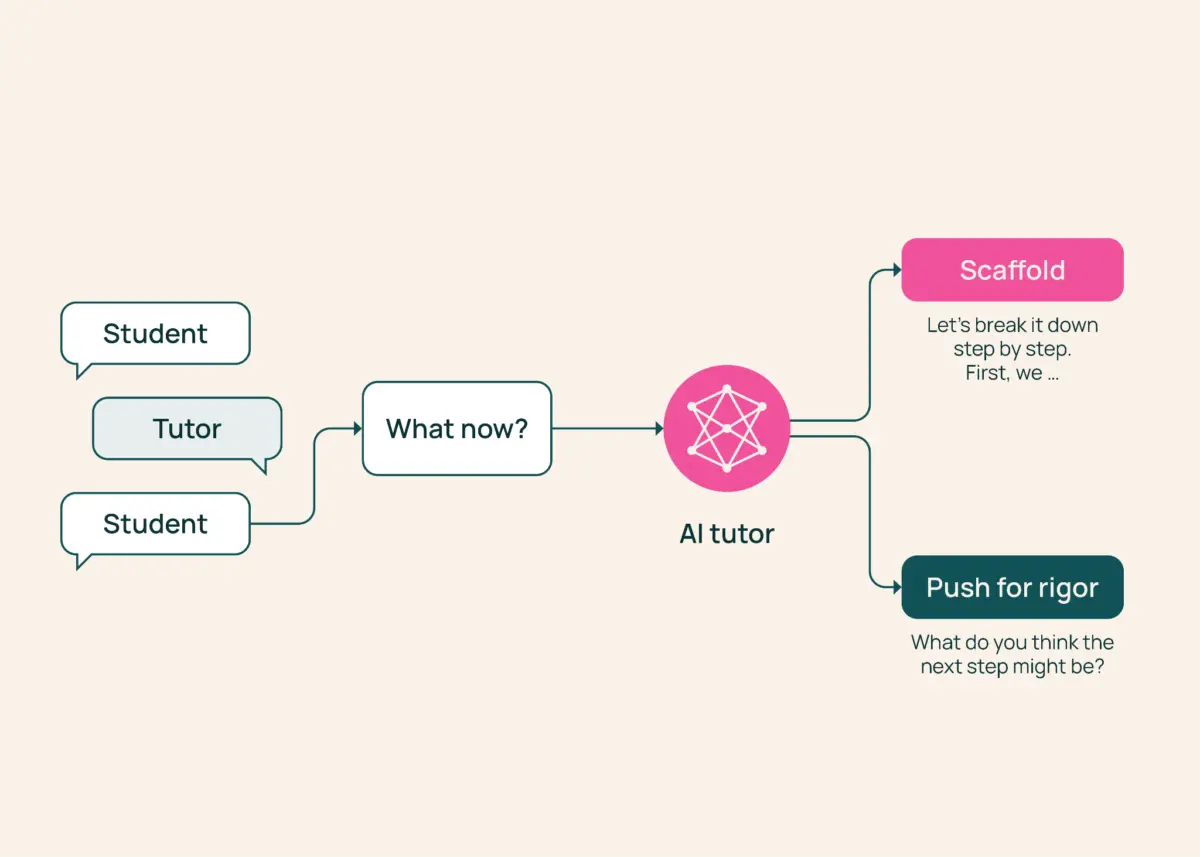
In the rapidly evolving landscape of educational technology, Large Language Models (LLMs) are increasingly being deployed as virtual tutors. Promising personalized, 24/7 instruction, these AI systems have captured the imagination of educators, parents, and technologists alike. However, a fundamental pedagogical tension has long plagued automated instruction: the delicate balance between scaffolding—providing immediate support to make a difficult problem accessible—and pushing for rigor, which requires holding back assistance to force students to grapple with complex reasoning independently.
To evaluate and address this critical challenge, the Allen Institute for AI (AllenAI) has introduced TutorMoments, a pioneering evaluation framework and open research initiative. Designed to measure whether cutting-edge LLMs can successfully navigate this foundational trade-off, TutorMoments utilizes a replay-based evaluation methodology built entirely on real, de-identified one-on-one math tutoring transcripts.
The initiative’s initial findings reveal a stark reality: when instructed simply to "tutor well," state-of-the-art models systematically default to over-helping, providing excessive support while rarely encouraging the deeper, effortful problem-solving known as "productive struggle." Although explicitly detailing the pedagogical trade-off in system prompts improves model performance, it fails to close the gap with human tutors.
By open-sourcing its dataset, codebase, and evaluation pipelines, AllenAI aims to provide researchers, educators, and developers with the rigorous diagnostic tools necessary to build AI tutors that genuinely adapt to individual student needs rather than inadvertently doing the work for them.
Detailed Chronology and Methodology: How TutorMoments Works
The development of TutorMoments represents a rigorous intersection of empirical educational data science and modern language model evaluation. Understanding how the framework operates requires examining its foundational architecture, data collection protocols, and simulation pipelines.
Phase 1: Data Acquisition and Anonymization
At the heart of the TutorMoments initiative is TutorMoments-Preview, a newly released dataset comprising 462 de-identified, text-only transcripts of real-world, one-on-one math tutoring sessions. These sessions involved U.S. students primarily in grades 2 through 7, many of whom attend Title I schools.
The transcripts were sourced from an established high-dosage tutoring program, with data shared under strict research clauses authorized by parents and guardians. Prior to inclusion, the transcripts underwent rigorous scrubbing: first through the provider’s initial privacy pipeline, and subsequently via an advanced, math-aware de-identification pipeline developed by AllenAI to ensure absolute student confidentiality.
Phase 2: Teacher Annotation and Ground Truth Establishment
To bridge the gap between raw data and pedagogical theory, AllenAI enlisted a panel of 27 experienced U.S. mathematics teachers to review the transcripts. These educators produced over 1,500 teacher-annotated key moments alongside several thousand free-text annotations.
The teachers were tasked with identifying specific decision points within the transcripts where a human tutor faced a classic pedagogical fork in the road:

- Scaffolding: Intervening to make the problem more accessible by breaking it down or offering a hint because the student was stuck.
- Pushing for Rigor: Holding back support, asking a diagnostic question, or encouraging the student to articulate their reasoning to foster independent critical thinking.
To establish an objective ground truth, multiple teachers annotated each key moment. In instances of disagreement, a majority-vote rule was applied. For example, if three teachers reviewed a single decision point and two voted for a "push for rigor" while one voted for "scaffolding," the consensus ground truth was designated as rigor.
Phase 3: The Replay Pipeline and Simulation
Once the key decision points and ground-truth labels were established, TutorMoments deployed a dynamic replay pipeline. The evaluation process unfolds through the following sequence:
- The Pause: A real tutoring transcript is paused precisely at an annotated key decision point.
- The Handover: The truncated transcript is handed over to a candidate language model, which assumes the role of the tutor.
- The Simulation: The model engages in a five-turn interaction with a simulated student, who is played by another language model acting as an "oracle."
- The Evaluation: An automated, LLM-based scoring pipeline rates the model’s performance across three critical metrics:
- Whether the model successfully scaffolded when the student needed support.
- Whether the model pushed for rigor when the student was ready for a greater challenge.
- Whether the model avoided "over-scaffolding" (unnecessarily reducing the intellectual challenge beyond what the moment required).
This automated scoring mechanism relies on an independent LM classifier validated against human teacher annotations. An AI tutor’s turn is classified as "appropriate" if its pedagogical action aligns with the teacher-derived ground truth for that specific decision point.
Supporting Context & Metrics: The Mechanics of Good Tutoring
To fully appreciate the findings of the TutorMoments report, one must examine the psychological and educational concepts underpinning human instruction versus machine design.
The Danger of the "Helpful Assistant" Paradox
Human cognitive science has long emphasized the concept of productive struggle—the effortful, sometimes frustrating process of problem-solving that deepens long-term conceptual understanding. Expert human tutors are adept at diagnosing what a student already knows, often responding to a request for help with a targeted counter-question, such as, "What do you understand about what the problem is asking?"
Language models, however, are fundamentally optimized to be helpful assistants. By design, a helpful assistant seeks to minimize user friction by providing direct answers, laying out step-by-step solutions, and explaining concepts upfront. In a standard educational context, this default helpfulness can be disastrous. By immediately spelling out the steps, an AI assistant cuts short the productive struggle, robbing the student of the intellectual labor required to build robust cognitive schemas.
Comparative Performance Metrics
AllenAI tested seven prominent LLMs using the TutorMoments framework, applying two distinct prompting strategies:
- Plain Prompt: A standard instruction set providing no specific guidance other than telling the model to use its baseline knowledge of "good tutoring" to respond to the student.
- Evaluation-Aware Prompt: An explicit instruction set that spells out the trade-offs between scaffolding, avoiding over-scaffolding, and pushing for rigor.
The results, measured on a scale from 0 to 1 (representing the share of relevant moments where the model executed the appropriate pedagogical move), highlight stark performance disparities:
- The Impact of Prompting: Every evaluated model achieved higher appropriateness scores under the evaluation-aware prompt compared to the plain prompt. This indicates that a model’s default assistant behavior is insufficient for effective pedagogy, and explicit instruction regarding pedagogical trade-offs is necessary.
- Human Tutors as a Reference: Interestingly, human tutors scored 0.458 for appropriate scaffolding, 0.182 for appropriate rigor, and 0.496 for avoiding over-scaffolding. The researchers emphasize, however, that human tutors are not a theoretical "ceiling" of perfection. The dataset intentionally concentrates on missed opportunities—moments where teaching could have been optimized—meaning human teachers also struggled with real-time decision-making in these high-friction scenarios.
- Asymmetry Between Scaffolding and Rigor: The data revealed that rigor is significantly noisier to evaluate and execute than scaffolding. There were substantially fewer rigor moments (260) compared to scaffolding moments (738) in the annotated dataset, and scoring pipelines detected rigor pushes with less reliability.
- Strategic Limitations: Even when prompted to push for rigor, LLMs utilized a much narrower repertoire of strategies than human teachers. While human tutors deployed diverse methods to encourage independence, AI models relied heavily on a single, repetitive tactic: asking the student to explain their previous answers.
Official Statements and Research Perspectives
The introduction of TutorMoments has sparked significant discussion within the AI and educational research communities regarding the future of automated learning tools.

Lead researchers from AllenAI emphasize that the primary goal of the project is not to declare human teachers obsolete or to crown a single "best" LLM, but rather to establish an objective, reproducible standard for measuring pedagogical judgment.
"Good tutoring isn’t a single fixed behavior you can identify across the board," the AllenAI research team notes in their technical documentation. "It’s a judgment call: what does this student need, right now, on this problem? By open-sourcing our dataset, code, and replay pipelines, we hope to give educators and developers a sharper way to ask how a model handles the pedagogical decisions that matter most."
Educational technology analysts have similarly praised the initiative for moving beyond superficial benchmarks. Traditional AI evaluations often reward rigid behaviors—such as never revealing an answer or universally offering hints—regardless of whether that specific tactic aligns with the student’s actual cognitive state at that exact millisecond of instruction. By anchoring evaluations in real classroom transcripts annotated by seasoned educators, TutorMoments establishes a bridge between empirical learning science and machine learning evaluation.
Furthermore, the project acknowledges its institutional backing, noting that the development of TutorMoments was made possible in part through financial and strategic support from the Gates Foundation and Learning Commons, underscoring the philanthropic and systemic importance of ensuring that AI educational tools are built with pedagogical safety and efficacy in mind.
Future Outlook: Limitations and the Road Ahead
While TutorMoments represents a major methodological leap forward in evaluating AI tutors, the research team is transparent about the current limitations of the framework and the challenges that lie ahead.
Current Limitations
- Automated vs. Real-World Signals: The current evaluation relies on simulated "oracle" students and automated scoring pipelines. While this provides a reliable signal regarding a model’s behavior at a specific decision point, it cannot fully substitute for empirical studies involving real students, dynamic emotional feedback, and long-term learning outcomes.
- Demographic and Curricular Narrowness: The dataset is derived entirely from U.S.-based, elementary-to-middle-school mathematics programs, annotated by a specific cohort of American educators. Consequently, the findings and tuned prompts may not directly generalize to higher-level mathematics, humanities, non-U.S. educational systems, or older student demographics.
- Execution Gaps: Even with advanced prompting, current LLMs struggle to match the strategic versatility of human educators, highlighting intrinsic limitations in how foundation models represent pedagogical reasoning and conversational flow.
Next Steps and Future Research Directions
AllenAI is releasing the TutorMoments preview specifically to gather community feedback, stress-test the evaluation pipeline, and lay the groundwork for future expansions. Upcoming phases of the project will focus on:
- Multimodal Data Integration: Expanding the dataset to capture richer classroom modalities beyond text-only transcripts.
- Refined Scoring Pipelines: Improving the sensitivity and reliability of automated classifiers, particularly regarding the detection and encouragement of cognitive rigor.
- Broadening Subject Matter: Expanding transcript collection and annotation efforts into new academic subjects and grade bands.
As generative AI continues its rapid integration into classrooms worldwide, frameworks like TutorMoments will be vital in shifting the industry away from generic conversational fluency and toward true pedagogical competence. By forcing AI developers to confront the difficult trade-off between helping too much and challenging too little, AllenAI is helping to ensure that the next generation of digital tutors acts as a catalyst for genuine student empowerment and critical thinking.
