

Executive Overview
For software engineers and AI architects scaling autonomous systems, the allure of model routing is undeniable. On paper, the architecture appears deceptively straightforward: build an intelligent traffic cop—powered by a lightweight classifier or heuristic—to triage incoming requests. Simple, low-stakes prompts head to cheaper, smaller models, while complex, reasoning-heavy tasks are reserved for expensive frontier models. Alternatively, requests can be routed by domain expertise: sending code generation to Anthropic’s Claude, multimodal tasks to Google’s Gemini, and general queries to OpenAI’s GPT series.
The promise is intoxicatingly simple: costs plummet, performance remains pristine, and engineering teams pat themselves on the back for a job well done.
Except, in practice, it rarely works out that way.
Recent operational data from advanced agentic deployments reveals a humbling truth: most routing frameworks are built on a flawed premise. They treat model selection as a static classification problem. When implemented in production environments, however, what appears to be a simple choice of model rapidly devolves into a complex, multi-variable systems optimization challenge.
Engineering teams discover that real-world costs defy sticker prices due to context caching, task complexity remains stubbornly invisible at the point of routing, and latency is dictated just as heavily by infrastructure states and serving hardware as it is by model size. Solving these hurdles requires a paradigm shift. Moving forward, high-performing engineering organizations must transition from asking, "Which model is best for this task?" to asking, "How do we optimize the entire operating point of the system across cost, quality, latency, and compliance?"
Detailed Chronology: The Anatomy of a Failed Routing Assumption
To understand why traditional routing strategies fracture under production workloads, it helps to examine how teams typically arrive at the routing bottleneck. The journey usually begins with a straightforward optimization sprint, follows a predictable path of disillusionment, and ultimately forces a structural architectural redesign.
Phase 1: The Honeymoon of Sticker-Price Economics
When teams first prototype agentic workflows, their budgets are dictated entirely by vendor pricing sheets. A typical audit compares input and output token costs across competing frontier models. Seeing that Model A charges fractions of a cent less per thousand tokens than Model B, engineers immediately write a rule: route bulk traffic to Model A and reserve Model B for edge cases.
In controlled, stateless benchmarks, this logic holds up. But once agents enter multi-turn loops—executing tool calls, evaluating intermediate outputs, and correcting errors over dozens of steps—these static rules begin to hemorrhage money.
Phase 2: The Clash Between Theory and Production
The reality check usually arrives during large-scale evaluation benchmarks. In recent trials on the AppWorld Test Challenge utilizing a standardized CodeAct agent, engineering teams put this exact economic theory to the test. They pitted models against 417 identical tasks, expecting lower-sticker-price models to dominate the cost-efficiency charts.
Instead, the results upended conventional wisdom. Claude Sonnet 4.6 racked up a total bill of $79 across the benchmark suite, averaging roughly $0.19 per task. Meanwhile, GPT-4.1—despite boasting lower baseline token pricing on both input and output—cost a staggering $155, or $0.37 per task. Running GPT-4.1 cost nearly double.
This financial inversion broke every rule of the initial routing blueprint. Sonnet actually took roughly three times as many reasoning steps to complete the exact same tasks as its competitor. By surface-level metrics, it should have been far more expensive. The discovery forced teams to look deeper beneath the hood at the hidden mechanics of modern LLM serving infrastructure.
Phase 3: The Pivot to Systems Optimization
Faced with contradictory metrics where cheaper models cost more and faster models felt sluggish, engineering teams realized that classification-based routers were blind to infrastructure realities.
To fix this, teams had to discard heuristic-based classification entirely. They engineered lightweight optimization engines capable of evaluating millions of state combinations in milliseconds. By treating routing as a dynamic optimization frontier rather than a binary sorting algorithm, developers could finally map out sustainable operating regions where cost, latency, and accuracy coexisted in a delicate, mathematically sound balance.
Supporting Context & Metrics: The Three Pillars of Production Routing Complexity
A production-grade agentic router must navigate three treacherous dimensions that invalidate traditional, flat-file classification models.

+-----------------------------------------------------------------------+
|                      THE PRODUCTION ROUTING TRIAD                      |
+----------------------------------+------------------------------------+
| 1. Cost & Caching Dynamics       | Sticker price vs. Cache hit rates  |
| 2. Multi-Dimensional Complexity  | Invisible difficulty & governance  |
| 3. Infrastructure-Driven Latency | Hardware state & step-wise overhead|
+----------------------------------+------------------------------------+
1. Cost Is More Than Model Pricing (The Caching Factor)
Why did Sonnet outperform GPT-4.1 so dramatically in the AppWorld trials despite taking more reasoning steps? The answer lies in context caching.
Modern agent workloads are inherently repetitive. Agents frequently pass massive system prompts, tool definitions, and long histories of prior execution steps back and forth to the model across multiple turns. When cache hit rates are high, effective input costs drop precipitously—often by 80% or more.
Sonnet’s specific pricing architecture for cache-read operations allowed it to benefit disproportionately from this caching pattern. Because the agent repeatedly referenced established context, Sonnet’s effective input costs plummeted far below its base sticker price. This massive caching discount was more than enough to offset both its higher baseline pricing and its longer, more verbose reasoning trajectories.
The Takeaway: Actual operating cost is an emergent property born from the interaction between the model architecture, the specific workload pattern, and the underlying cloud provider’s caching infrastructure. A router that only references static pricing sheets is actively optimizing against phantom numbers.
2. Complexity Is More Than Task Difficulty
A staple of early router design is the "difficulty estimator"—a sub-model or set of regex rules designed to gauge how hard an incoming prompt is, routing harder jobs upward. Unfortunately, this breaks down in two distinct ways:
- Invisible Difficulty: At the exact moment of routing, a task’s true complexity is frequently unknowable. A prompt as deceptively simple as "Summarize this contract and flag liability risks" reads like a trivial summarization task. However, once executed, it may trigger multi-step database retrievals, external API compliance checks, specialized tool invocations, and iterative loops of self-correction. Conversely, a deeply technical, code-heavy prompt might be cleanly and efficiently dispatched by a smaller, highly specialized model. You cannot judge a task’s operational footprint before execution begins.
- Competing Governance Constraints: Even if difficulty could be predicted with 100% accuracy, difficulty is merely one variable among dozens. Production systems operate under heavy enterprise constraints: data residency mandates, strict privacy and PII boundaries, regulatory compliance frameworks, and corporate white-lists of approved models. A task ideally suited for Model A might be legally barred from touching its servers due to data governance rules. A robust router must handle these constraints gracefully, dynamically pivoting paths without breaking the user experience.
3. Latency Is More Than Model Speed
Engineers often model latency as a linear function of parameter count: larger models are slow; smaller models are fast. But end-user latency is an aggregate of systemic bottlenecks:
- Serving Infrastructure State: The physical hardware hosting a model endpoint matters immensely. Is the endpoint experiencing high traffic contention? Is the context cache warm or cold? A theoretically lightning-fast model can yield sluggish end-to-end performance if it is deployed on oversubscribed hardware or suffering from cold-cache penalties.
- Routing Granularity Overhead: Deciding when to route introduces its own architectural tax. Routing once at the very beginning of a task introduces negligible latency. However, implementing step-wise routing—where the system re-evaluates and potentially switches models at every single step of an agent’s execution loop—grants incredible flexibility, but piles on operational latency and systemic complexity at every decision node.
Official Statements & Technical Validation
Reflecting on the shift from naive classification to systems optimization, engineering leads emphasize that the breakthrough lies in treating routing as a multi-objective optimization problem rather than a filtering task.
"When routing works well, it’s rarely because you found the ‘single best model’ for a given task," notes an infrastructure architect close to recent agentic orchestration studies. "It’s because your system successfully located the optimal operating point across a chaotic matrix of caching states, infrastructure latencies, and compliance rules. It is an engineering problem of orchestration, not categorization."
Empirical data validates this philosophy. When testing optimization-based routers against traditional baselines on complex agentic frameworks, the performance delta is striking:
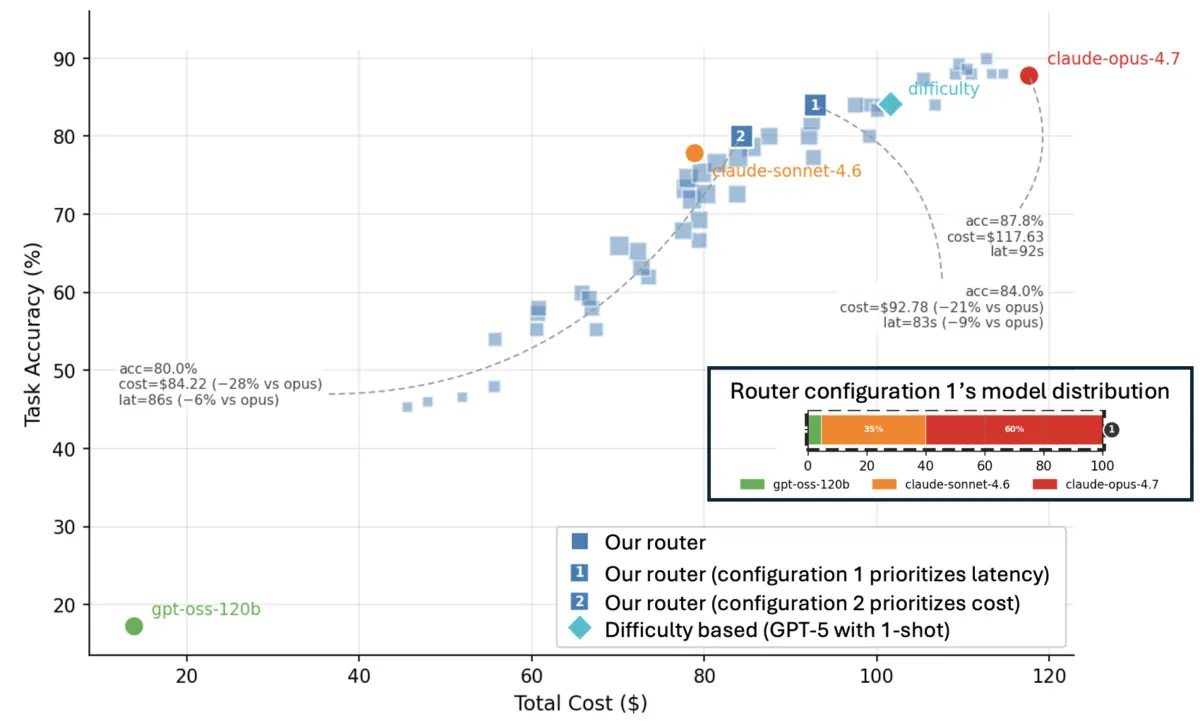
- Configuration 1 (Latency-Optimized): Achieved an impressive 84% accuracy on the AppWorld benchmark while consuming $93 in total execution costs and averaging 83 seconds per task. Compared to running a frontier model like Opus exclusively, this represented a 21% cost reduction and a 9% latency improvement, with only a negligible 4% drop in accuracy.
- Configuration 2 (Cost-Optimized): Pushed financial expenditure down even further, proving that optimization-based routers can carve out entirely new operational frontiers that static routers miss.
- The Classifier Fallacy: Traditional difficulty-based routers (represented by teal diamond benchmarks) managed similar accuracy tiers but consistently landed at significantly higher cost thresholds. They lacked the flexibility to explore the wider Pareto frontier because they viewed the routing decision as a rigid, singular choice rather than a fluid, multi-variable trade-off.
Crucially, this optimization engine does not become a performance bottleneck itself. Operating with an ultra-lightweight footprint—consuming roughly 6 milliseconds of compute time and 2 kilobytes of memory per task—the router executes silently in the background without degrading the end-user experience.
Future Outlook: The Next Frontier of Agentic Infrastructure
As autonomous agents transition from experimental toys to mission-critical enterprise infrastructure, the expectations placed upon routing layers will only intensify. The era of static, hard-coded model routing is coming to a close.
In the near future, we can expect to see several key evolutions in how agentic systems manage their underlying intelligence:
- Real-Time Telemetry Feedback Loops: Future routers will not rely on static historical pricing or assumed cache states. Instead, they will integrate live telemetry from cloud providers, dynamically adjusting routing tables based on real-time endpoint latency, current cache warmth, and localized server load.
- Native Compliance-Aware Routing: Governance will no longer be an afterthought bolted on via post-hoc filtering. Privacy constraints, regional data residency laws, and corporate compliance guardrails will be baked directly into the router’s core objective function, treating compliance as a hard constraint alongside cost and accuracy.
- Multi-Agent Orchestration Fabrics: As multi-agent systems scale—where specialized sub-agents collaborate to solve sprawling enterprise workflows—routing will evolve from a task-level decision into a continuous, decentralized scheduling protocol. Models will be dynamically swapped mid-trajectory not just to save money, but to leverage emergent cognitive strengths discovered during intermediate execution steps.
Conclusion
The evolution of AI routing teaches a timeless lesson about software engineering: simple abstractions are seductive, but production reality is relentlessly complex.
By abandoning the illusion that model selection is merely a classification problem, engineering teams can unlock unprecedented efficiencies. The future belongs to those who build systems capable of balancing the delicate, shifting interplay between cost, quality, latency, and compliance. It is an undeniably harder problem to solve, but for organizations building the next generation of autonomous agents, it is the only one that matters.
