

Executive Overview
The landscape of generative artificial intelligence has undergone a paradigm shift, expanding from text generation into sophisticated multimodal domains capable of producing photorealistic images, dynamic videos, and complex audio snippets. However, this fidelity comes at a steep architectural cost. Modern text-to-image diffusion transformers in native BF16 (Bfloat16) precision frequently demand between 20 and 30 gigabytes of VRAM. For millions of AI practitioners, researchers, and hobbyists reliant on consumer-grade graphics processing units, these resource constraints have historically posed an insurmountable barrier.
While conventional quantization solutions like bitsandbytes, GGUF, torchao, and Quanto have democratized access by storing model weights in lower precision, they have historically operated as weight-only backends. These systems compress weights to save precious VRAM, but they are forced to dequantize them back to high precision during active compute loops. As a result, memory consumption plummets, but inference speeds rarely improve—and can occasionally suffer from latency overhead.
Enter SVDQuant and its reference CUDA inference engine, Nunchaku. By utilizing a groundbreaking 4-bit weights and activations (W4A4) quantization scheme, Nunchaku radically alters the performance equation. Until recently, deploying these ultra-efficient checkpoints required specialized, standalone inference libraries that demanded local CUDA compilation and intricate environment setups.
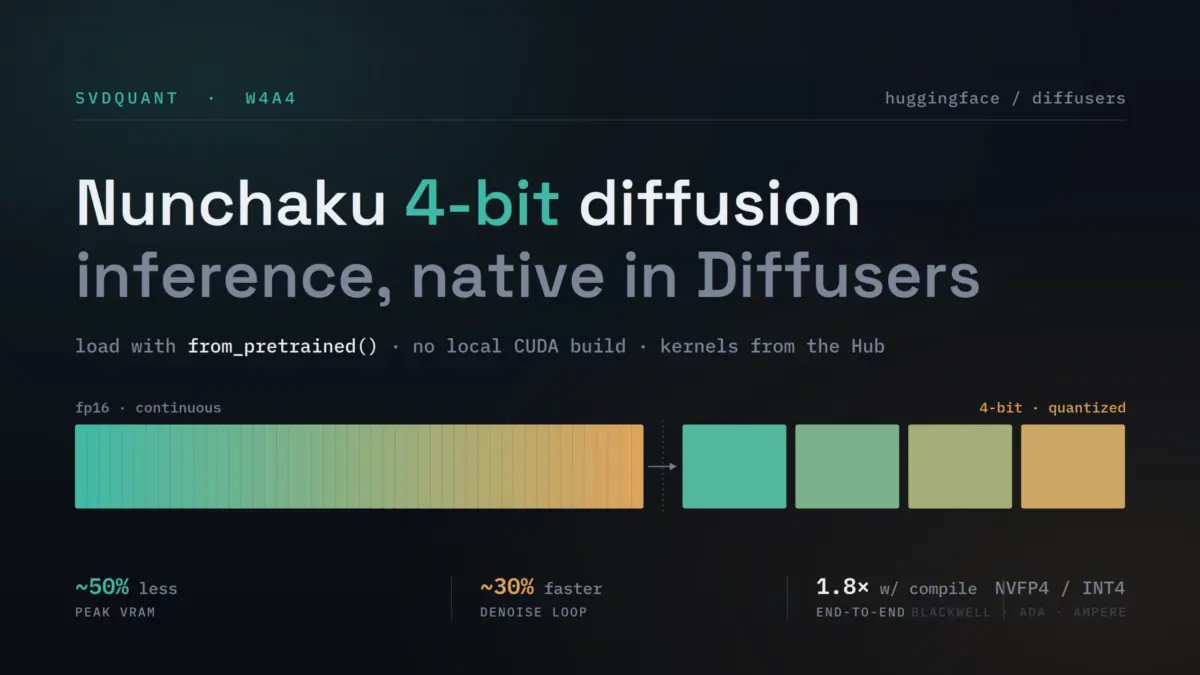
Today, this friction is a thing of the past. Through a collaborative integration spearheaded by Pham Hong Vinh (rootonchair) and Sayak Paul, the Hugging Face Diffusers library now features native support for Nunchaku checkpoints. Without requiring custom local CUDA compilation—thanks to the Hugging Face kernels package—developers can load and execute these advanced models using the familiar, ubiquitous from_pretrained() API. Accompanied by the diffuse-compressor toolkit, the AI community can now seamlessly quantize novel architectures, slash VRAM consumption by up to 50%, accelerate denoising loops by roughly 30%, and publish optimized models directly to the Hugging Face Hub.

Detailed Chronology & Technical Genesis
The Bottleneck of Diffusion Transformers
Diffusion models present unique challenges for quantization engineers. Unlike traditional large language models, where activation values are relatively well-behaved, diffusion transformers feature both weights and activations containing extreme, erratic outliers. Traditional 4-bit uniform quantization schemes crumble under these conditions, leading to catastrophic degradation in image generation quality.
To resolve this, the researchers behind SVDQuant devised an ingenious workaround: they isolate the activation outliers and absorb them directly into the weight matrices. The most mathematically challenging portions of each weight matrix are factored out into a nimble, 16-bit low-rank branch, while the remaining bulk residual matrix is compressed down to a highly efficient 4-bit format.
From Standalone Engines to Native Diffusers Integration
While the SVDQuant and Nunchaku approach delivered unprecedented speed and efficiency, its adoption was bottlenecked by infrastructure. The original Nunchaku engine derived its raw velocity from highly optimized, model-specific fused execution paths—such as fused QKV projections and fused GELU/MLP kernels. These performance optimizations were tightly coupled to individual model architectures and specialized checkpoint layouts. Supporting a new model family required extensive, bespoke engineering work, and deploying them required external libraries disconnected from standard ecosystems.
Recognizing the need for a more accessible, architecture-agnostic approach, the developers introduced Nunchaku Lite. Rather than forcing models through rigid, hardcoded optimization paths, Nunchaku Lite introduces a runtime patching mechanism. Before a checkpoint is loaded, Diffusers dynamically injects runtime SVDQ/AWQ linear layers into the stock model’s nn.Linear modules.

Crucially, the required custom CUDA kernels are fetched dynamically on demand from the Hugging Face Hub via the lightweight kernels package. This decoupling eliminated the necessity for users to compile CUDA extensions locally—a process that has long been a notorious source of dependency hell and environment friction in the deep learning community.
Supporting Context & Metrics: Under the Hood of Nunchaku Lite
To understand the practical impact of this integration, it is essential to examine how Nunchaku Lite handles hardware execution, memory allocation, and computational latency.
Architecture-Agnostic Flexibility vs. Fused Performance
The design philosophy behind Nunchaku Lite introduces an intentional trade-off. Without the rigid, architecture-specific fused kernels found in the standalone Nunchaku engine, Nunchaku Lite cannot achieve the absolute maximum theoretical speedups of a bespoke C++/CUDA pipeline. However, it retains roughly 90% of the practical benefits: users enjoy an average 30% speedup in denoising latency alongside a massive VRAM reduction of up to 50%.
Furthermore, because the quantized model preserves the exact modular hierarchy of its dense counterpart, everything downstream remains completely unaffected. Schedulers, LoRA loading hooks, memory offloading utilities, and torch.compile continue to function seamlessly, interacting with the model as if it were a standard, unquantized Diffusers pipeline.

Hardware Compatibility Matrix
Nunchaku Lite deploys different kernel variants tailored to specific GPU generations and precision targets:
| Scheme | Precision | Supported Hardware Architecture |
|---|---|---|
svdq_w4a4 |
nvfp4 |
NVIDIA Blackwell (RTX 50 series, RTX PRO 6000, B200) |
svdq_w4a4 |
int4 |
Turing / Ampere / Ada Lovelace (RTX 30 & 40 series, A100, L40S) |
awq_w4a16 |
int4 |
Turing / Ampere / Ada Lovelace (RTX 30 & 40 series, A100, L40S) |
Note: Older architectures such as Volta and Hopper are currently unsupported by these 4-bit kernels. The runtime quantizer performs rigorous validation of the host GPU’s CUDA compute capability upon initialization, throwing clear, informative error messages rather than generating corrupted outputs.
Empirical Performance Benchmarks
Comprehensive benchmarking conducted on an NVIDIA RTX PRO 6000 (Blackwell architecture) at a 1024×1024 resolution using the rootonchair/ERNIE-Image-Turbo-nunchaku-lite-int4-bnb4-text-encoder repository highlights the efficiency gains:
- BF16 Baseline: Full pipeline latency of 3.00 seconds (denoise loop: 2.86s), consuming 31.1 GB of peak VRAM.
- Nunchaku Lite (NVFP4): Full pipeline latency drops to 2.27 seconds (denoise loop: 2.13s), with peak VRAM slashed to 20.6 GB (a 1.35x speedup).
- Nunchaku Lite (NVFP4) +
torch.compile: End-to-end latency drops further to 1.68 seconds (denoise loop: 1.53s), achieving a 1.8x speedup while maintaining 20.6 GB peak VRAM. - Nunchaku Lite (NVFP4) + NF4 Text Encoder: Latency sits at 2.29 seconds, while peak VRAM usage plummets to an astonishing 16.0 GB—representing a nearly 50% reduction in memory overhead compared to the baseline.
Getting Started: Implementation Guide
Integrating Nunchaku Lite into existing workflows requires minimal code modifications. First, ensure your environment is updated with the latest versions of Diffusers, Transformers, Accelerate, and the Hugging Face kernels package:

pip install -U diffusers transformers accelerate kernels bitsandbytesLoading and executing a pre-quantized pipeline is as straightforward as initializing any standard Diffusers model:
import torch
from diffusers import ErnieImagePipeline

# Load the pre-quantized pipeline natively without local compilation
pipe = ErnieImagePipeline.from_pretrained(
    "lite-infer/ERNIE-Image-Turbo-nunchaku-lite-nvfp4_r32-bnb4-text-encoder",
    torch_dtype=torch.bfloat16,
).to("cuda")

# Execute generation
image = pipe(
    prompt="A cinematic portrait of a red fox in a misty forest at sunrise, detailed fur, volumetric light",
    height=1024,
    width=1024,
    num_inference_steps=8,
    guidance_scale=1.0,
    generator=torch.Generator("cuda").manual_seed(42),
).images[0]

image.save("output.png")
Quantizing Custom Architectures
For developers wishing to compress their own models, the accompanying diffuse-compressor toolkit provides an end-to-end SVDQuant pipeline encompassing calibration, quantization, packaging, and publishing.
Taking FLUX.2 Klein 4B as an example, the workflow proceeds through four distinct stages:
- Inspection: Run the generic scanner to verify target layers and ensure clean structural patterns:
python examples/text_to_image/quantize_hf.py black-forest-labs/FLUX.2-klein-4B --precision int4 --rank 32 --inspect-config - Quantization Execution: Generate the SVDQuant checkpoint:
python examples/text_to_image/quantize_hf.py black-forest-labs/FLUX.2-klein-4B --precision int4 --output outputs/checkpoints/svdq-int4_r32-flux-2-klein-4b.safetensors - Pipeline Packaging: Bundle the transformer with the base pipeline components and embed the
nunchaku_liteconfiguration:python examples/convert_nunchaku_lite_diffusers.py --checkpoint outputs/checkpoints/svdq-int4_r32-flux-2-klein-4b.safetensors --model-id black-forest-labs/FLUX.2-klein-4B --bnb4-text-encoder text_encoder --compute-dtype bfloat16 --output-dir outputs/diffusers/FLUX.2-klein-4B-nunchaku-lite-int4-bnb4-text-encoder - Verification & Hub Publication: Load locally for final sanity checks before pushing directly to the Hugging Face Hub using
pipe.push_to_hub().
Official Statements & Community Perspectives
The integration of Nunchaku Lite into the Hugging Face ecosystem marks a major milestone in democratizing high-end generative AI hardware accessibility.

Reflecting on the engineering hurdles overcome during development, the core maintainers emphasized the importance of seamless user experience. Transitioning complex, low-level CUDA optimizations into high-level Python libraries without sacrificing performance required careful abstraction of runtime patching mechanisms. By leveraging the Hugging Face kernels package as a dynamic bridge, the team successfully eliminated the barrier of local compilation, allowing consumer hardware owners to harness cutting-edge quantization schemes with a single line of code.
Community contributors who tested early iterations of nunchaku-lite praised its plug-and-play reliability. Early adopters noted that shrinking memory footprints by half while simultaneously accelerating generation speeds transformed previously unusable, high-parameter architectures into practical tools for local workstation environments.
Future Outlook
The successful native integration of SVDQuant and Nunchaku Lite into Diffusers establishes a powerful precedent for future model optimization. As hardware vendors continue to introduce advanced low-precision data types—such as the NVFP4 formats native to NVIDIA’s Blackwell architecture—the gap between datacenter-grade computational power and consumer hardware continues to narrow.
Looking ahead, development efforts are focused on expanding architecture-agnostic structural rewrite support, enabling automated fusion of complex query-key-value (QKV) projections across an even broader array of emerging diffusion transformer backbones. Furthermore, ongoing refinements to the diffuse-compressor toolkit will streamline the creation of custom-quantized checkpoints, empowering the open-source community to publish optimized models with unprecedented ease.

Ultimately, this development signals a broader industry trend: high-performance model compression is transitioning from an esoteric, engineering-heavy specialty into an accessible, native primitive of modern deep learning frameworks. For the broader AI community, this means that state-of-the-art generative fidelity is no longer confined to server racks equipped with banks of enterprise accelerators—it is rapidly becoming a standard capability of the modern desktop computer.
