

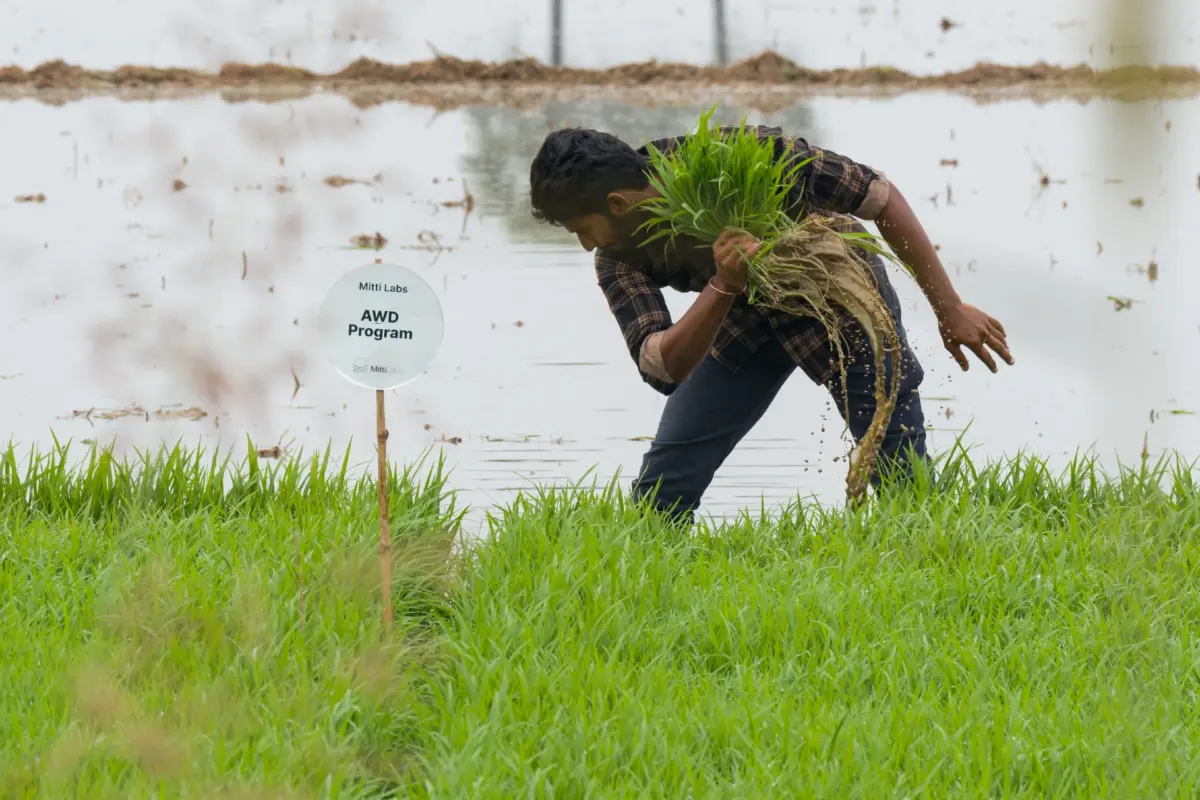
NEW YORK & BENGALURU — As escalating global temperatures, prolonged droughts, and shifting monsoon patterns place unprecedented pressure on Asia’s agrarian economies, a climate-tech startup is leveraging advanced artificial intelligence and space-borne radar to transform the world’s most water-intensive staple crop.
Mitti Labs, an enterprise dual-headquartered in New York and Bengaluru, has successfully closed a $9.5 million Series A funding round. The investment was led by Aramco Ventures—the venture capital arm of energy giant Saudi Aramco—marking a strategic milestone as the firm’s inaugural investment in an Indian startup.
The latest round also saw participation from existing backer Lightspeed India, alongside prominent institutional and corporate investors including Godrej Industries Group, Cisco, the Francis Family Fund, and Volta Circle. This new infusion of capital brings Mitti Labs’ total equity financing to $12.5 million, following a $3 million seed round secured in July 2024.
Armed with fresh funding and a rapidly expanding footprint, Mitti Labs aims to take its proprietary GeoAI platform beyond India, setting its sights on Southeast Asia to help millions of smallholder farmers slash water consumption, eliminate massive methane leaks, and unlock alternative revenue streams through carbon markets.
Executive Overview: The High Stakes of Rice Agriculture
Rice serves as the primary dietary staple for more than half of the global population, anchoring food security across billions of households, particularly throughout South and Southeast Asia. However, traditional rice cultivation methods carry a severe environmental cost.
Under conventional farming paradigms, paddy fields are kept under continuous, standing water throughout the growing season. This practice, while effective at suppressing weeds, creates anaerobic (oxygen-starved) soil conditions that trigger the prolific proliferation of methanogenic bacteria. Consequently, flooded rice paddies account for a staggering share of global agricultural methane emissions—a greenhouse gas with a warming potential significantly more potent than carbon dioxide over a 20-year timescale.
Simultaneously, the agricultural sector is confronting an acute water crisis. Rice is notoriously water-intensive, requiring thousands of liters of freshwater to produce a single kilogram of grain. As groundwater tables plummet and climate volatility disrupts historical rainfall cycles, traditional irrigation is becoming increasingly untenable.
Mitti Labs was founded to solve this dual crisis. By combining satellite radar technology, machine learning algorithms, and hyper-localized agronomic field operations, the startup offers a scalable platform designed to transition smallholder farmers away from continuous flooding toward sustainable water management practices—all without sacrificing crop yields.
Detailed Chronology: From Concept to Continental Ambition
The Genesis and Early Traction (2023–2024)
Mitti Labs emerged onto the climate-tech scene with a distinct thesis: that true agricultural decarbonization in developing nations requires marrying cutting-edge remote sensing with boots-on-the-ground farmer engagement.
In its inaugural operating season in 2024, the startup launched pilot programs engaging approximately 8,000 farmers. Recognizing the acute fragmentation of Asian agriculture—where smallholder farmers typically manage plots averaging just one hectare—Mitti Labs realized that manual auditing of fields was economically and logistically impossible. To achieve scale, the company needed to automate monitoring, reporting, and verification (MRV) processes.
To solve this, the founders built a platform fusing synthetic aperture radar (SAR) satellite imagery with years of proprietary ground-truth data. This technological foundation allowed the company to secure a $3 million seed round in July 2024, backed by early believers like Lightspeed India.
Rapid Scaling and Workforce Expansion (2025–Present)
The momentum generated during the seed phase catalyzed exponential growth. By the current season, Mitti Labs expanded its reach across multiple Indian states, scaling its active farmer network from 8,000 to more than 100,000 participants.
To support this rapid expansion, the company’s headcount surpassed 150 employees. The vast majority of this workforce is based in India, where dedicated field teams work directly with local agricultural organizations, cooperatives, and individual farmers. These human networks are vital: they bridge the digital divide, building trust and guiding smallholders through the operational shift to alternate wetting and drying (AWD) irrigation techniques.
The Series A Milestone and Aramco’s Entry
The closing of the $9.5 million Series A round marks a watershed moment for the company. Notably, the investment is spearheaded by Aramco Ventures, representing the oil conglomerate’s first-ever equity investment into the Indian startup ecosystem.
According to Mitti Labs Co-founder Xavier Laguarta, the partnership was catalyzed by a shared interest in scaling high-impact climate technologies in emerging markets. Aramco Ventures was particularly drawn to the startup’s ability to concurrently address methane mitigation, water conservation, and AI-driven agricultural optimization.
Supporting Context, Technology, and Metrics
Decoding the GeoAI Platform
At the core of Mitti Labs’ operational success is its proprietary GeoAI platform. While commercial and public satellites provide raw imagery—utilizing synthetic aperture radar (SAR) with resolutions ranging from 50 centimeters to 10 meters—Laguarta emphasizes that the true competitive moat lies not in the satellite hardware, but in the proprietary datasets used to train the company’s machine learning models.
Radar imagery penetrates cloud cover—a critical advantage during the tropical monsoon seasons common across Asian agricultural hubs. By correlating historical field measurements with real-time radar signatures, Mitti Labs constructs dynamic "digital twins" of individual smallholder rice fields.
This remote capability enables the platform to monitor:
- Crop growth cycles and health indices
- Soil moisture fluctuations
- The exact timing and duration of field flooding and drainage events
- Estimated localized methane flux reductions
Agronomic Impact and Sustainable Yields
The practical application of Mitti Labs’ platform centers around the promotion of alternate wetting and drying (AWD) and other water-saving management practices. Instead of keeping fields permanently submerged, farmers allow the soil to dry out intermittently to specific thresholds before re-flooding.
According to company data, this operational shift yields profound environmental and economic dividends:
- Water Reduction: Cuts agricultural water use by approximately 40%, preserving rapidly depleting regional aquifers.
- Methane Mitigation: Suppresses methanogenic bacterial activity, reducing methane emissions by more than 50%.
- Yield Protection: Achieves these environmental metrics without negatively impacting crop yields, preserving the livelihoods and food security of smallholders.
- Additional Revenue Streams: Every ton of greenhouse gas emissions avoided is quantified, verified, and converted into high-integrity carbon credits, providing farmers with a secondary, diversified income source.
Commercial Ecosystem and B2B Monetization
Mitti Labs operates a dual revenue model, monetizing both through the issuance and sale of carbon credits and through direct enterprise subscriptions to its GeoAI analytics platform.
The startup’s customer and partner ecosystem spans multiple tiers of the global agricultural supply chain:
- Carbon Marketplaces: Partnerships with entities like Cool Effect, which channels carbon credits to multinational heavyweights such as Google and American Airlines.
- Corporate Supply Chain Resilience: Collaborations with major agricultural and food corporations, including global rice producer Ebro Foods and agribusiness giant Syngenta. These enterprises utilize Mitti Labs’ data dashboards to track water stress, improve supply chain transparency, and hit corporate Scope 3 emission reduction targets.
Official Statements and Industry Perspectives
The convergence of oil-and-gas venture capital with a South Asian agricultural tech startup highlights a broader macro trend: heavy-industry investors are aggressively seeking verifiable, nature-based solutions to offset residual emissions and address systemic climate risks.
"Obviously, Aramco is one of the largest companies in the world, and being able to have them as a partner and potential customer over time is a really interesting position for us to be in," remarked Xavier Laguarta, Co-founder of Mitti Labs, in an interview detailing the strategic alignment with Aramco Ventures.
Laguarta noted that the partnership extends far beyond financial capital. It opens prospective pathways for Mitti Labs to leverage Aramco’s vast global network within international carbon markets and potentially collaborate directly with the energy titan as its corporate sustainability mandates evolve.
Discussing the inherent challenges of scaling agricultural technology across culturally and geographically diverse landscapes, Laguarta emphasized the platform’s fundamental identity:
"We’re really a data company at the end of the day," Laguarta explained. "When you do these expansions, you’re generating and gathering data from very different ecosystems."
Future Outlook: Expansion into Southeast Asia
With its foundation firmly established in India—where the company is on track to serve over 100,000 farmers this season—Mitti Labs is preparing for its next major continental leap.
Roadmap for 2025 and Beyond
- Philippine Market Entry: Later this year, Mitti Labs will officially launch operations in the Philippines, adapting its GeoAI models and field operations to local rice cultivation typologies and irrigation infrastructure.
- Expansion into Indonesia: Following the Philippine rollout, the startup plans to scale its footprint into Indonesia and broader Southeast Asian markets by 2027.
- Entering Compliance Markets: While the company currently operates primarily within the voluntary carbon market, expanding into diverse Southeast Asian regulatory jurisdictions will allow Mitti Labs to participate in emerging compliance carbon markets, broadening its commercial viability.
Scaling to Millions by 2030
Mitti Labs’ ultimate corporate horizon is ambitious: the startup has set a firm target to reach millions of smallholder farmers by 2030.
Achieving this will require continuous refinement of its machine learning architectures, deeper integrations with multinational food conglomerates desperate to secure water-resilient supply chains, and seamless scaling of its localized field-support networks. As climate pressures mount across the Asian continent, platforms like Mitti Labs are positioning themselves not merely as ag-tech novelties, but as indispensable infrastructure for the future of global food security and climate stabilization.
