

For years, the discourse surrounding artificial intelligence and the modern workplace has been dominated by a single, anxiety-inducing question: Will a machine take my job?
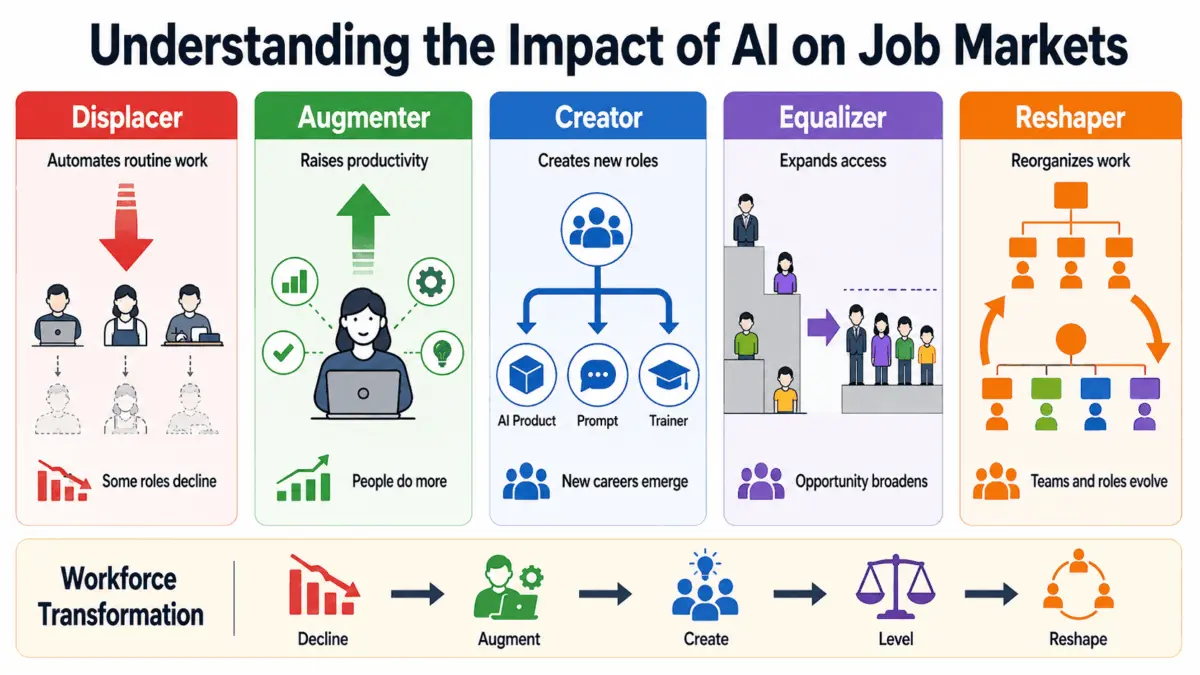
According to labor economists, business leaders, and workforce analysts, this is the wrong question—or, at best, an incomplete one. AI is not a monolith. It is not a single technological wave that either spares a role or obliterates it overnight. Instead, artificial intelligence operates as a multi-pronged catalyst, exerting simultaneous, competing pressures on the global labor market.
How AI impacts any given profession depends entirely on which of these underlying forces is acting upon it. Certain tasks are being systematically automated away. Others are being profoundly amplified. Entire new categories of work, unimaginable a decade ago, are emerging from the digital ether. Beneath these visible shifts, AI is quietly altering how organizations hire talent, how professional skills are acquired, and how career trajectories are built.
To accurately chart where the global labor market is heading, we must unpack these phenomena individually. Backed by empirical data from leading economic institutions, let us examine the five distinct ways artificial intelligence is transforming work—and what it means for the future of human capital.
Executive Overview
The integration of generative AI and machine learning into the global economy represents the most sweeping technological disruption since the advent of personal computing—and many economists argue its velocity far surpasses past industrial shifts. Rather than a blanket displacement of human labor, current data points to a complex restructuring of tasks.
While organizations actively move to reduce headcount in routine information processing, they are simultaneously pouring capital into infrastructure, specialized software engineering, and strategic oversight. The net impact will not be a frictionless transition; it is a structural realignment that rewards adaptability, specialized judgment, and technical literacy while severely punishing unadaptable routine work.
Understanding this environment requires moving past speculative panic and grounding our analysis in hard data from organizations like the World Economic Forum, Goldman Sachs, Stanford University, and the Federal Reserve.
Detailed Chronology: The Evolution of Workplace Automation
To understand where we are today, it is essential to trace how technological integration has evolved from rule-based automation to cognitive generation.
- The Pre-Generative Era (Pre-2022): For decades, enterprise automation was largely deterministic. Robotic Process Automation (RPA) and basic software scripts handled predictable, repetitive tasks like data entry, ledger reconciliation, and basic manufacturing assembly. These systems required explicit human programming for every contingency.
- The Generative Inflection Point (2022–2023): The public release of advanced large language models (LLMs) shifted the paradigm from deterministic scripting to probabilistic generation. AI transitioned from executing rigid instructions to parsing unstructured data, drafting prose, writing code, and recognizing complex patterns across diverse domains.
- The Productivity and Integration Phase (2024–2025): Enterprises moved rapidly from experimentation to deployment. Research from firms like Goldman Sachs began estimating that up to 300 million jobs globally were exposed to some degree of generative AI automation, triggering widespread corporate evaluations of workforce efficiency.
- The Structural Realignment (2026 and Beyond): The current landscape is marked by a paradox. While experienced professionals leverage AI for unprecedented productivity gains, early-career workers face an unprecedented "entry-level bottleneck" as companies route foundational tasks directly to software, redrawing the traditional corporate career ladder.
Supporting Context & Metrics: The Five Forces of AI Transformation
1. The Displacer: Automating Routine Tasks
This is the effect that dominates mainstream media headlines—and for good reason. AI excels at pattern recognition, processing massive volumes of structured and unstructured data, and executing repetitive cognitive tasks without fatigue. Where workflows are predictable, algorithms can take over the routine components that once required human labor.
The World Economic Forum’s Future of Jobs Report 2025 estimates that 92 million roles will be displaced by 2030 as technology, demographic shifts, and economic pressures reshape the global market. Furthermore, a survey of more than 1,000 global employers revealed that 41 percent plan to actively reduce their workforces as AI automates specific tasks.
Who feels this first? Roles built around routine information processing: data entry clerks, administrative assistants, basic accounting personnel, and first-line customer support agents. Rarely does an entire job vanish overnight; instead, organizations break roles down into discrete tasks, hand the predictable components to software, and leave human workers to grapple with the unpredictable edge cases.
2. The Augmenter: Amplifying Knowledge Work
For millions of professionals, AI acts less like a replacement and more like an extraordinarily capable collaborator. Rather than eliminating jobs, it absorbs the friction-heavy, repetitive elements of knowledge work—such as summarizing multi-page legal briefs, generating boilerplate code, or drafting initial marketing copy—freeing humans to focus on high-level strategy and creative direction.
Goldman Sachs research estimates that roughly two-thirds of all occupations are at least partially exposed to AI automation, translating to roughly 300 million exposed jobs worldwide. However, the firm projects that the vast majority of this exposure will manifest as a productivity multiplier rather than outright job destruction, potentially lifting global GDP by approximately 7 percent over a decade.
Who feels this? Software developers, copywriters, financial analysts, industrial designers, and middle managers. The nature of daily work shifts from production to direction and editing. A copywriter transitions into an editor of AI-generated drafts; a software engineer focuses on system architecture and code review while an AI assistant handles the foundational syntax.
3. The Creator: Generating New Occupations
Every major technological revolution destroys legacy jobs while inventing entirely new categories of work that were previously impossible to conceptualize. The commercialization of the internet birthed roles like web developer, search engine optimization specialist, and cybersecurity engineer—positions that would have seemed nonsensical a generation prior. AI is driving a parallel wave of job creation.
The Future of Jobs Report 2025 projects the creation of 170 million new roles by 2030, resulting in a net gain of 78 million jobs even after accounting for displacement. High-growth titles include big data specialists, machine learning engineers, and information security analysts. Crucially, the massive compute demands behind AI infrastructure are also driving a physical building boom, causing a surge in hiring for electricians, HVAC technicians, and specialized construction crews building next-generation data centers.
4. The Equalizer: Compressing the Skill Gap
For decades, transformative technologies disproportionately rewarded already-skilled workers, widening wage inequality and expanding skill gaps. Generative AI, however, frequently works in reverse within specific operational contexts.
Economists Erik Brynjolfsson, Danielle Li, and Lindsey Raymond studied more than 5,000 customer support agents at a major software firm. Access to an AI assistant raised overall productivity by roughly 14 percent, but the distribution of those gains was striking: novice and lower-skilled agents saw their performance jump by approximately 34 percent, while top-tier veteran agents experienced little change. The AI tool democratized the tacit knowledge of top performers, effectively enabling agents two months into the job to perform at levels comparable to peers with six months of tenure.
5. The Reshaper: Redrawing the Career Ladder
While the equalizer effect helps novices get up to speed faster, it raises a troubling question: If software can handle entry-level work, where do future senior experts come from?
A pivotal 2025 Stanford University study titled "Canaries in the Coal Mine" tracked payroll records for millions of workers and discovered that individuals aged 22 to 25 in AI-exposed fields—such as software development and customer service—suffered a roughly 13 percent relative decline in employment following the widespread adoption of generative AI, while older workers in identical roles remained stable. A subsequent 2026 dashboard confirmed this trend was deepening. Compounding this, the Federal Reserve Bank of New York reported that underemployment among recent college graduates reached 42.5 percent in late 2025.
Companies that lean too heavily on AI to eliminate entry-level hiring risk undermining their own talent pipelines, cutting off the foundational experience required to cultivate tomorrow’s senior leadership.
Official Statements & Industry Perspectives
Industry leaders and academic institutions continue to issue guidance on navigating this transition. In policy briefings accompanying the WEF Future of Jobs Report, labor experts emphasize that corporate agility is paramount.
"The organizations that survive and thrive will not be those that simply cut payroll to boost short-term margins, but those that invest aggressively in internal reskilling," notes a consortium of workforce development researchers. "The human element—comprising critical thinking, empathy, ethical oversight, and complex problem-solving—remains irreplaceable. Technology changes the tools of the trade; it does not eliminate the human need for purpose-driven enterprise."
Similarly, technological ethicists argue that regulatory frameworks must evolve alongside enterprise adoption. As AI systems take over decision-making processes in hiring, credit scoring, and resource allocation, the demand for rigorous compliance, bias auditing, and governance specialists has never been more urgent.
Summary Matrix: The Five Forces at a Glance
| Force | Primary Operational Effect | Roles Most Heavily Impacted | Recommended Professional Adaptation |
|---|---|---|---|
| The Displacer | Automates predictable, routine tasks | Data entry clerks, administrative staff, basic support | Transition toward complex, strategic, human-centric responsibilities |
| The Augmenter | Collaborates on complex knowledge work | Developers, copywriters, financial analysts, managers | Master the art of prompting, editing, and directing AI outputs |
| The Creator | Spawns brand-new industries and infrastructure | Tech sector, infrastructure trades, specialized consulting | Cultivate continuous learning and technical adaptability |
| The Equalizer | Narrows performance gaps between novices and experts | Support staff, content writers, junior analysts | Adopt AI tools early to rapidly flatten the learning curve |
| The Reshaper | Restructures and thins entry-level career rungs | Early-career professionals in exposed technical fields | Build deep judgment, domain expertise, and emotional intelligence |
Future Outlook
The global labor market is undergoing its most profound structural evolution since the Industrial Revolution. Most modern professions do not experience just one of these forces in isolation; rather, a software engineer, financial analyst, or marketing director feels the push and pull of multiple forces simultaneously. A modern developer benefits from augmentation daily, leverages the equalizer effect to master new languages quickly, yet faces reshaping pressures at the junior hiring level.
The most effective strategy for the modern worker is not to ask abstractly whether machines will steal employment, but to perform a rigorous audit of their specific professional domain. Identify which of the five forces is acting upon your daily responsibilities, pinpoint your vulnerabilities, and deliberately redirect your energy toward cultivating the uniquely human skills—strategic oversight, emotional intelligence, cross-disciplinary synthesis, and complex ethical judgment—that artificial intelligence cannot replicate.
Those who map their careers against these tectonic shifts will not merely survive the AI transition; they will lead it.
Written by Vinod Chugani, an AI and data science educator specializing in agentic workflows, machine learning applications, and technical skill development for modern professionals.
