

Executive Overview
In a watershed moment for the autonomous vehicle (AV) industry, Santa Clara-based startup Gatik has successfully closed a massive $200 million funding round. This capital infusion arrives on the heels of a high-profile, multiyear commercial agreement with consumer goods giant PepsiCo, signaling an aggressive pivot from pilot programs to full-scale commercialization.
The Series E-tier financing was co-led by the Qatar Investment Authority (QIA) and Koch Disruptive Technologies (KDT), with strategic participation from institutional heavyweights including Millennium Management, ARK Invest, and Intact Private Capital. While Gatik’s executive team has chosen to keep the company’s current valuation private, this latest influx brings the startup’s total capital raised to an impressive $500 million since emerging from stealth mode in 2019.
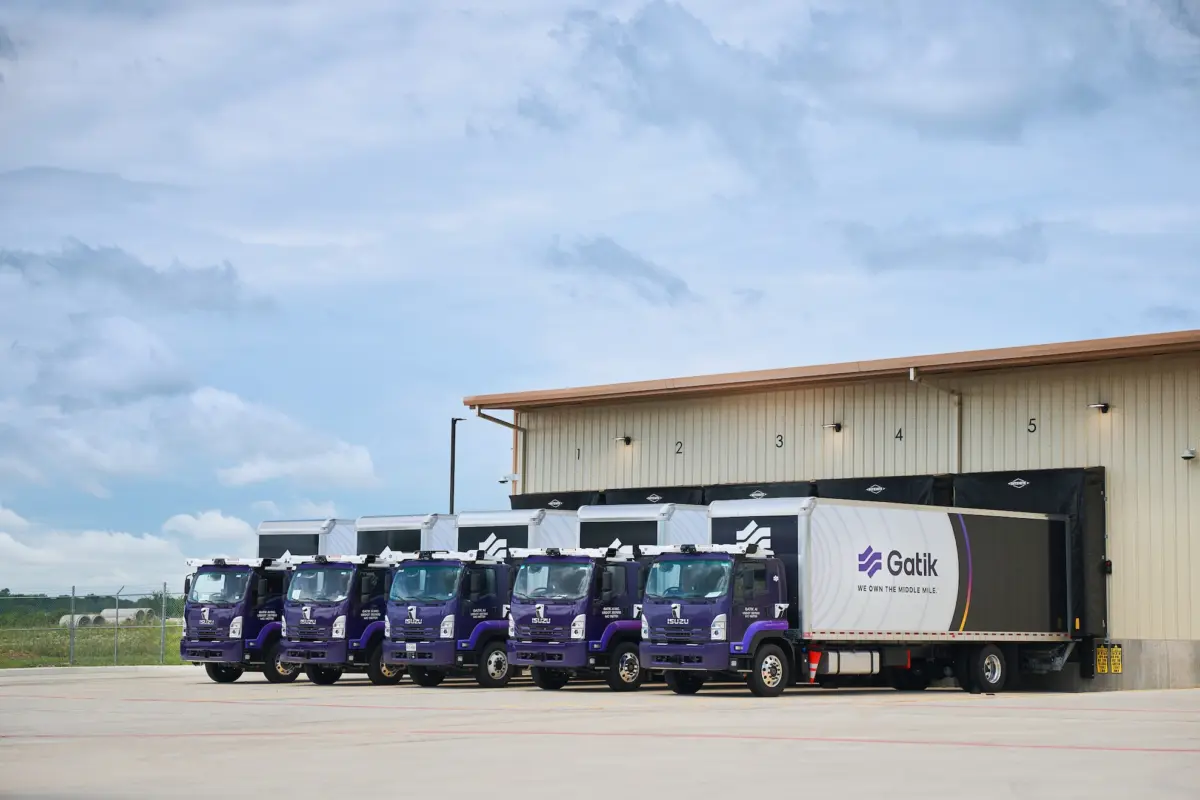
This record-breaking investment is Gatik’s largest to date, serving as both a financial cushion and a strategic springboard. Unlike many of its industry peers who chased the elusive consumer robotaxi market or struggled to commercialize long-haul semi-trucks, Gatik carved out a highly specialized, highly lucrative niche: Business-to-Business (B2B) middle-mile logistics. By utilizing a fleet of specialized Isuzu box trucks tailored for short-to-medium-haul B2B deliveries, Gatik has systematically solved the supply chain bottlenecks that plague major retailers and food distributors.
With over $600 million in contracted revenue locked in, a rapidly expanding blue-chip client roster that includes Walmart, Kroger, Loblaws, Tyson Foods, and PepsiCo, and a proven capability to operate fully driverless commercial routes around the clock, Gatik is no longer just a promising Silicon Valley experiment. It is a mature logistics powerhouse redefining the commercial transit landscape across North America—with global expansion firmly in its sights.
Detailed Chronology: From Stealth Startup to Commercial Heavyweight
To understand Gatik’s current market dominance, one must examine the meticulous, calculated trajectory the company has maintained since its inception.
2019: Emerging from Stealth with a Retail Giant
Founded in 2017 by veteran autonomous vehicle technologists Gautam Narang and Sven Beiker, Gatik deliberately avoided the crowded race to build consumer-facing robotaxis or long-haul Class 8 big rigs. Instead, the founders zeroed in on the "middle mile"—the critical transit phase where goods are moved from central distribution centers to retail storefronts, dark stores, and micro-fulfillment centers.
In June 2019, Gatik officially came out of stealth, announcing a landmark commercial partnership with retail behemoth Walmart. This initial deployment utilized a fleet of autonomous multi-temperature delivery vans operating on fixed, highly regulated B2B routes in New Orleans and Northwest Arkansas. It proved that automated logistics could deliver immediate, measurable ROI for enterprise supply chains.
2020–2021: Scaling the Footprint and Proving Safety
While the global pandemic threw traditional supply chains into chaos, Gatik’s autonomous model thrived. The company rapidly expanded its geographic footprint into Canada through a partnership with grocery titan Loblaws, deploying autonomous box trucks across Toronto to transport goods safely and efficiently amid labor shortages and surging e-commerce demand.
During this period, Gatik also forged a strategic vehicle-manufacturing partnership with Isuzu Motors, integrating its proprietary autonomous driving system (ADS) directly into commercial-grade chassis. This ensured the hardware was rugged, reliable, and easily integrated into existing commercial fleet management workflows.
2022–2023: Achieving True Driverless Operations
A critical inflection point arrived in late 2022 when Gatik reached a monumental technical and regulatory milestone: pulling the safety driver from behind the wheel on commercial routes. Operating without a safety driver (safety-driver-out operations) represents the holy grail of the AV industry, transforming a high-burn research project into a high-margin, scalable commercial enterprise.
Gatik successfully transitioned to commercial driverless operations in multiple complex urban markets, proving its third-generation technology stack could safely navigate dense traffic, unpredictable pedestrian behavior, and severe weather events, including heavy rain and snow.
Late 2024–Present: The PepsiCo Partnership and $200M Capital Infusion
In late 2024, Gatik announced its largest public commercial rollout to date: a multiyear agreement with PepsiCo. The deployment features a fleet of 41 fully driverless box trucks transporting iconic Frito-Lay products—including Cheetos, Doritos, and Lay’s—from regional distribution hubs directly to retail shelves in Dallas, Phoenix, and Northwest Arkansas.
Building directly upon this momentum, Gatik secured its $200 million funding round in early 2025. This capital is earmarked specifically to accelerate fleet manufacturing, expand workforce headcount, and scale operational deployment across new and existing geographical markets.
Supporting Context & Metrics: Decoding the Middle-Mile Phenomenon
The autonomous vehicle landscape is littered with billions in venture capital that yielded unrealized promises. Why has Gatik succeeded where others stalled? The answer lies in market design, operational focus, and rigorous risk mitigation.
The Middle-Mile Advantage
While consumer robotaxis face insurmountable regulatory hurdles, unpredictable urban environments, and complex passenger liability, and long-haul trucking contends with massive highway speeds and infrastructure gaps, middle-mile logistics offer an ideal "Goldilocks" operating environment:
- Fixed or Semi-Fixed Routes: Gatik’s trucks typically operate on predictable, repetitive B2B corridors. This allows engineers to map routes meticulously and eliminate countless variables.
- Controlled Stakeholders: Pick-up and drop-off points are commercial distribution centers and corporate-owned retail stores—not chaotic consumer curbsides.
- High Economic Value: Retailers and grocers face staggering labor shortages and rising transportation costs. Automating the middle mile directly addresses a retailer’s bottom line, guaranteeing rapid adoption and strong contract retention.
Key Performance Metrics & Financial Health
- Total Capital Raised: ~$500 million since 2019.
- Latest Funding Round: $200 million (Series E equivalent), co-led by Qatar Investment Authority (QIA) and Koch Disruptive Technologies (KDT).
- Contracted Revenue: ~$600 million in secured commercial contracts.
- Fleet Size & Operations: Dozens of third-generation autonomous Isuzu box trucks operating 24/7 across multiple U.S. and Canadian markets.
- Workforce: Approximately 350 employees, with aggressive hiring plans for engineering and operational talent.
- Enterprise Client Roster: PepsiCo, Walmart, Kroger, Loblaws, and Tyson Foods.
Official Statements: Perspectives from Leadership
The strategic significance of Gatik’s recent milestones is best captured through the words of its leadership team and key investors.
Reflecting on the caliber of investors backing the company’s vision, Gautam Narang, Co-founder and CEO of Gatik, emphasized the long-term nature of the partnership in a recent interview:
“These are all long-term investors. All the scale-up plans that we have and the growth that we have in mind for the next few years — these are the kind of financial partners that can help us.”
Detailing the rapid maturation of Gatik’s proprietary technology stack, Narang highlighted how engineering breakthroughs have unlocked 24/7 operational capability:
“The technology has evolved and matured a lot over the last few years, especially with the latest generation of our tech. Our third-generation self-driving trucks operate around the clock on surface streets and highways, and can handle light rain and snow.”
Investors have similarly expressed high conviction in Gatik’s business model. Representatives from Koch Disruptive Technologies and the Qatar Investment Authority noted that Gatik’s ability to solve real-world supply chain inefficiencies—while maintaining an uncompromising focus on safety and unit economics—positions the company as a definitive category leader in the B2B autonomous transportation sector.
Future Outlook: Scaling Beyond North America
With $200 million freshly added to its balance sheet and $600 million in contracted revenue ready to be fulfilled, Gatik’s roadmap for the coming years is both aggressive and deliberate.
1. Workforce Expansion and Engineering Excellence
Scaling a commercial AV fleet requires top-tier talent. Gatik plans to aggressively expand its ~350-person workforce, recruiting elite robotics engineers, artificial intelligence researchers, software developers, and localized operations staff to manage real-time fleet oversight and maintenance.
2. Deepening Existing Partnerships and Regional Densification
Rather than spreading itself too thin across dozens of unproven markets, Gatik’s immediate strategy centers on deepening density within its existing operational hubs—such as Dallas, Phoenix, Arkansas, and Toronto. By saturating these high-volume corridors with additional Isuzu box trucks, Gatik can drive down operational costs per mile for enterprise clients like PepsiCo and Walmart.
3. International Expansion Beyond North America
While Gatik’s current operational footprint is strictly North American, CEO Gautam Narang has made it clear that the company’s ambitions extend far beyond U.S. and Canadian borders. As supply chain digitization accelerates globally, international markets with high labor costs and structured retail distribution networks—such as parts of Europe and the Asia-Pacific region—represent prime targets for future international deployment.
Conclusion
Gatik’s $200 million funding round is more than just a financial milestone; it is validation of a pragmatic approach to autonomous mobility. By turning its back on hype and focusing entirely on the unglamorous yet vital mechanics of middle-mile logistics, Gatik has quietly built a robust, revenue-generating commercial empire. As its fleet of driverless box trucks continues to roll 24/7 across highways and city streets, Gatik is proving that the driverless future of supply chains has already arrived.
