

Executive Overview
The technological landscape is undergoing a profound paradigm shift, fundamentally reshaping how software is conceptualized, engineered, and brought to market. At the epicenter of this transformation is the artificial intelligence boom, a movement that has torn down the traditional barriers of entry to software development. Today, a vastly wider demographic—ranging from domain experts with zero traditional coding background to seasoned software architects—is leveraging generative AI to write code, spin up applications, and launch digital products at unprecedented velocity.
This democratization of software creation carries profound implications. For established developers, AI has transitioned from a novel productivity hack to an operational imperative, with many modern coders refusing to work without AI-powered assistants, even as industry veterans debate the long-term impacts on foundational programming skills and code quality. Meanwhile, for everyday visionaries, the distance between conceiving a software application and deploying it has shrunk from months of rigorous engineering to mere hours of natural language prompting.
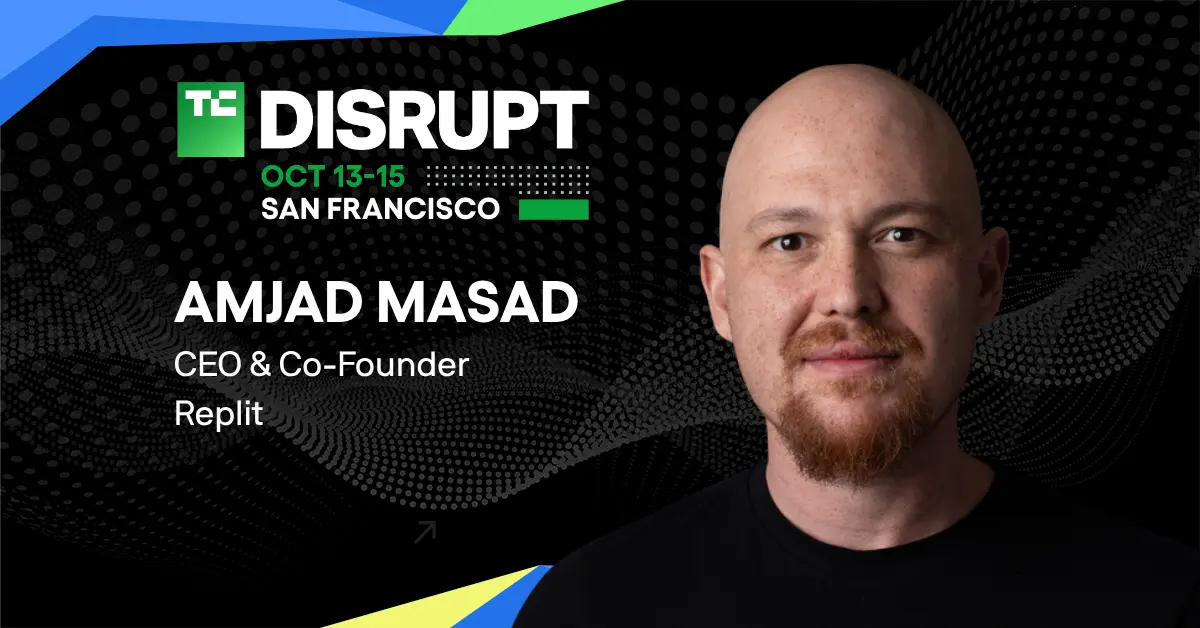
Sitting squarely at the center of this evolutionary leap is Replit, a platform that has transformed from a collaborative browser-based integrated development environment (IDE) into an AI-native software creation engine. As Replit experiences staggering financial growth—surging from modest revenues of $2.8 million in 2024 to an annualized run-rate tracking toward a billion dollars—its co-founder and CEO, Amjad Masad, is preparing to take center stage at TechCrunch Disrupt 2026.
Scheduled for October 13–15 at San Francisco’s Moscone West, Disrupt 2026 will host Masad for a headline-making, wide-ranging discussion on the future of programming, the maturation of AI-driven entrepreneurship, and the mechanics of turning raw ideas into scalable, production-ready software. This comprehensive report explores Replit’s explosive ascent, the broader socio-technical shifts in the AI-coding ecosystem, and what attendees can expect from the year’s defining technology conference.
Detailed Chronology: From Niche Browser IDE to a Multi-Billion-Dollar AI Giant
To truly understand Replit’s current dominance, one must trace its evolution from a niche developer utility to an enterprise-grade juggernaut. Founded a decade ago by Amjad Masad, Haya Al-Husseini, and Faris Masad, Replit originally carved out a loyal following by lowering the friction of writing code. By enabling developers to write, compile, and run code entirely within a web browser without the tedious setup of local environments, Replit democratized learning how to code for students and hobbyists worldwide.
However, the past 18 months have marked an era of hyper-acceleration that even the company’s founders could scarcely have predicted. The timeline of this transformation illustrates the blistering pace of the generative AI revolution:
- The Baseline (2024): Replit operated as a robust, cloud-based collaborative coding platform. While widely praised by educators and lightweight developers, its reported annual revenue stood at a modest $2.8 million, reflecting a traditional SaaS growth trajectory for developer tools.
- The AI Inflection Point (Late 2024 – Early 2025): As large language models capable of code synthesis matured, Replit aggressively pivoted its product roadmap. The company integrated contextual AI agents capable not just of autocompleting lines of code, but of generating entire project structures, debugging errors, and deploying applications autonomously.
- The Valuation Leap (Late 2025 – Early 2026): The market responded with historic fervor. Just six months after securing a $3 billion valuation, Replit stunned the venture capital ecosystem in March 2026 by closing a funding round that pegged its valuation at a staggering $9 billion.
- The Billion-Dollar Horizon (Mid 2026): Defying skeptics who questioned whether AI-centric developer tools could achieve durable monetization, Replit’s financial metrics skyrocketed. By mid-2026, the company’s current run-rate was officially tracking toward $1 billion annually, representing one of the fastest scale-ups in software history.
This chronology underscores a fundamental shift in the software economy: tools that empower non-technical creators while supercharging professional developers are capturing unprecedented market share and capital.
Supporting Context & Metrics: The Economics of the AI-Coding Era
The staggering financial metrics surrounding Replit are not an isolated anomaly; they are emblematic of a broader macroeconomic shift driven by artificial intelligence. According to recent industry data, the global software development market is undergoing a structural reorganization driven by three key pillars: the expansion of the developer pool, the compression of software lifecycles, and the emergence of AI-first venture formation.
1. Expanding the Total Addressable Market (TAM) of Creators
Historically, the software engineering workforce was capped by the time-intensive process of learning syntax, memory management, and deployment pipelines. By introducing natural language as the primary programming interface, platforms like Replit have effectively expanded the addressable market of software creators from roughly 30 million professional developers worldwide to the global population of knowledge workers. Entrepreneurs, marketers, operations managers, and domain specialists can now act as product architects.
2. The Productivity Dividend vs. Technical Debt
While the productivity gains are undeniable—routine coding tasks that once took days are now executed in minutes—the ecosystem faces growing pains. A recent TechCrunch investigation highlighted a polarizing trend: a rising cohort of coders are outright refusing to work without AI assistants. While this dramatically accelerates delivery speeds, engineering leaders are grappling with the long-term consequences of dependency on AI-generated code, including increased technical debt, security vulnerabilities, and a potential degradation of foundational computer science problem-solving skills in junior engineers.
3. Valuation Velocity and Venture Capital Realities
Replit’s leap from a $3 billion valuation to $9 billion in just half a year highlights the intense capital competition for category-defining AI infrastructure. Investors are no longer merely funding software-as-a-service (SaaS) products; they are buying equity in platforms that aim to become the operating systems for the next generation of digital businesses. Yet, this high-stakes environment brings immense pressure. The critical question facing Masad and his peers at TechCrunch Disrupt 2026 is sustainability: How do you build a structurally sound, profitable enterprise in an era where AI capabilities evolve by the month and competitive moats can evaporate overnight?
Official Statements and Industry Perspectives
Amjad Masad’s upcoming keynote at TechCrunch Disrupt 2026 is anticipated to offer deep strategic insights into these exact dilemmas. In previous statements and interviews leading up to the conference, Masad has consistently emphasized that Replit’s ultimate mission transcends simple code generation.
"We are not just building a tool to help users prototype their ideas," Masad has noted in discussions surrounding the company’s product philosophy. "The true milestone of AI development is taking an abstract concept and guiding the user all the way through to a fully fleshed-out, production-ready, revenue-generating product."
This distinction between prototyping and production is vital. While many early AI code generators allow users to spin up a flashy demo in minutes, they often break down when subjected to edge cases, scalability demands, and enterprise-grade security protocols. Replit’s recent product iterations have focused heavily on closing this gap—providing infrastructure, database management, and hosting natively within the ecosystem so that a non-technical founder can build, test, and scale a real business without ever leaving the platform.
Industry analysts will also be listening closely to Masad’s perspective on market consolidation, including Replit’s navigation of the competitive landscape (such as its positioning relative to tools like Cursor), its navigation of platform dynamics with tech giants like Apple, and Masad’s long-term vision for maintaining independence in an industry dominated by massive tech consolidation.
Future Outlook: What to Expect at TechCrunch Disrupt 2026
As the technology sector looks toward the remainder of 2026 and beyond, events like TechCrunch Disrupt serve as the ultimate barometer for industry health, innovation, and upcoming trends.
Key Themes of Disrupt 2026
Running from October 13–15 at San Francisco’s Moscone West, Disrupt 2026 will gather more than 10,000 founders, investors, engineers, and tech executives across six specialized stages. Key focal points of this year’s conference include:
- Sustainable AI Business Models: Moving past the hype cycle to examine how startups can achieve durable unit economics and profitability in the shadow of high compute costs.
- The Next Generation of Software Architecture: Exploring how autonomous AI agents, multi-modal programming interfaces, and natural language computing are rewriting the rules of system design.
- Founder Guidance & Strategic Networking: Dedicated tracks providing actionable playbooks for early-stage founders navigating fundraising, hiring, and scaling in a hyper-competitive macroeconomic climate.
Secure Your Place at the Forefront of Innovation
For those looking to build, invest, or innovate within the AI era, attending Disrupt 2026 offers an unmatched opportunity to witness industry leaders like Amjad Masad share their blueprints for the future.
Special Promotional Pricing Notice: TechCrunch has extended its special ticket promotion. Attendees can currently secure up to $300 off their tickets until 11:59 p.m. PT on Tuesday, August 25.
Whether you are a seasoned software architect adapting to the AI-coding reality or a non-technical founder building your first software enterprise, the insights shared on the Moscone West stage this October will help define the next decade of digital innovation. Grab your tickets today to join thousands of peers shaping the future of technology.
Disclaimer: When you purchase tickets or products through links in our articles, TechCrunch may earn a small commission. This editorial independence ensures our coverage remains unbiased, rigorous, and dedicated to serving the global startup and technology community.
