

Published: August 6, 2026
Dateline: SAN FRANCISCO & MESA, ARIZONA
Executive Overview
In a milestone transaction highlighting the surging intersection of national security, artificial intelligence, and advanced manufacturing, defense technology startup Hadrian announced on Thursday that it has closed a staggering $1.37 billion Series D funding round. The new capital injection vaults the company to a $7.87 billion valuation, cementing its status as one of the most critical foundational players in the modern Western defense-industrial complex.
Unlike the software-first defense startups that typically dominate venture capital headlines—those focused on autonomous drone swarms, battlefield AI, or satellite reconnaissance—Hadrian is tackling an arguably more vulnerable bottleneck: hardware manufacturing. The company designs, builds, and operates highly automated, software-driven factories that mass-produce high-precision aerospace and defense components. These are the critical mechanical parts, turbine blades, structural frames, and propulsion elements required for the complex military hardware—such as nuclear submarines, fighter jets, and tactical vehicles—that the United States and its allies rely on for strategic deterrence.
The Series D round features an extraordinary roster of institutional heavyweight investors. It was co-led by WCM Investment Management, Washington Harbour Partners, Valor Equity Partners, 137 Ventures, and Baillie Gifford. They were joined by an elite consortium of participating entities, including 1789 Capital, Morgan Stanley Wealth Management, funds managed by Apollo and T. Rowe Price, CapitalG, Andreessen Horowitz, Founders Fund, Lux Capital, and Altimeter.
This massive influx of capital arrives roughly a year after Hadrian secured its $260 million Series C financing—which was co-led by Founders Fund and Lux Capital. According to venture capital data provider PitchBook, Hadrian’s cumulative fundraising total now hovers around $2 billion, making it one of the fastest-scaling industrial technology companies in history.
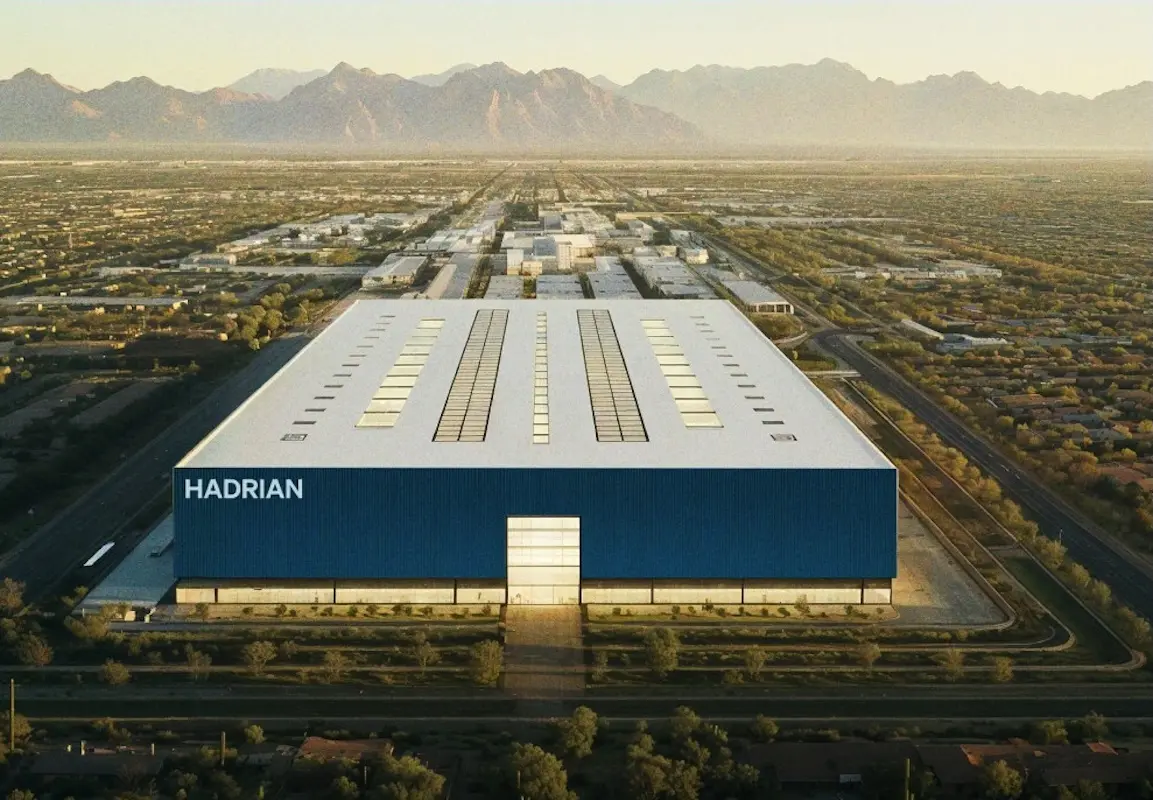
With the fresh capital, Hadrian plans to accelerate its aggressive footprint expansion, highlighted by the development of its third major facility in Mesa, Arizona, and its broader mission to reverse decades of industrial hollowing out in the United States.
Detailed Chronology: From Concept to Industrial Titan
The journey of Hadrian reflects the rapid evolution of defense technology investing, a sector that has pivoted dramatically over the last half-decade from skepticism to aggressive national urgency.
The Founding Era and Early R&D
Founded with the realization that the Western world’s manufacturing capacity had withered—leaving critical supply chains vulnerable to geopolitical friction—Hadrian set out to bypass the legacy, manual-heavy machine shops that have traditionally supplied the aerospace and defense sectors. Traditional aerospace machining is notoriously slow, heavily reliant on a rapidly retiring skilled labor force, and plagued by severe supply chain bottlenecks.
Hadrian approached this challenge not as a traditional manufacturer, but as a deep-tech software company. By integrating proprietary artificial intelligence, machine learning, and robotics into the factory floor, the company built an end-to-end automated manufacturing pipeline capable of drastically reducing lead times and error rates for complex metal parts.
Scaling and the Series C Turning Point
For years, hardware startups faced an uphill battle against the "hard-tech" stigma in Silicon Valley, where investors historically preferred high-margin, zero-marginal-cost software plays. However, shifting geopolitical tensions—particularly regarding manufacturing concentration in Asia and vulnerabilities in raw material supply chains—fundamentally shifted venture capital sentiment.
Approximately a year prior to the Series D announcement, Hadrian closed a $260 million Series C round led by stalwart defense tech backers Founders Fund and Lux Capital. This round provided the foundational capital needed to transition Hadrian from an experimental production house to a full-scale commercial manufacturer capable of handling high-volume contracts for prime defense contractors.
The Alabama Submarine Partnership
The true turning point for Hadrian’s industrial scale came earlier this year in March, when the company officially opened an advanced manufacturing facility in Alabama, designed specifically to feed parts into the production lines for the U.S. Navy’s Columbia- and Virginia-class nuclear-powered submarines.
Structured as a unique public-private partnership, the deal surrounding the Alabama site was valued at an impressive $2.4 billion. This facility marked Hadrian’s fourth major operational site, positioning the company as an indispensable link in the naval maritime supply chain. The U.S. Navy has faced severe backlogs in submarine construction due to a lack of Tier 2 and Tier 3 component suppliers; Hadrian’s entry into the space offered an immediate, technologically advanced remedy to a critical national security vulnerability.
The Mesa, Arizona Expansion and Series D Milestone
Building on its momentum in Alabama and its existing footprints, Hadrian turned its sights toward the American Southwest. The company recently released renderings and broke ground on its planned third facility in Mesa, Arizona (with manufacturing operations scaling across multiple regional hubs).

To fund this next generation of factories—which will feature even higher degrees of automation, proprietary robotics, and AI-driven quality control—Hadrian went to market for its historic $1.37 billion Series D. By commanding a $7.87 billion valuation in a macroeconomic environment that has otherwise seen tighter venture capital discipline, Hadrian proved that capital markets are willing to heavily reward tangible, mission-critical infrastructure plays that directly address sovereign manufacturing deficits.
Supporting Context & Metrics: The Defense Manufacturing Crisis
To understand the significance of Hadrian’s $1.37 billion round, one must examine the macro-level state of the U.S. defense-industrial base. For decades, the logic of globalization drove the outsourcing and consolidation of heavy manufacturing. Between the end of the Cold War and the mid-2010s, the number of independent defense suppliers in the United States plummeted by tens of thousands.
The Tier 2 and Tier 3 Bottleneck
While prime contractors like Lockheed Martin, Northrop Grumman, General Dynamics, and Huntington Ingalls Industries manage massive systems integration, they rely on a vast ecosystem of smaller machine shops—known as Tier 2, 3, and 4 suppliers—to build the individual structural components, valves, brackets, and propulsion shafts.
- Labor Shortage: The average age of a certified machinist in the United States is pushing past 55, with thousands retiring every year and insufficient younger workers entering the trade.
- Lead Times: Traditional machine shops often quote lead times of 12 to 18 months for specialized aerospace titanium or inconel parts, creating crippling gridlock for military procurement schedules.
- Geopolitical Vulnerability: Heavy reliance on foreign raw materials and overseas processing leaves the U.S. military exposed to sudden supply shocks.
How Hadrian Solves the Crisis
Hadrian’s automated factories are engineered to break these bottlenecks through three core pillars:
- Software-Defined Manufacturing: By using proprietary software to ingest CAD (Computer-Aided Design) files and instantly generate toolpaths, Hadrian eliminates days of manual programming by human engineers.
- Lights-Out Automation: The company’s facilities leverage advanced robotics to handle material loading, machine tending, and part transfer, enabling continuous, multi-shift production with minimal human intervention.
- Rigorous Quality Assurance: AI-powered optical and laser metrology systems inspect parts in real-time, drastically reducing scrap rates and ensuring that every component meets the stringent mil-spec standards required for nuclear submarines and hypersonic flight.
Financial Footprint Breakdown
- Total Capital Raised to Date: Approximately $2.0 billion (inclusive of seed, Series A, B, C, and the new $1.37 billion Series D).
- Latest Valuation: $7.87 billion.
- Key Facilities: Spanning multiple high-tech manufacturing sites, including major hubs in California, the $2.4 billion-backed Alabama facility supporting Navy submarines, and the rapidly developing Mesa, Arizona campus.
- Investor Diversity: A rare blend of traditional Silicon Valley venture capital (Founders Fund, Lux Capital, Andreessen Horowitz, CapitalG), institutional crossover giants (T. Rowe Price, Baillie Gifford, Morgan Stanley Wealth Management, Apollo), and specialized national security and industrial funds (Washington Harbour Partners, Valor Equity Partners, 137 Ventures, 1789 Capital).
Official Statements and Industry Perspective
While formal press statements released via PR Newswire emphasize the collective push toward "America’s industrial renewal," industry analysts and macroeconomic observers have noted the profound shift in how private capital views national defense.
"Hadrian is not merely building factories; they are reconstructing the physical foundation of Western deterrence," noted an industry strategist close to the defense technology sector. "For too long, policymakers assumed that software alone could solve our strategic challenges. Hadrian’s rapid scaling proves that investors now realize supremacy requires heavy metal, precision machining, and industrial muscle delivered at software speed."
The composition of the investment syndicate also speaks volumes. The inclusion of long-term asset managers like Baillie Gifford and T. Rowe Price alongside early-stage venture firms indicates that Hadrian is transitioning rapidly from a venture-backed startup into a durable, multi-decade industrial institution capable of generating substantial sovereign and commercial revenue.
Furthermore, public-private partnerships—such as the one underpinning the Alabama facility for Columbia- and Virginia-class submarine parts—demonstrate that the Department of Defense and auxiliary procurement agencies are actively welcoming non-traditional defense primes into the fold. By streamlining procurement and injecting commercial-grade efficiency into military supply chains, Hadrian is emerging as a trusted partner for long-term national security readiness.
Future Outlook: The Road Ahead for Hadrian
With $1.37 billion in fresh liquidity and a nearly $8 billion valuation, Hadrian faces both monumental opportunities and unique operational challenges over the next several years.
Scaling the Mesa Facility and Beyond
The immediate priority for Hadrian will be the buildout and operationalization of its new manufacturing hub in Mesa, Arizona. Transforming blueprints into fully automated, high-yield production lines requires navigating complex supply chains for industrial machinery, securing high-capacity power grids, and recruiting specialized engineering talent to oversee automated systems.
Broadening the Commercial Portfolio
While the company’s most high-profile contracts to date involve naval shipbuilding and aerospace defense components, the underlying technology has massive commercial applications. Commercial aviation, space launch providers, clean energy infrastructure, and heavy robotics all suffer from the exact same precision manufacturing bottlenecks that plague the defense sector. As Hadrian scales its capacity, analysts expect the company to selectively expand its footprint into high-value commercial sectors where supply chain security and speed are paramount.
The New Paradigm of Defense Tech
Hadrian’s massive Series D round signals a permanent evolution in how capital markets interact with national security. The era of relying solely on legacy defense primes with decades-long development cycles is being challenged by tech-enabled industrial upstarts. By proving that advanced software and robotics can successfully revive American manufacturing capacity, Hadrian has set a new benchmark for what is possible when venture capital meets heavy industry.
As geopolitical competition intensifies throughout the late 2020s, the ability to manufacture advanced hardware rapidly, reliably, and at scale will remain the ultimate test of national resilience. Backed by billions in fresh capital and a mandate for industrial renewal, Hadrian is positioning itself at the very epicenter of that industrial renaissance.
