

Executive Overview
The rapid, unchecked expansion of artificial intelligence (AI) has birthed a massive, energy-intensive industry that is rapidly locking in fossil fuel dependency for decades to come. To deflect mounting criticism over soaring greenhouse gas emissions and hyper-scaled data center construction, tech conglomerates driving the AI boom have heavily promoted a comforting narrative: that AI will eventually evolve to solve climate change.
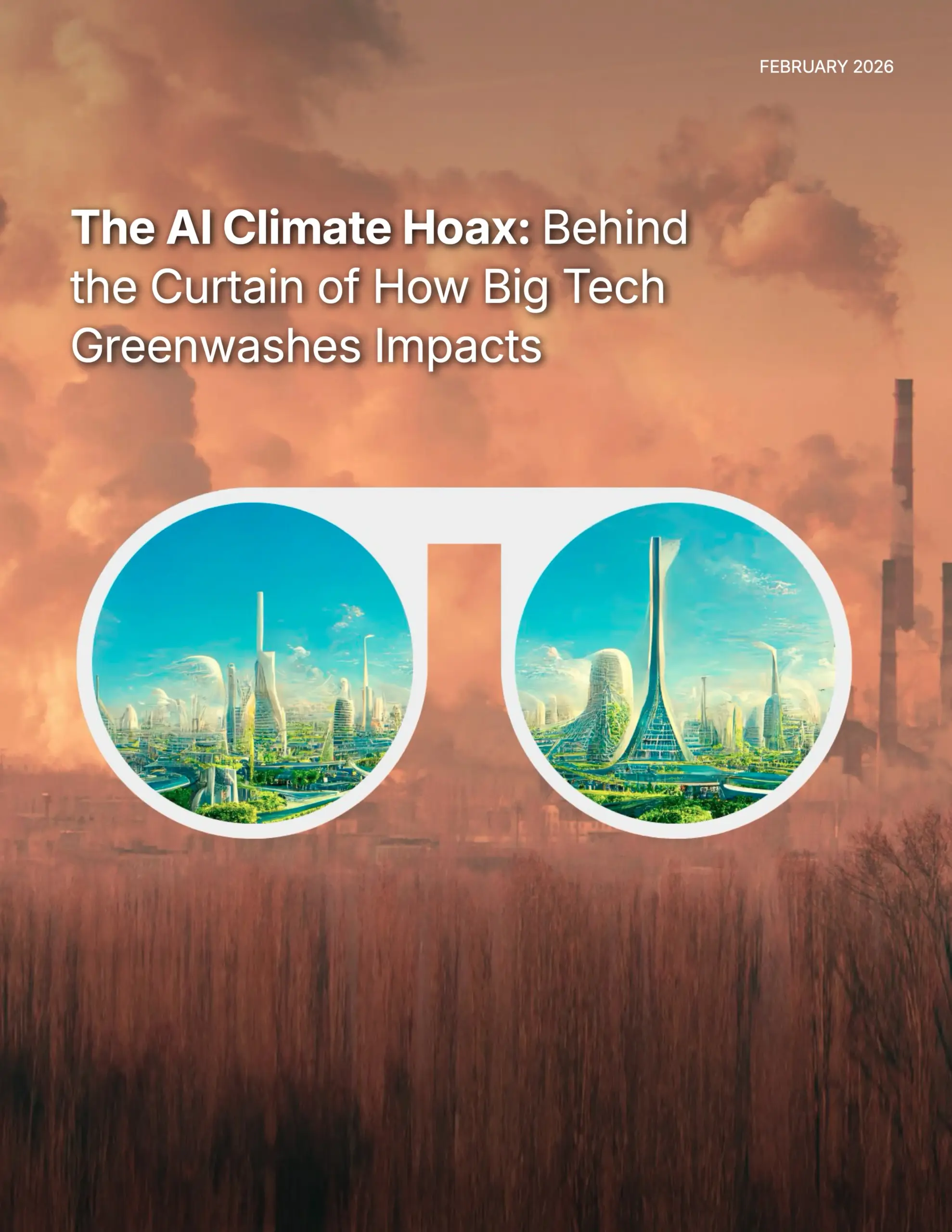
However, a landmark new investigative report by analyst Ketan Joshi, produced in collaboration with civil society partners, shatters this premise. The analysis reveals that the industry’s sweeping claims of a net-positive environmental impact are entirely unbacked by credible, verifiable data. On the contrary, while the environmental damage wrought by energy-guzzling generative AI models is heavily documented and visibly growing, the evidence for any significant, countervailing climate benefit remains weak, speculative, or entirely absent.
At the heart of this deception lies a calculated strategy of semantic obfuscation. Major technology corporations routinely engage in a "bait-and-switch" tactic, deliberately blurring the lines between older, highly specialized analytical AI systems and modern, resource-draining generative AI. By exploiting these generalized "sustainability claims," the tech sector has pioneered a sophisticated new frontier of corporate greenwashing—one that urgently demands regulatory intervention and public scrutiny.
Detailed Chronology of an Environmental Blind Spot
To understand how the tech industry successfully spun a narrative of ecological salvation while simultaneously ramping up fossil fuel consumption, one must examine the timeline of the generative AI gold rush and the parallel evolution of corporate climate marketing.
Phase 1: The Quiet Rise of the Data Center Footprint (2020–2022)
When deep learning models and large language models (LLMs) first burst into the mainstream consciousness, public discourse focused primarily on capabilities, job displacement, and intellectual property. Behind closed doors, however, hyper-scalers—including tech titans like Microsoft, Google, Meta, and Amazon—began acquiring real estate and commissioning massive networks of data centers at an unprecedented rate.
Initially, the environmental footprint of these server farms was treated as a localized issue, manageable through standard corporate power purchase agreements (PPAs) for renewable energy. However, the computational intensity required to train frontier models quickly outpaced grid modernization. As early as 2022, internal corporate sustainability reports began showing a troubling decoupling between net-zero pledges and actual carbon emissions, largely driven by the explosive power demands of machine learning infrastructure.
Phase 2: The Pivot to Climate Rhetoric (2023–2024)
Facing mounting pressure from climate scientists, shareholders, and regulatory bodies over soaring carbon counts, the tech sector adjusted its public relations playbook. Rather than scaling back energy consumption, companies pivoted to a forward-looking defensive strategy.
Executives began claiming that the massive carbon investments of today were merely "down payments" on a sustainable future. According to this narrative, AI would soon optimize global supply chains, design advanced battery materials, revolutionize nuclear fusion, and forecast localized weather patterns with pinpoint accuracy, thereby offsetting its own immense footprint many times over. These assertions were heavily amplified in keynote presentations, ESG (Environmental, Social, and Governance) reports, and white papers, establishing a baseline assumption that AI and climate action were inherently synergistic.

Phase 3: The Exposure of the "AI Climate Hoax" (2025–2026)
As the gap between climate promises and operational realities widened—with several major tech companies quietly abandoning their short-term emissions reduction targets—civil society organizations pushed back.
The publication of Ketan Joshi’s comprehensive report marked a critical turning point in the discourse. By systematically auditing the foundational evidence behind the industry’s favorite climate talking points, the report exposed a startling reality: the emperor had no clothes. The vast majority of citations linking generative AI to concrete emissions reductions relied on anecdotal evidence, theoretical computer science papers detached from real-world energy constraints, or intentional mischaracterizations of what modern AI systems actually achieve.
Supporting Context & Metrics: The Mechanics of the Bait-and-Switch
The core mechanism of the tech industry’s greenwashing strategy rests on a deliberate conflation of distinct technological categories. To evaluate the validity of AI climate claims, Joshi’s report analyzed the specific types of artificial intelligence cited in corporate literature, uncovering a systematic "bait-and-switch" methodology.
Traditional AI vs. Generative AI
For decades, traditional AI applications—such as machine learning algorithms used for smart thermostat regulation, wind turbine predictive maintenance, or localized agricultural yield optimization—have delivered modest, verifiable efficiencies. These systems are computationally lightweight, highly targeted, and designed to solve discrete optimization problems.
Generative AI, by contrast, operates on an entirely different thermodynamic scale. Training and operating massive transformer models requires continuous, round-the-clock computational output from tens of thousands of specialized graphics processing units (GPUs). These systems demand colossal quantities of electricity, often forcing utility companies to keep aging coal and natural gas plants online—or even commission new fossil gas infrastructure—just to maintain uninterrupted uptime for data centers.
By bundling the energy-efficient profile of traditional AI together with the staggering resource consumption of generative AI under a single, ambiguous banner, tech companies create a statistical illusion. They point to historical efficiencies achieved by simple algorithms to justify the unrestrained, carbon-intensive expansion of large language models and generative image engines.
The Evidence Vacuum
When researchers subjected the most prominent corporate climate claims to rigorous empirical scrutiny, the results revealed an alarming vacuum of proof:
- Absence of Empirical Data: Over 60% of the examined corporate claims regarding AI’s net-positive climate impact cited no verifiable empirical data whatsoever, relying instead on speculative projections of future capabilities.
- The Rebound Effect: Many cited studies ignored the economic "rebound effect," wherein efficiency gains driven by software optimization frequently lead to increased overall consumption and production, neutralizing the initial carbon savings.
- Overlooked Supply Chain Costs: Life-cycle assessments referenced by tech firms routinely omitted the carbon-intensive manufacturing processes required to build advanced hardware, server racks, and cooling infrastructure, as well as the immense water consumption necessary to cool high-density data hubs.
Official Statements and Industry Pushback
The release of the report has ignited a fierce debate between civil society watchdogs and the leadership of the world’s most valuable technology corporations.
Representatives from major tech coalitions have defended their environmental records, emphasizing that computational research is actively contributing to climate science. In a statement issued following the report’s release, a tech industry spokesperson argued:

"Artificial intelligence is a foundational general-purpose technology that will play an indispensable role in decarbonizing the global economy. From accelerating breakthroughs in material science to managing complex smart grids, the tools we are building today are essential to solving the climate crisis. Dismissing these potential gains ignores the velocity of technological innovation and the dedication of our engineering teams to sustainable scaling."
However, climate advocates and independent researchers have pushed back fiercely against such rhetoric, characterizing it as a dangerous distraction from immediate accountability. Ketan Joshi noted during a briefing on the findings:
"The tech industry has mastered the art of talking about tomorrow to excuse the pollution of today. When you look under the hood of these grand climate claims, you find an alarming absence of accountability. They are asking the public to accept speculative, decades-away utopian scenarios in exchange for guaranteed, immediate, and escalating harm to our climate system."
Environmental legal experts have similarly pointed out that vague, unverified projections of future climate benefits do little to mitigate the immediate local environmental degradation caused by data center expansion—including strained municipal water supplies, localized air pollution from emergency diesel generators, and skyrocketing electricity bills for nearby residential communities.
Future Outlook: Navigating the Silicon Crossroads
As the artificial intelligence sector enters its next phase of maturation, the collision between relentless computational demand and planetary boundaries is reaching a critical inflection point. The findings of this recent analysis serve as a vital warning flare for policymakers, investors, and the public.
1. Regulatory Reckoning and Truth in Advertising
Governments and regulatory bodies—particularly in the European Union and the United States—are increasingly turning their attention toward corporate greenwashing. As net-zero commitments face mounting legal and public relations scrutiny, regulatory frameworks must be updated to crack down on unsubstantiated "future-offset" claims. Tech companies should no longer be permitted to use speculative, unproven climate technologies of tomorrow as a free pass to drive up fossil fuel emissions today.
2. Mandatory Carbon Transparency for Hyper-Scalers
Transparency must become non-negotiable. Technology companies must be legally mandated to publish granular, real-time data regarding the exact energy consumption, water usage, and carbon intensity associated with training and deploying individual AI models. Hiding behind aggregated corporate sustainability metrics or purchasing distant, low-quality carbon offsets is no longer an acceptable substitute for direct decarbonization.
3. Redefining "Innovation" Through Planetary Boundaries
Ultimately, the tech industry faces a profound philosophical and structural reckoning. The prevailing assumption that infinite computational scaling can coexist with a finite, fragile biosphere has been exposed as a dangerous illusion. True technological innovation moving forward cannot be measured solely by parameter counts, token generation speeds, or market capitalization. Instead, the viability of artificial intelligence must be judged by a stricter, more honest standard: whether its net contribution to society genuinely outweighs its undeniable, heavy toll on the natural world.
