

By Investigative Desk
Published June 2026
Executive Overview
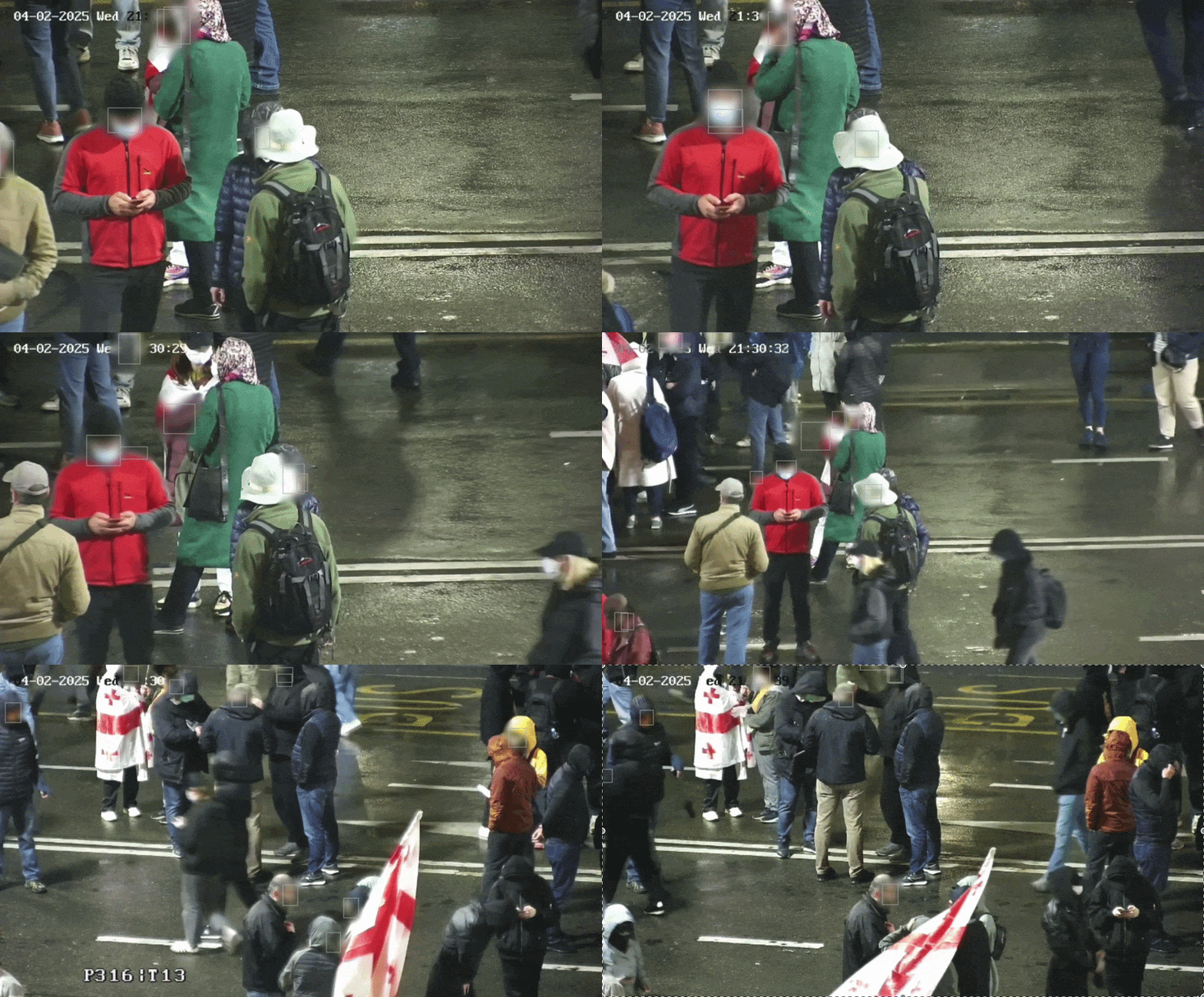
In the heart of Tbilisi, outside the grand neo-classical facade of the Georgian Parliament on Rustaveli Avenue, a silent, high-tech war has been quietly won. For over 580 consecutive days, tens of thousands of Georgians flooded the streets to protest what they decried as systemic electoral fraud and the abrupt, unconstitutional suspension of their nation’s path toward European Union integration. For months, the ruling "Georgian Dream" party—in power since 2012 and heavily influenced behind the scenes by billionaire founder Bidzina Ivanishvili—struggled to quell the relentless demonstrations using traditional methods of statecraft. Police deployed water cannons, rubber bullets, and physical intimidation, yet the crowds kept returning.
Physical force, however, has been superseded by a far more insidious apparatus: an extensive, AI-driven facial recognition surveillance network integrated with automated financial penalties. This investigative deep dive reveals how the Georgian Ministry of Internal Affairs weaponized Polyface—a biometric surveillance software procured from Moscow-based company Papillon AO, an entity heavily sanctioned by the United States, European allies, and Ukraine.
By seamlessly cross-referencing high-definition crowd footage against the state’s "Unified Information Bank," authorities bypassed the limitations of physical policing. They began systematically hunting down dissenters through automated summons, exorbitant fines, and sudden, debilitating bank freezes. This chilling technological crackdown achieved what tear gas and batons could not: it weaponized uncertainty, fractured the solidarity of the civic movement, and effectively dismantled mass assembly through psychological exhaustion and economic fear.

Detailed Chronology: From EU Aspirations to Digital Totalitarianism
2023–2024: The Euphoria of European Integration and the Turning Point
In December 2023, Georgia was officially granted European Union candidate status. To the vast majority of the Georgian populace—86% of whom supported integration in public opinion polls—this milestone represented far more than a diplomatic achievement. It was viewed as an institutional shield against historical interference from Russia, guaranteeing long-term legal protection, economic growth, and democratic stability.
The optimism proved short-lived. Following the disputed parliamentary elections on October 26, 2024, credible allegations of electoral rigging sparked immediate outrage. Protesters converged on Rustaveli Avenue, establishing an encampment that would survive wind, snow, and relentless police pressure.
In response, Prime Minister Irakli Kobakhidze—the public face of the Georgian Dream party—announced a stunning reversal: the government was unilaterally suspending EU accession talks until 2028. This move directly violated Article 78 of the Georgian Constitution, which legally mandates state bodies to take all steps to ensure full integration into the European Union and NATO.
As protests swelled into the largest demonstrations seen since Georgia regained independence in 1990, the legislative and judicial apparatus shifted gears from a democratic facade to open repression.

- Late 2024: Assembly regulations were systematically tightened. Covering one’s face at a protest was reclassified as an administrative offense, and fines for blocking roadways skyrocketed from 500 GEL to 5,000 GEL (approximately €1,620).
- 2025: Street blocking and sidewalk gatherings without prior state registration were elevated to criminal offenses. Freedom of assembly was effectively nullified.
- 2026: Penalties were further expanded to criminalize calling the government illegitimate or criticizing state officials online using terms deemed offensive.
Transparency International concluded in official evaluations that the legislative amendments introduced by Georgian Dream effectively abolished the constitutionally protected right to free assembly.
Supporting Context & Metrics: The Anatomy of the Crackdown
The enforcement mechanism relied heavily on a staggering escalation of financial warfare against ordinary citizens. By March 2025, the Georgian Young Lawyers Association (GYLA) reported that protest participants had been hit with a cumulative total of 2 million GEL (approx. €640,000) in administrative and criminal fines.
Because citations were not served in real-time, victims received no advance warning. Instead, weeks or months later, citizens would discover that their bank accounts had been automatically frozen by automated debt enforcement systems.
Case Studies in Economic Stifling
- Nino, a PR lecturer in her 40s, was summoned by the Tbilisi City Court in March 2025 regarding a road-blocking incident from two and a half months prior. Captured by surveillance cameras utilizing facial recognition, she was slapped with a 5,000 GEL fine. Without receiving a physical ticket, she awoke one morning to find her bank accounts frozen. Though she managed to crowd-fund the amount within half an hour, the psychological toll forced her to abandon Rustaveli protests entirely to avoid burdening her network further.
- Luka, a 20-something winemaker who began protesting after witnessing police brutality, accumulated three separate fines. Living in constant anxiety of sudden bank seizures, he was forced to route his income through friends’ accounts, effectively losing his ability to save or achieve financial independence.
- Elene, a civil society researcher, described how the constant threat of retroactive identification altered her daily routine. She began taking circuitous routes to work to avoid the dense camera clusters around parliament, deleted her Facebook presence entirely, and migrated all communication to encrypted platforms like Signal.
The psychological impact created a deep rift within the protest movement. Seasoned activists who could no longer afford the financial risks grew distant from those who remained on the front lines, fracturing civic solidarity precisely when unity was most critical.

Official Statements and Technological Architecture: The Russian Connection
For months, protesters and civil society organizations were baffled by the preternatural accuracy of law enforcement. Demonstrators noted that security cameras possessed an impossible zoom capability, capable of rendering text on a held piece of paper or capturing micro-expressions from hundreds of feet away.
The truth slipped out during a courtroom proceeding, when a prosecutor casually referenced "Artificial Intelligence," prompting an immediate, panicked intervention from a colleague. The "special program" was later identified as Polyface, a proprietary facial recognition system developed by the Russian firm Papillon AO.
The Papillon AO and 3DiVi Pipeline
Papillon AO, based in Moscow, has been subjected to international sanctions by Switzerland, Ukraine, Japan, and the United States. Its surveillance infrastructure is deployed extensively across Russian law enforcement and authoritarian client states, including Belarus, Kazakhstan, Tajikistan, and Turkmenistan.
Procurement documentation reviewed through Georgia’s public tender databases reveals that the Ministry of Internal Affairs has entered into at least six major contracts with Papillon since 2013, quietly upgrading the software across five distinct iterations. The latest variant, Polyface 3.7.0, was delivered in June 2025. It is powered by a deep-learning facial and skeletal tracking algorithm developed by 3DiVi, a Russian AI firm based in Novosibirsk with direct financial backing from Russian state venture funds.

National Security Vulnerabilities
Security experts have raised profound alarms regarding the integration of a Russian-controlled biometric pipeline into Georgia’s sovereign infrastructure. Eto Buziashvili, a researcher at the Atlantic Council’s Digital Forensic Research Lab, highlighted the immense geopolitical risk:
"Integrating this kind of Russian-developed biometric technology into the national infrastructure represents a substantial risk to Georgia’s national security. Deploying adversarial AI surveillance is a mechanism for long-term dominance over another country’s citizens in the information domain."
Buziashvili drew chilling parallels to historical precedents, such as the Taliban inheriting U.S.-built biometric databases in Afghanistan to track down dissidents, warning that foreign access to Georgia’s Unified Information Bank provides hostile intelligence services with deep profiling capabilities over the nation’s entire political opposition.
Future Outlook: A Precarious Crossroad
Despite the criminalization of sidewalks, the banning of face coverings, the deployment of Russian AI surveillance, and millions of lari in crippling fines, the spirit of dissent in Georgia has not been entirely extinguished.

As of mid-2026, hundreds of defiant citizens continue to gather on Rustaveli Avenue every evening, standing under the unblinking lenses of thousands of high-definition cameras. However, the nature of civic resistance has fundamentally transformed. Protesting is no longer an impulsive, spontaneous act of democratic expression; it has become an underground calculus of risk, encryption, and economic survival.
The struggle in Georgia has transcended a localized political dispute. It has transformed into a litmus test for the digital age: a frontline battleground determining whether sovereign nations can maintain democratic self-determination against the combined forces of domestic authoritarian capture and imported, AI-driven totalitarian surveillance.
As high-school teacher Erekle poignantly observed from the fringes of the avenue: "When blocking the road was criminalized, I moved onto the pavement. When the law prohibiting demonstrating on pavements was passed, I moved further back. It feels like retreating in war. But this is not the end of the battle. They still haven’t managed to put the fire out."
Note: To protect interviewees from immediate state retaliation and ongoing judicial proceedings, the names of several demonstrators and civil society participants have been altered or anonymized.
