

Executive Overview
The landscape of Artificial Intelligence has reached a critical inflection point. While the initial wave of agentic AI adoption was characterized by lightweight, 40-line Python scripts that wrapped Large Language Models (LLMs) in raw prompt loops, enterprise engineering teams have quickly discovered that such scripts fail outside controlled demo environments. When subjected to concurrent multi-tenant usage, flaky third-party APIs, untrusted user inputs, or multi-step tasks requiring complex state resolution, primitive implementations crumble.
The gap separating an unstable proof-of-concept from a resilient, production-grade agentic system is not solved by prompt engineering. It is solved by systems architecture.
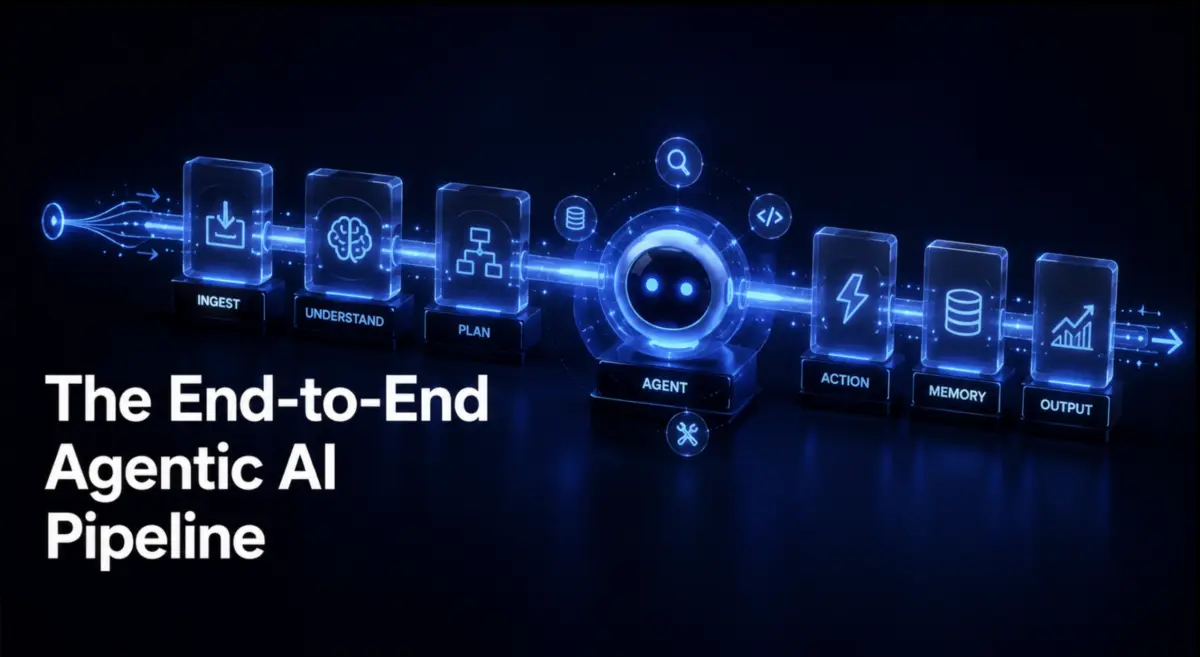
Recent architectural surveys, enterprise postmortems, and academic research point to a unified operational model: production agentic systems require seven interconnected, decoupled components. Five of these components—Perception, Memory, Reasoning & Planning, Tool Execution, and Orchestration—form a closed, sequential feedback loop. Surrounding this core cycle are two cross-cutting wrapper layers: Guardrails and Observability.
                         +-------------------------------------------------------+
                         |                      GUARDRAILS                       |
                         |   (Policy Enforcement, Cost Control, Human Approval)   |
                         +---------------------------+---------------------------+
                                                     |
+-------------------+     +------------------+       v       +-------------------+     +-------------------+
|    PERCEPTION     | --> | MEMORY RETRIEVAL | ------------> | REASONING & PLAN  | --> |  TOOL EXECUTION   |
| (Normalization)   |     | (Working/Episodic)               | (Pure State)      |     | (Side Effects)    |
+-------------------+     +------------------+               +-------------------+     +---------+---------+
                                    ^                                                            |
                                    |                     +-------------------+                  |
                                    +-------------------- |   ORCHESTRATION   | <----------------+
                                                          |  (State Control)  |
                                                          +---------+---------+
                                                                    |
                         +------------------------------------------v------------+
                         |                     OBSERVABILITY                     |
                         |         (Trace Logging, Root-Cause Analysis)          |
                         +-------------------------------------------------------+
Underlying this architectural framework is an unbroken continuous cycle:
$$textGoal longrightarrow textPerception longrightarrow textMemory Synthesis longrightarrow textReasoning longrightarrow textPlanning longrightarrow textAction longrightarrow textObservation longrightarrow textMemory Update$$
This cycle iterates continuously until the state machine resolves the objective, triggers a terminal stop condition, or hands execution off to a human operator. Decoupling each step into explicit architectural components allows systems engineers to build deterministic, testable, and fault-tolerant software around non-deterministic intelligence cores.
Detailed Chronology: The Anatomy of the Agentic Feedback Loop
To understand how high-scale agent systems operate under real-world production constraints, we must trace data sequentially through the runtime feedback loop.
[Raw Event / Input]
        │
        ▼
┌────────────────────────────────────────────────────────────────────────┐
│ 1. Perception Layer                                                    │
│    • Ingests text, webhooks, or file artifacts                         │
│    • Strips payload metadata & standardizes into unified AgentInput    │
└────────────────────────────────────────────────────────────────────────┘
        │
        ▼
┌────────────────────────────────────────────────────────────────────────┐
│ 2. Context & Memory Layer                                              │
│    • Manages volatile in-process context window (Working Memory)       │
│    • Queries persistent vector index for past runs (Episodic Memory)   │
└────────────────────────────────────────────────────────────────────────┘
        │
        ▼
┌────────────────────────────────────────────────────────────────────────┐
│ 3. Reasoning & Planning Layer                                          │
│    • Evaluates goals against retrieved context                         │
│    • Emits pure, side-effect-free structured plan objects (PlanStep)   │
└────────────────────────────────────────────────────────────────────────┘
        │
        ▼
┌────────────────────────────────────────────────────────────────────────┐
│ 4. Guardrail Interception                                              │
│    • Checks plan against security allow-lists and cost ceilings        │
│    • Directs high-risk/irreversible steps to human approval flows      │
└────────────────────────────────────────────────────────────────────────┘
        │
        ▼
┌────────────────────────────────────────────────────────────────────────┐
│ 5. Tool Execution Engine                                               │
│    • Validates argument constraints prior to external dispatch         │
│    • Enforces SHA-256 idempotency keys and strict timeout budgets     │
└────────────────────────────────────────────────────────────────────────┘
        │
        ▼
┌────────────────────────────────────────────────────────────────────────┐
│ 6. State Orchestration                                                 │
│    • Ingests execution step outcomes                                   │
│    • Evaluates pass/fail thresholds and halts execution on errors     │
└────────────────────────────────────────────────────────────────────────┘
        │
        ▼
┌────────────────────────────────────────────────────────────────────────┐
│ 7. Observability Logging                                               │
│    • Generates step-level structured trace traces                      │
│    • Records telemetry data across all stages for audit trails         │
└────────────────────────────────────────────────────────────────────────┘
Phase 1: Ingestion & Perception Layer
Every workflow begins at the Perception component. In simple demonstrations, input is treated as a clean string provided directly by a user. In production, raw inputs arrive asynchronously through disparate channels: HTTP webhooks, JSON payloads, unstructured user text, sensor metrics, or binary file attachments.
The primary duty of Perception is data normalization. The layer strips transport-level noise (such as HTTP headers or signature wrappers), parses binary formats, and maps incoming events into a standardized schema—typically represented as a strongly-typed AgentInput dataclass. By enforcing a single normalized state interface, downstream components remain entirely agnostic to input sources.
Phase 2: Contextual Retrieval & Memory Synchronization
Once input is normalized, the agent populates its immediate context window by querying its Memory architecture. Real-world systems split memory into two distinct tiers:
- Working Memory: Represents active, short-term context bounded by model context windows. It operates as an in-memory queue with strict eviction limits (such as sliding FIFO windows over conversation turns). It vanishes when a task terminates.
- Episodic & Semantic Memory: Represents long-term persistence stored in external vector stores or relational databases. Using dense vector embeddings, the system performs semantic similarity searches against historical sessions, surfacing factual knowledge and past user interactions relevant to the current
AgentInput.
This tiered architecture prevents context bloat, reduces token overhead, and equips the reasoning model with contextual hindsight without filling working memory with stale turn histories.
Phase 3: Pure Cognitive Synthesis (Reasoning & Planning)
With historical context attached to normalized input, execution passes to the Reasoning and Planning engine. This component functions as the primary cognitive synthesizer.
A central principle of production-grade design is the absolute separation of planning from execution. The Planning component accepts goals, context, and semantic memories, then outputs a structured, declarative plan (e.g., a Plan object containing a sequence of PlanStep nodes). It does not call external APIs, query live production databases, or mutate external state. Keeping planning pure and side-effect-free allows the system to validate, modify, optimize, or reject plans before any external operation occurs.
Phase 4: Side-Effect Enzicing (Tool Execution)
When a plan passes validation, individual steps hand off to the Tool Execution Engine. This module serves as the boundary between abstract agent decisions and real-world infrastructure (such as payment gateways, database endpoints, or messaging services).
Given that tool invocations incur side effects, this engine cannot simply call an API endpoint and assume success. It enforces three vital reliability guarantees:
- Pre-Execution Validation: Ensures all required arguments are present and correctly typed before network calls occur.
- Deterministic Timeout Budgets: Kills hanging connections before network latencies stall the orchestrator.
- Idempotency Keys: Computes unique cryptographic signatures (e.g., SHA-256 hashes of tool names and sorted argument dictionaries) to ensure retried requests do not trigger duplicated side effects, such as double-billing a user.
Phase 5: State Orchestration & Flow Control
The Orchestrator manages loop iteration, multi-agent context passing, and failure propagation. When the Tool Execution Engine returns a StepOutcome, the Orchestrator evaluates the result against the execution graph.
If an intermediate step fails—for instance, an eligibility policy check returning success=False—the Orchestrator intervenes. Rather than allowing the LLM to proceed blindly to downstream tasks (such as triggering an automated refund), the Orchestrator halts execution, evaluates fallback branches, or escalates the issue. Industrial orchestration engines (including LangGraph, AutoGen, and CrewAI) utilize graph-based finite state machines (FSMs) to keep multi-step execution deterministic.
Supporting Context & Metrics: Operational Fault Tolerance and Guardrails
Building scalable agentic infrastructure requires managing compound failure rates across multi-step plans. A mathematical analysis of unmitigated agent workflows reveals why basic script architectures break down in enterprise settings.
The Compound Risk of Multi-Step Execution
Consider an autonomous agent executing a multi-step task where each individual action possesses a fixed probability of success $Ptextstep$. The overall probability of successful task completion across $n$ sequential steps ($Ptexttotal$) is given by:
$$Ptexttotal = (Ptextstep)^n$$
Assuming a tool execution success rate of 95% ($P_textstep = 0.95$)—a optimistic figure in real-world environments with external web APIs—the overall success rate decays rapidly as plan steps increase:
| Number of Plan Steps ($n$) | Step Success Rate ($P_textstep$) | Overall Plan Success Rate ($P_texttotal$) | System Failure Probability |
|---|---|---|---|
| 1 | 95.0% | 95.0% | 5.0% |
| 5 | 95.0% | 77.4% | 22.6% |
| 10 | 95.0% | 59.9% | 40.1% |
| 15 | 95.0% | 46.3% | 53.7% |
| 20 | 95.0% | 35.8% | 64.2% |
Overall Success Rate vs. Number of Steps (at P_step = 0.95)

  100% ────┐
       │   └────┐
   80% │        └───────┐
       │                └───────────┐
   60% │                            └───────────┐
       │                                        └───────────┐
   40% │                                                    └───────────
       └──────┬──────────┬───────────┬───────────┬───────────┬───────────
              1          5          10          15          20
                                  Number of Steps
At 20 operational steps, an unmitigated workflow will experience a system-level failure roughly 64% of the time. This probability compounding demonstrates why production architectures cannot rely purely on prompt-level probabilistic loops. Enterprise systems demand deterministic wrapper layers to handle errors predictably.
Cross-Cutting Layer 1: The Policy Guardrail Engine
Guardrails do not run as isolated steps inside the core loop; they wrap around the entire architecture. The GuardrailEngine intercepts proposed actions issued by the Planning engine before they reach the Tool Execution layer.
       [ Proposed Action ]
                │
                ▼
  /───────────────────────────
 < Allowed in Tool List?       > ──NO──> [ VERDICT: DENY ]
  ───────────────────────────/
                │ YES
                ▼
  /───────────────────────────
 < Cost <= Action Ceiling?     > ──NO──> [ VERDICT: DENY ]
  ───────────────────────────/
                │ YES
                ▼
  /───────────────────────────
 < Action Irreversible?        > ──YES─> [ VERDICT: REQUIRE_APPROVAL ]
  ───────────────────────────/
                │ NO
                ▼
       [ VERDICT: ALLOW ]
Guardrail verification operates through explicit validation policies:
- Tool Allow-Listing: Rejects proposed calls to non-approved systems or unauthorized capabilities.
- Financial & Token Cost Ceilings: Assesses estimated computational or real-world costs against fixed action budgets (e.g., hard-capping single-action spend at $100.00).
- Action Reversibility Policies: Evaluates whether actions can be cleanly undone. Any action tagged as
irreversible=True(such as issuing funds or deleting records) is halted and flagged for human review (REQUIRE_APPROVAL), regardless of model confidence or cost limits.
Cross-Cutting Layer 2: Observability & Structural Tracing
Debugging autonomous systems requires complete visibility into execution flow. Traditional application logging records isolated application errors, but agent observability demands structured, step-by-step trace auditing.
A trace entry schema captures metadata across every point in the lifecycle:
  "run_id": "run_2026_06_20_001",
  "trace": [

      "step": 1,
      "component": "perception",
      "event": "input_normalized",
      "detail":  "source": "user_text", "content": "Refund order 4821" ,
      "timestamp": "2026-06-20T10:14:02.112Z"
    ,

      "step": 2,
      "component": "planning",
      "event": "plan_created",
      "detail":  "step_count": 3, "goal": "Process a refund for order 4821" ,
      "timestamp": "2026-06-20T10:14:03.450Z"
    ,

      "step": 3,
      "component": "tool_execution",
      "event": "tool_called",
      "detail":  "tool": "database_lookup", "success": true, "output": "Order found" ,
      "timestamp": "2026-06-20T10:14:04.002Z"
    ,

      "step": 4,
      "component": "tool_execution",
      "event": "tool_called",
      "detail":
        "tool": "policy_check",
        "success": false,
        "output": "Order too old",
        "error": "Policy check failed: order too old"
      ,
      "timestamp": "2026-06-20T10:14:04.891Z"
    ,

      "step": 5,
      "component": "orchestrator",
      "event": "run_stopped",
      "detail":  "reason": "step_failed", "step_number": 4 ,
      "timestamp": "2026-06-20T10:14:04.895Z"

  ]
By decoupling trace collection from state orchestration, engineers can query runs using utilities like find_failure_point() to isolate exact failure causes instantly. When a failure occurs, observability tooling highlights the exact component, tool parameters, and error message responsible—eliminating the need to re-run non-deterministic workflows during postmortems.
Official Statements & Structural Consensus
Industry consensus has shifted decisively toward explicit software architecture over raw model capabilities. Leading framework developers, security researchers, and enterprise architects emphasize that model reasoning is merely one element within a broader systems framework.
In an architectural analysis published in late 2025, security and systems researchers noted:
"The primary failure mode of early agentic systems stemmed from over-trusting model capabilities while under-architecting the execution environment. Autonomous systems operate effectively only when non-deterministic model outputs are bounded by deterministic software components."
Similarly, technical guidance released by the lead maintainers of multi-agent orchestration engines emphasizes the importance of state isolation:
"Treating an LLM as a control loop without explicit planning, tool validation, and state machine orchestration is the software equivalent of running code without exception handling or type safety. Real-world systems require strict boundaries between cognitive synthesis and side-effect-inducing execution engines."
A comparative survey of modern enterprise architectures highlights how responsibilities map cleanly across specialized layers:
| Architectural Component | Core Responsibility | Failure Mode When Omitted | Enterprise Standard Pattern |
|---|---|---|---|
| Perception | Normalize incoming data streams | Data-type mismatches, unparsed webhooks | Strongly-typed unified datatypes |
| Memory | Manage short/long-term context | Context window overflow, forgotten history | Vector stores paired with bounded FIFO queues |
| Reasoning / Planning | Synthesize pure execution plans | Unvalidated, destructive direct execution | Pure, side-effect-free JSON plan objects |
| Tool Execution | Dispatch commands to external systems | Double billing, hanging requests, API crashes | SHA-256 idempotency, timeouts, pre-validation |
| Orchestration | Enforce loop state transitions | Infinite loops, cascading multi-step failures | Graph-based finite state machines (FSMs) |
| Guardrails | Enforce security policies and controls | Data leaks, runaway spending, unauthorized actions | Policy-as-code and human approval gates |
| Observability | Generate structured event logs | Unreproducible failures, unresolvable bugs | Step-level JSON tracing and telemetry |
Future Outlook
As enterprise agentic AI architectures mature, the boundary between tradition systems engineering and artificial intelligence continues to refine. Emerging patterns point toward several key developments:
- Standardized Agent Execution Protocols: Similar to how HTTP standardized web communications, standard protocols are emerging to govern perception handoffs, tool interfaces, and trace logging across enterprise stacks.
- Formal Verification of Plan Graphs: Future orchestrators will move beyond basic static allow-lists, using formal verification methods to evaluate plan safety before handing execution to tool engines.
- Decoupled Edge Guardrail Engines: Security policies will increasingly run on dedicated, low-latency edge nodes. This ensures policy enforcement operates independently from the primary LLM provider, mitigating prompt injection risks.
- Hardware-Enforced Execution Sandboxes: High-security workloads will run tool execution engines inside short-lived microVM sandboxes, isolating side-effects from core enterprise network zones.
Ultimately, transitioning an AI agent from a fragile script to a resilient enterprise service requires a fundamental shift in perspective. High-performing agentic applications depend less on finding the perfect prompt and more on implementing sound, decoupled, and fault-tolerant software architecture. By decoupling Perception, Memory, Reasoning, Planning, Tool Execution, Orchestration, Guardrails, and Observability, engineering teams can deploy resilient autonomous systems capable of operating reliably at enterprise scale.
