

The Weaponised Canvas: How AI "Nudification" Apps and Non-Consensual Deepfakes Are Redefining Digital Violence
Executive Overview
The dawn of generative artificial intelligence was heralded as a triumph of human ingenuity—a technological inflection point promising to streamline workflows, democratise creativity, and accelerate problem-solving. Yet, as the digital landscape matures, this democratisation of technology has unleashed a darker, profoundly insidious side. Today, anyone with an internet connection and a digital photograph can strip the clothing off a stranger, a colleague, or a public figure with the swipe of a finger.
At the center of this crisis are "nudification" applications and Non-Consensual Sexualisation Tools (NSTs). These systems harness deep-learning models to synthesize hyper-realistic, manipulated imagery, transforming benign portraits into explicit, non-consensual pornography. While high-profile incidents—such as the weaponisation of X’s AI chatbot, Grok, to mass-produce sexualised deepfakes of women, children, and LGBTQI+ individuals—have temporarily forced regulators to reckon with the technology, the systemic underbelly of this crisis remains largely unaddressed.
From journalists in Rio de Janeiro and sex workers in the United Kingdom to refugees in Turkey and high-ranking European politicians, the victims of NSTs span demographics, socioeconomic classes, and public profiles. This investigation explores how algorithmic violence has dissolved the boundary between the digital and physical worlds. It exposes a multi-million-dollar shadow economy built on the commodification of non-consensual intimacy, law enforcement’s systemic failure to protect survivors, and the persistent misogyny that treats the bodies of women and gender-expansive people as public property.
Detailed Chronology & Human Impact: Stories from the Front Lines of Digital Violence
The Spillover: From Digital Screens to Physical Spaces
For 31-year-old journalist Julie, living in Rio de Janeiro, the psychological toll of digital violence manifested as an immediate, visceral claustrophobia. Targeted by an orchestrated swarm of fake nude photos of herself distributed across social media, Julie’s reality fractured.
Every time she enters an elevator crowded with men, her thoughts race. Have they seen the photos? Have they accessed an intimate version of my body that I never consented to share? As the walls seem to close in, a darker dread takes hold: What if one of these men is the very creator of the fake images?
What began as online harassment has successfully colonized her offline reality. Julie no longer feels safe anywhere, stripped of her fundamental bodily autonomy.
The Betrayal of Image-Ownership
Thousands of miles away in the UK, Laura—a seasoned sex worker—stumbled across a digital ghost of herself while scanning the internet for leaked content. The image showed her locking lips with a famous personality. The scenario was entirely fabricated; the kiss never happened.
As a sex worker accustomed to publishing lewd content for paying subscribers on verified platforms, Laura’s livelihood depends on image management. Yet, stumbling upon an altered image she never authorized induced physical nausea. It was a profound betrayal. Like Julie, Laura realized that she had lost sovereign control over her own body and image.
Coerced Outing and Sextortion
The violence facilitated by NSTs extends far beyond anonymous swarms; it frequently weaponizes personal relationships.
In Turkey, Kelly, a non-binary refugee assigned male at birth, undertook sex work to survive while establishing a new life. Meticulously protective of their identity to avoid severe sanctions from both local authorities and international refugee frameworks, Kelly believed their safety was secure. That security vanished after a petty political disagreement with a colleague within the refugee community who was aware of Kelly’s side work.
Days later, Kelly received completely nude, anatomically detailed deepfake photographs of themselves, accompanied by a direct threat: Be compliant, or be reported to the authorities. Living in constant terror, Kelly never discovered which specific application was used to manufacture the blackmail material.
A parallel nightmare befell Annie, a non-binary sex worker in Poland. Annie’s ex-girlfriend weaponised "nudified" artificial pictures by distributing them directly to Annie’s family, forcibly outing them as a sex worker. When the images leaked online alongside geographic background markers from the original photos, Annie’s home address was exposed. Months of housing instability, forced relocation, and persistent trauma followed. For sex workers already marginalized by criminalization and stigma, the constant sword of Damocles that is AI-generated exposure represents an unprecedented threat to survival.
Supporting Context & Metrics: Democratising Technology for Evil
The Mechanics of NSTs
The technical architecture underpinning NSTs relies on generative adversarial networks (GANs) and massive training datasets. By scraping existing photographs of nude bodies and remixing them to match the facial features and physical outlines of a target, these tools generate photorealistic fabrications in seconds.
While manual photo montages—superimposing private individuals onto the bodies of pornographic actors—have existed for decades, generative AI has eliminated the barrier of technical skill and labor. As investigative researcher Kolina Koltai from Bellingcat notes:

"The speed and the ease with which someone can now realistically create content makes the difference. Nowadays, you don’t need money or a technological skill-set to make it happen."
A Lucrative Shadow Economy
This ease of use has fueled a massive, highly profitable commercial ecosystem. According to a landmark report by the Tech Transparency Project, NST applications have been downloaded an astonishing 483 million times on the Apple App Store alone, generating over $122 million in lifetime revenue.
Many of these applications disguise their true utility behind benign facades—such as romantic AI companion apps or photo-enhancement tools—making them notoriously difficult for platform moderators and app store gatekeepers to track. However, mass platforms like X have acted as public megaphones. Julie’s targeted attack in early 2026 coincided with the viral exploitation of X’s AI chatbot, Grok, which was systematically prompted by coordinated bot networks to strip clothing off real women, politicians, and public figures.
The fallout reached the highest echelons of global politics:
- Italy: Prime Minister Giorgia Meloni was forced to publicly debunk an AI-generated deepfake depicting her in a lingerie chemise.
- Sweden: Deputy Prime Minister Ebba Busch fell victim to a coordinated campaign where users prompted Grok to sexualise her posture and physical attributes, forcing her to issue public statements.
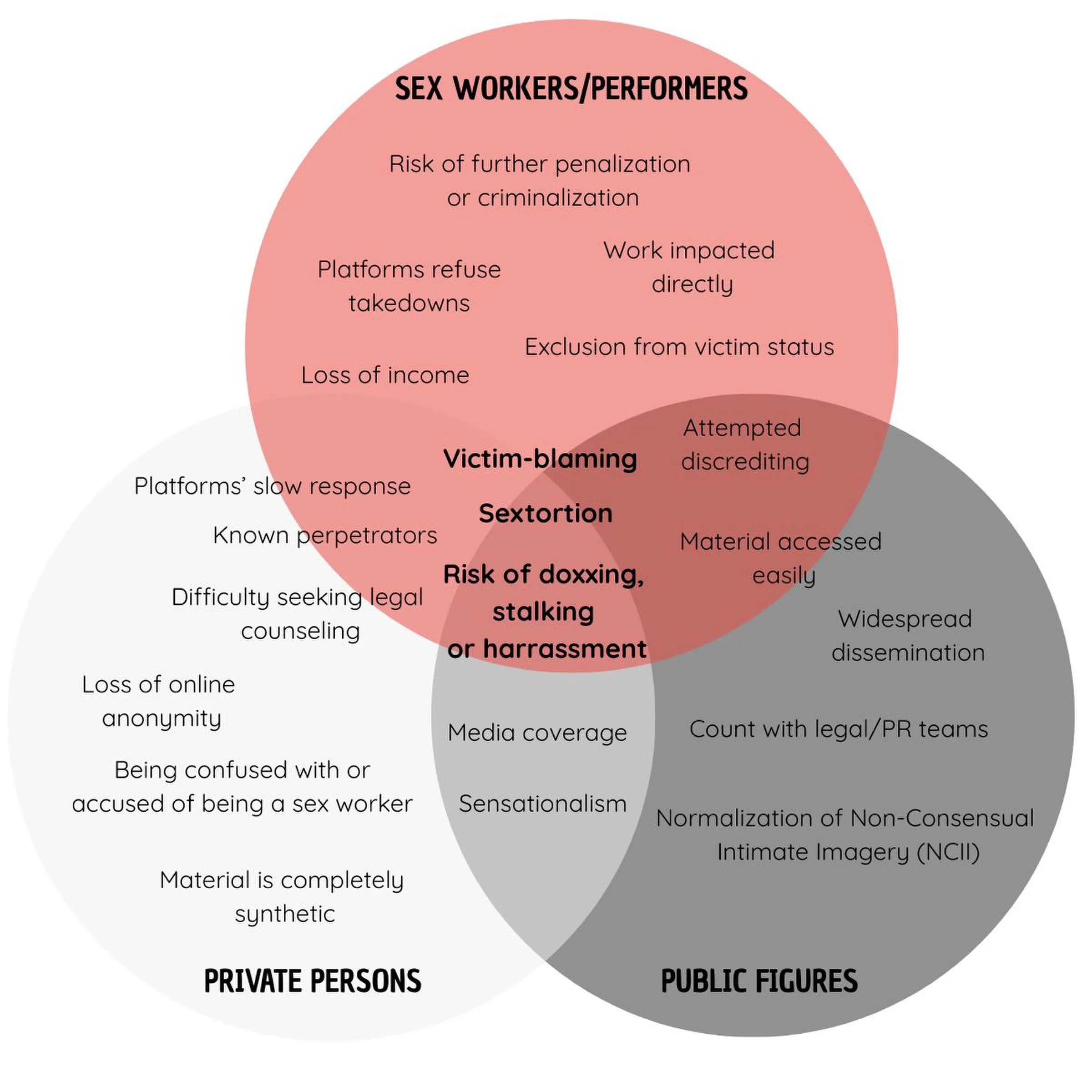
Despite these high-profile cases, sex workers bearing the brunt of this digital theft and harassment are consistently denied victim status. Not only do NSTs constitute a form of digital abuse, but they also function as industrial-scale theft. For sex workers, their image is their labor; when AI models scrape their paid content without permission to generate free, altered alternatives, it directly destroys their economic survival.
Official Statements and Institutional Failures
The Justice Gap
When survivors attempt to seek recourse through legal and institutional channels, they are met with systemic apathy and institutional unpreparedness.
When Julie approached law enforcement and legal counsel, the experience was profoundly re-traumatizing. "The police were basically acting like I was overreacting because the photos were fake," she recalls. In the UK, Laura encountered an identical brick wall; authorities claimed they could take no action because synthetic imagery leaves no definitive proof of the victim’s physical involvement.
Cordelia Moore, a digital violence consultant in Germany, emphasizes that this policy vacuum leaves victims entirely unprotected: "With synthetic images, there is still a large gray area: law enforcement is not prepared to deal with such cases."
Platform Complicity
Digital platforms fare no better. When Julie reported the abusive accounts on X, the content was occasionally removed, but the underlying infrastructure remained untouched. Lejla Podgoršek, Senior Policy Manager at AlgorithmWatch, notes that reported accounts using Grok to generate sexualised deepfakes often vanish temporarily, only to resurface under new guises.
Because many perpetrators deploy interconnected networks of "ghost profiles" and automated bots across international jurisdictions, tracing the human origin of abuse is near-impossible under current platform governance models. Furthermore, demanding that marginalized victims—such as sex workers or undocumented refugees—submit sensitive, identifying personal data to platforms just to process a takedown request exposes them to even greater risks of doxxing and legal persecution.
Future Outlook: Dismantling the Roots of Algorithmic Misogyny
As European regulators attempt to streamline digital frameworks—such as the recent intense political battles surrounding the AI Omnibus law—the intersection of fundamental rights, platform liability, and digital violence remains fiercely contested. Yet, focusing solely on technical patches misses the broader sociological diagnosis.
Non-consensual sexualisation tools are not an isolated glitch in the matrix; they are a modern symptom of an ancient disease. As tech entrepreneur Elon Musk demonstrated by using Grok to generate a deepfake of himself in a bikini, powerful men can toy with synthetic nudity as a harmless joke precisely because their reputation, safety, and socioeconomic standing are never at risk.
For women and gender-expansive individuals, however, sexuality and nudity continue to be weaponised as instruments of coercion, blackmail, and social exile. As feminist scholarship has long highlighted, patriarchal societies historically treat the female body as public property—a "commons" to be regulated, policed, and exploited.
If the proliferation of NSTs is to be halted, society must move beyond the victim-blaming mantra of "what did you expect by posting online?" True reform requires:
- Strict App Store Accountability: Treating anonymous nudification tools with the same legal liability as malware and illicit content distributors.
- Law Enforcement Training: Equipping judicial and police systems with the technical literacy required to recognize synthetic image-based abuse as genuine violent crime.
- Decriminalization and Destigmatization: Protecting sex workers and vulnerable communities by providing safe, anonymous reporting mechanisms that do not risk exposing their livelihoods.
Until the underlying misogyny that normalises the policing of bodies is dismantled, technological evolution will simply continue to manufacture new, more efficient ways to inflict old harms.
