

Executive Overview
For the past several years, the mainstream discourse surrounding artificial intelligence has been dominated by digital abstractions. Corporate boardrooms and consumer markets alike have fixated on large language models, chat-based interfaces, and background agents tasked with distilling meeting notes into project tickets. However, a seismic shift is underway—one that is migrating artificial intelligence out of silicon server racks and software windows and directly into the material world.
This burgeoning paradigm is known as Physical AI. Defined as the seamless integration of advanced machine intelligence into autonomous and semi-autonomous systems, Physical AI equips machines with the capacity to perceive their surrounding environment, reason through complex spatial variables, and execute intricate, physical actions in the real world.
While public imagination tends to fixate on anthropomorphic humanoid robots or fully autonomous robotaxis navigating crowded urban boulevards, enterprise adoption is tracing a far more pragmatic and expansive trajectory. From self-driving forklifts and automated quality-inspection sensors to enterprise-scale warehouse coordination arrays and smart city infrastructure, Physical AI is rapidly evolving from speculative R&D into a multi-billion-dollar operational necessity. According to PwC projections, the global Physical AI market—currently valued at approximately $92 billion—is on an aggressive trajectory to surpass $489 billion by 2030.
For Chief Information Officers, technology leaders, and industrial strategists, understanding this transition requires looking past the "humanoid theater" of flashy tech-convention demonstrations and examining the quiet, highly effective integration of digital intelligence into everyday industrial gear.
Detailed Chronology: The Evolution Toward Physical AI
The convergence of robotics, edge computing, computer vision, and machine learning did not happen overnight. It is the culmination of decades of incremental hardware engineering meeting exponential software maturation.
- The Early Industrial Era (Pre-2010s): Industrial automation relied heavily on rigid, hard-coded robotics. These machines performed hyper-specific, repetitive tasks within heavily segregated factory cages. Any deviation in the environment—a slightly misaligned part or an unexpected obstruction—resulted in immediate system halts.
- The Rise of Computer Vision and Edge Processing (2010–2020): Driven by breakthroughs in deep learning and the proliferation of low-power, high-efficiency graphics processing units (GPUs), machines began to acquire "sight." Cameras and sensors could finally classify objects, paving the way for advanced driver-assistance systems (ADAS) and early logistics automation.
- The Autonomous Vehicle and Drone Proliferation (2020–2024): Fueled by billions of venture capital dollars, autonomous vehicle pioneers like Waymo, Tesla, and various agricultural tech firms proved that deep-learning models could pilot heavy machinery through variable outdoor environments. Simultaneously, enterprise drone testing moved from novelty to legitimate testing phases for inventory and delivery.
- The Operational Scale-Up and Edge Foundation Models (2025–Present): Today, Physical AI has crossed the chasm from isolated pilots to enterprise-grade deployments. Backed by foundational vision-language-action (VLA) models, machines are no longer restricted to rigid programming. They can interpret hardware schematics natively, adapt to changing floor conditions in real time, and operate collaboratively alongside human workforces.
Supporting Context & Metrics: Market Dynamics and Economic Drivers
The rapid acceleration of Physical AI is not driven by technological novelty alone; it is being forced by compounding macroeconomic pressures. Across manufacturing, supply chain logistics, and municipal management, organizations are confronting acute labor shortages, rising operational overhead, and an escalating intolerance for unplanned downtime.
Key Market Statistics
- Overall Market Growth: Projected by PwC to leap from $92 billion to over $489 billion by 2030.
- Industrial Robotics Market: Valued at $54.3 billion in 2026, this sector is forecasted to expand to $94.4 billion by 2031, according to Mordor Intelligence.
- Autonomous Driving and Farm Equipment: The self-driving car market surpassed $200 billion in value by 2025, while autonomous farm machinery (tractors, harvesters, and specialized drones) hit an estimated $70.9 billion in 2025, with projections scaling toward $144.7 billion by 2035.
- Logistics Scalability: Leading warehouse operators are already running massive fleets. For instance, warehouse automation vendor Symbotic reported that its fleet of 22,000 autonomous mobile robots logged over 200 million miles in 2025 alone, with individual units traveling upwards of 52,000 miles.
What Makes a Strong Use Case for Physical AI?
Industry experts emphasize that successful adoption depends on strict operational criteria rather than chasing technological hype. Vikram Venkat, an investor in physical AI systems at Cota Capital, notes that ideal deployment scenarios share several distinct characteristics:
- High Labor Intensity and Risk: Operations characterized by chronic labor shortages or hazardous conditions that pose direct threats to human safety.
- Constrained Environments: Because contemporary physical AI platforms are not yet universally proficient at navigating wholly unpredictable, chaotic settings, relatively bounded or semi-structured environments yield the highest immediate ROI.
- Repeatability and Measurable Outcomes: High-volume tasks with clear, auditable operational metrics.
- Frictionless Integration: Near-term deployments must require minimal architectural overhauls, allowing for straightforward integration into existing legacy workflows and providing reliable human-in-the-loop oversight to correct errors.
Official Statements and Industry Insights
Enterprise technology leaders and architectural experts urge organizations to strip away the marketing noise and focus strictly on utility.
"I usually have one caution for CIOs — skip the humanoid theater. The near-term advantage is adaptive automation in variable environments where conditions change, humans share the space, and downtime is expensive."
— Adnan Masood, Chief AI Architect, UST
Masood points out that modern agentic pipelines are now capable of reading hardware schematics and chip pinouts natively. They can automatically generate regression suites that engineers once scripted by hand, cross-referencing live equipment telemetry against digital twins to catch firmware bugs and signal-integrity faults before a production run even begins.
Echoing this perspective on spatial intelligence rather than mere mobility, Albert Liu, founder and CEO of edge AI solutions vendor Kneron, emphasizes the broader philosophical shift:
"Most people think physical AI begins with robots, which is simply the example our minds go to since it has been the most visible until now. But physical AI isn’t just about the typical answer — machines that move — it’s about environments that become intelligent."
Parm Sandhu, Group Vice President for Enterprise AI, Edge Computing, and Digital Innovation at NTT DATA, underscores the urgency of automation in foundational industrial roles, noting the quiet crisis in supply chain labor:
"If you think about manufacturing, pretty much everything you touch in that world was lifted by a forklift somewhere or components were lifted by a forklift somewhere. But people don’t want to drive forklifts, and that’s a huge problem."
Deep Dive: Seven Core Domains of Physical AI Deployment
To understand the practical footprint of Physical AI, one must look across the diverse sectors where digital intelligence has taken physical form.
1. Manufacturing and Assembly Robots
While humanoid systems like Boston Dynamics’ Atlas or BMW’s deployment of humanoids for precision welding capture headlines, the backbone of manufacturing AI is found in specialized industrial arms and adaptive assembly units. These machines collaborate safely alongside human technicians, optimizing factory throughput and adjusting assembly logic on the fly.
2. Quality Inspection and Predictive Maintenance
Factory floors are increasingly saturated with AI-enabled cameras and acoustic sensors running self-learning foundation models. Instead of relying on manual spot-checks, these systems learn standard operating procedures instantly, evaluating products against exacting quality standards at production line speeds. Furthermore, predictive maintenance platforms monitor machine health via digital twins, preventing catastrophic equipment failures before they manifest.
3. Autonomous Vehicles, Drones, and Material Handlers
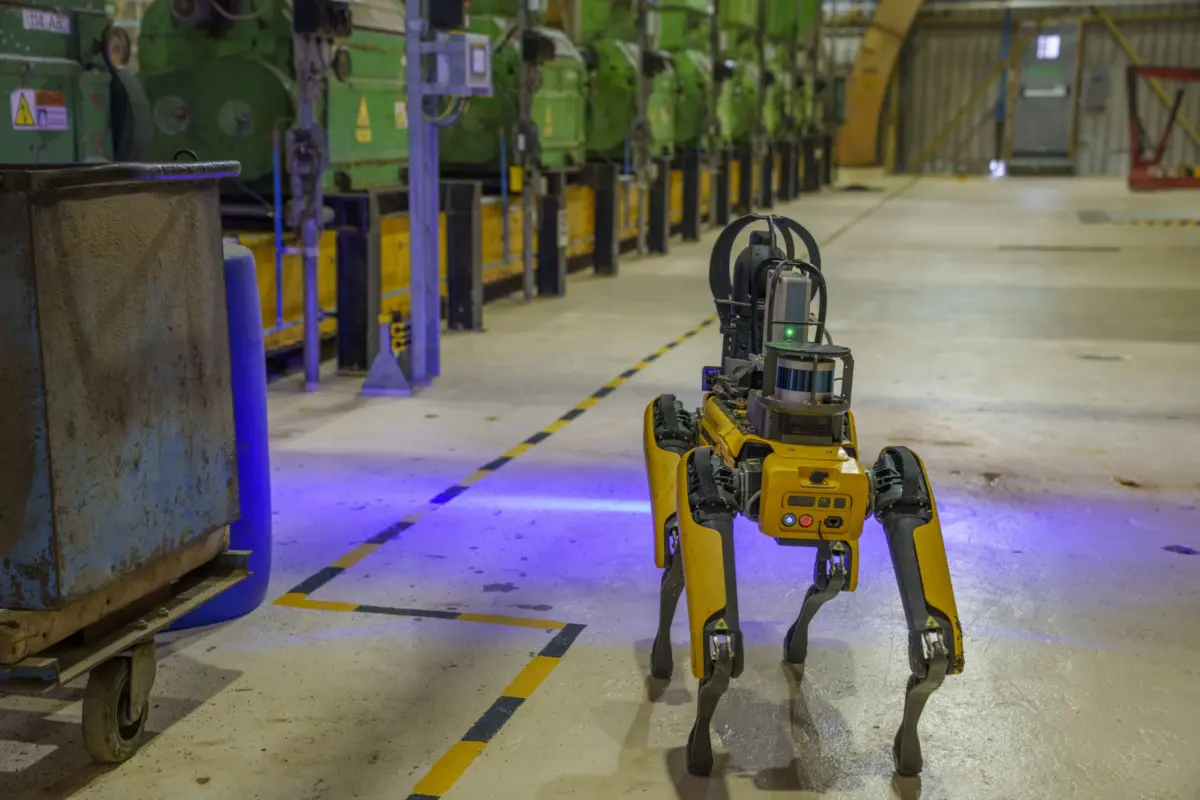
Beyond highway robotaxis from Waymo and Tesla, autonomy is revolutionizing specialized transport. Self-driving forklifts developed by companies like NTT DATA and Hyster-Yale are bridging severe labor gaps in warehouses and distribution hubs. Simultaneously, autonomous agricultural tractors, delivery drones from companies like DoorDash and Amazon, and industrial quadrupeds like Boston Dynamics’ Spot are handling hazardous outdoor and indoor inspections across energy, mining, and manufacturing sites.
4. Fleet and Warehouse Coordination
Managing thousands of autonomous mobile robots (AMRs) requires sophisticated orchestration layers. Described by UST’s Masood as "air traffic control for robots," advanced AI coordination models sequence routes, resolve traffic conflicts, and optimize logistics telemetry across massive fulfillment networks far exceeding the capabilities of single-robot programming.
5. Surveillance and Physical Security
Physical AI has fundamentally transformed enterprise security. Rather than relying on passive closed-circuit television (CCTV) feeds, modern platforms stitch together cameras, fixed sensors, automated lighting, and roving patrol robots into an intelligent security mesh. Platforms like SARA (Speaking Autonomous Responsive Agent) can evaluate live events, verify security anomalies, communicate directly with individuals on site, and trigger approved tactical responses autonomously.
6. Smart Buildings and Infrastructure
Inside commercial real estate, healthcare facilities, and utility grids, Physical AI acts as a continuous operational brain. Hospitals utilize intelligent sensors to coordinate patient care and track equipment, while commercial buildings deploy AI to autonomously optimize lighting, HVAC energy consumption, and spatial occupancy.
7. Smart Cities
Municipalities are embedding edge AI into traffic grids and public infrastructure to enhance civic safety. By deploying lidar and computer vision sensors at complex intersections—such as the New Jersey Department of Transportation’s deployment ahead of major international sporting events—cities can dynamically manage pedestrian flow and vehicular congestion. Similarly, municipal programs in cities like Brownville, Texas, utilize AI alert networks to streamline sanitation management and assist law enforcement reporting.
Future Outlook: The Intelligent Environment Ahead
As the boundary between digital software and physical hardware continues to dissolve, the next decade will cement Physical AI as an invisible, ubiquitous utility. Industry futurists predict that within ten years, intelligent systems will be natively embedded into nearly every physical environment—from commercial drive-thru lanes and hospitality concierges to healthcare wards and retail shelving.
Consumers and enterprises alike will soon inhabit spaces that do not merely record data, but actively understand intent. Hospital rooms will autonomously recognize subtle physiological shifts in patients before vital sign alarms are tripped; retail shelves will manage inventory and restocking vectors autonomously; and urban infrastructure will continuously self-optimize for energy conservation, security, and human mobility.
For leadership teams, the mandate is clear: the journey toward Physical AI requires looking beyond the superficial spectacle of humanoid robots. Success lies in identifying the constrained, high-volume, labor-intensive processes within current operations and injecting adaptive, spatial intelligence where it matters most—in the physical world.
